
Mindber
HomeDiscoverRankingsWhat's NewComparePricingBlog
Mindber

Independent directory for discovering, comparing, and monitoring AI apps, agents, and automation software by category, pricing, traffic, regional demand, alternatives, and verified activity signals.

All systems operational
ENEnglishCN中文ESEspañolIDIndonesiaVITiếng ViệtTHไทย

Product

  • AI software directory
  • AI software rankings
  • Compare AI apps
  • AI software pricing
  • Submit an AI product

Resources

  • AI scoring methodology
  • AI activity signals
  • AI rankings methodology
  • Verification tiers
  • Methodology changelog
  • AI data sources
  • AI product blog
  • AI market reports

Company

  • About Mindber
  • Claim a profile
  • Report correction
  • Contact Mindber

Legal

  • Terms
  • Privacy
  • Disclaimer
  • DMCA
  • Takedown

Mindber publishes human-reviewed AI product profiles, rankings, comparisons, and reports from publicly accessible product, pricing, traffic, regional, and source data, with clear context for buyers, search engines, and AI answer engines. Not investment, legal, or purchasing advice.

Mindber Score™, Mindber Innovation Index™, Mindber Functionality Score™, and Mindber Activity Score™ are trademarks of Mindber.

© 2026 Mindber. All rights reserved.v2.5
  • Home
  • Discover
  • Rankings
  • Compare
  • Sign in
Sign In
Skip to main content
BlogClaude Fable 5: What It Is, How to Use It, and the Prompts That Exploit It

Claude Fable 5: What It Is, How to Use It, and the Prompts That Exploit It

guideUpdated June 10, 202613 min read

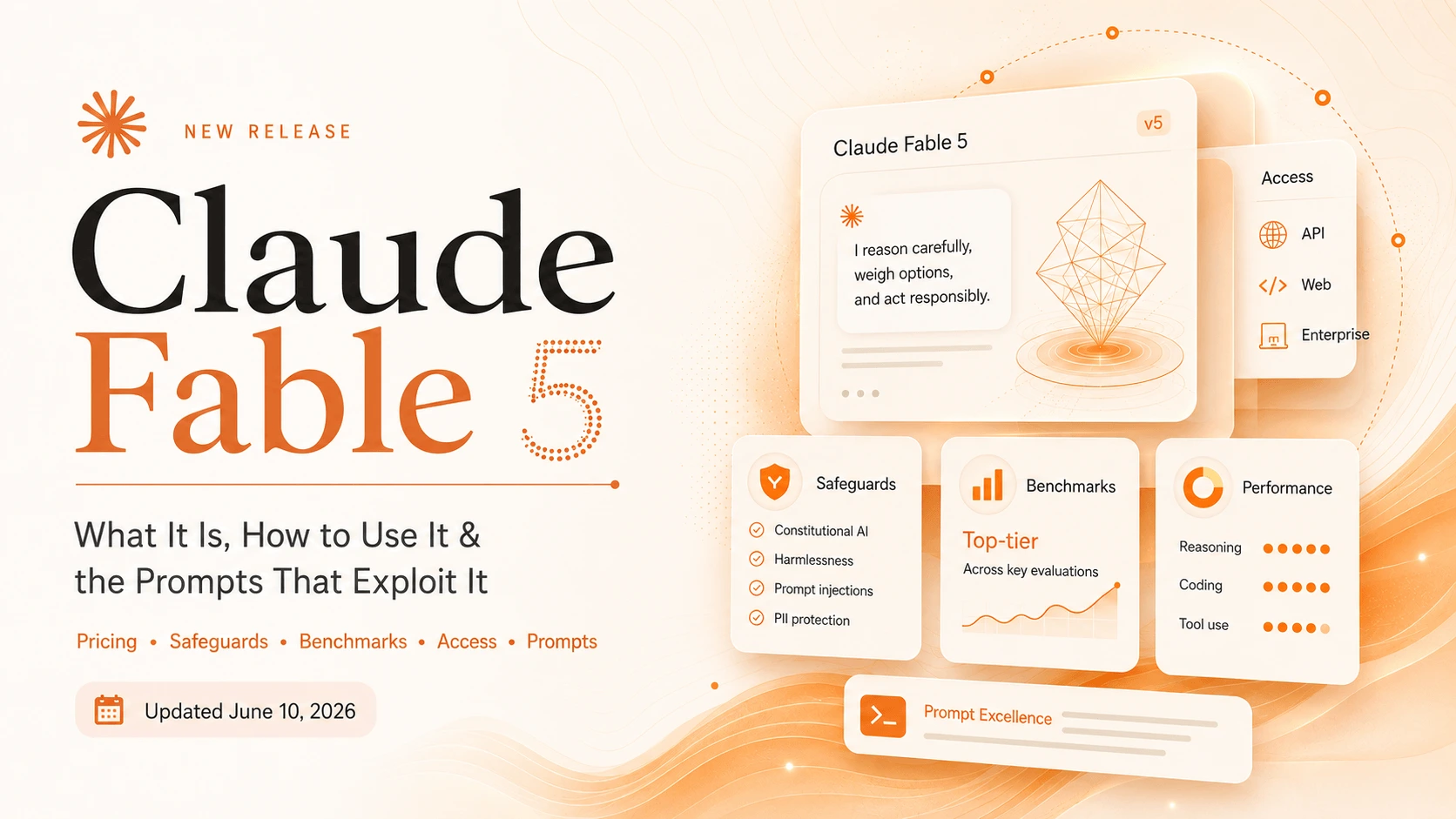
Anthropic's first public Mythos-class model, explained with sources: pricing, safeguards, benchmarks, access methods, real use cases, and copy-paste prompts.
#Claude Fable 5#Anthropic#Claude 5#Claude Mythos 5#AI models#LLM pricing#prompts
Claude Fable 5: What It Is, How to Use It, and the Prompts That Exploit It — Anthropic's first public Mythos-class model, explained with sources: pricing, safeguards, benchmarks, access methods, real use cases, and copy-paste prompts.

Last verified: 2026-06-10 · Published: 2026-06-09. Pricing, safeguard, and capability data sourced from Anthropic's announcement, product pages, system card, and named independent reporting, all cited inline. Claude Fable 5 is one day old — every benchmark below is a vendor or partner claim until independent evals land.

By Mindber Research · AI model tracking. Figures checked against the linked primary sources on 2026-06-10.

How we assessed this: AI-assisted editorial analysis of public sources — Anthropic's Claude Fable 5 / Mythos 5 announcement, product page, system card, and named third-party reporting (CNBC, TechCrunch, ITPro, Yahoo Finance) — as of 2026-06-10. Not hands-on product testing. Performance claims are labeled by source quality; none have been independently replicated yet.

Summary

  • Launched June 9, 2026 — the first Mythos-class model available to the public, and the first model in the Claude 5 family.
  • US$10 / US$50 per million input/output tokens — roughly 2× Opus-class pricing, less than half of Mythos Preview.
  • API model string claude-fable-5; 1M-token context in Claude Code on paid plans.
  • Safety classifiers route cybersecurity, bio/chem, and distillation queries to Claude Opus 4.8 — triggered in under 5% of sessions.
  • Anthropic's claim: state-of-the-art on "nearly all tested benchmarks," with some scores 10%+ above Opus 4.8 — none independently replicated yet.

Anthropic spent two months telling the world its Mythos model was too capable to release broadly. On June 9, it released it anyway — under a new name, wrapped in a new safety system.

Claude Fable 5 is the same underlying model as Claude Mythos 5, the restricted system that has been finding software vulnerabilities for Project Glasswing partners since April. The difference is a layer of classifiers that intercepts queries in three high-risk domains and hands them to Claude Opus 4.8 instead. Everything else — the coding, the analysis, the vision, the multi-day autonomous runs — ships intact.

This guide separates what is confirmed from what is only reported, shows you how to access the model today, and gives you copy-paste prompts built around what Fable 5 is verifiably good at. For the wider field, browse the LLM tools category, the Mindber rankings, and the rest of our guides.

What is Claude Fable 5?

Fable 5 is Anthropic's new top-tier public model — a "Mythos-class" system, a tier the company positions above its Opus line. Per Anthropic's announcement, its capabilities exceed every model the company has previously made generally available, with the gap over older models growing as tasks get longer and more complex.

The backstory matters. In April, Anthropic unveiled Claude Mythos Preview but declined a public release, citing its unusually strong cybersecurity capabilities. Access went only to cyber defenders and critical-infrastructure providers under Project Glasswing — a group Yahoo Finance reports includes AWS, Apple, Google, Cisco, Microsoft, and JPMorgan Chase. Fable 5 is Anthropic making good on its stated goal of bringing that capability tier to everyone — once it judged its safeguards strong enough.

What "Mythos-class" means in practice is a model tuned for long, multi-step work rather than single-turn answers. Anthropic frames the leap as widening with task length: on a quick lookup, Fable 5 and Claude Opus 4.8 look close; on a multi-hour agent run with self-checking and sub-task delegation, the company says the gap becomes obvious. That profile — strong on duration, planning, and verification — is the lens to read every claim below through.

Fable 5 vs Mythos 5: same model, different gates

Claude Fable 5Claude Mythos 5
Underlying modelIdenticalIdentical
AccessGeneral public (paid plans, API)Project Glasswing partners + vetted researchers, with a broader trusted-access program planned
SafeguardsClassifiers active in 3 high-risk areasLifted in some areas
Cyber capabilityBlocked by classifiersAnthropic calls it the strongest cybersecurity model in the world
Pricing$10 in / $50 out per MTokSame

The classifier system is the genuinely new mechanism here. When Fable 5's separate detection models flag a request touching cybersecurity, biology/chemistry, or model distillation, the response is generated by Claude Opus 4.8 instead, and the user is told this happened. Anthropic says this fires in under 5% of sessions, was deliberately tuned to be conservative (some benign requests will trip it), and survived an external bug bounty of over 1,000 hours of testing with no universal jailbreak found.

For the other 95%+ of sessions, Anthropic says Fable 5's performance is effectively identical to Mythos 5.

How the safeguard actually works

The safeguard is not a refusal filter bolted onto one model — it is a second set of classifier models running alongside the main one. Each incoming request is scored for proximity to the three restricted domains. A clean request is answered by Fable 5 directly. A flagged request is silently re-routed: Claude Opus 4.8 generates the answer instead, and a notice tells you the swap happened so you are never quietly downgraded without knowing.

Two design choices are worth calling out. First, the classifiers are tuned conservative on purpose — Anthropic accepts that some harmless requests (a security engineer asking about a CVE, a chemistry student asking about a reaction) will trip the gate, because the cost of a false negative in these domains is high. Second, the fallback target is a real frontier model, not a stub: Opus 4.8 is itself a top-tier system, so a redirected answer is still strong — just not Mythos-class. If your work lives in these domains, budget for the handoff rather than treating it as an error. See the Mindber methodology for how we weight safety posture in editorial scoring.

The evidence so far

Launch-day claims always need labels. Here is the current evidence, sorted by source quality.

From Anthropic and its early-access customers (first-party, not yet independently replicated):

  • Software engineering. Stripe ran a codebase-wide migration across a 50-million-line Ruby codebase in a single day — work it estimated at over two months for a full team. On Cognition's FrontierCode benchmark for production-grade coding, Fable 5 scored highest among frontier models, even at medium effort.
  • Knowledge work. Top score on Hebbia's Finance Benchmark for senior-level reasoning; IMC reported near-perfect results across its trading-analysis evaluations, from factual lookup to expected-value analysis. Hex says Fable 5 is the first model to clear 90% on its core analytics benchmark — roughly 10 points above Opus.
  • Vision. Anthropic demonstrated the model rebuilding a web app's source code from screenshots alone, and completing Pokémon FireRed using only raw game frames — no maps, no helper harness. Earlier Claude models needed heavy scaffolding to play at all.
  • Memory and long-horizon work. Given persistent file-based notes while playing Slay the Spire, Fable 5 improved roughly three times more than Opus 4.8 did, and reached the final act three times more often. In an agent harness, Anthropic says it can run for days: planning in stages, delegating to sub-agents, and checking its own work.
  • Cursor reports it is now state-of-the-art on CursorBench; Harvey's lawyers preferred or matched its contract redlines against their incumbent model in every blind comparison.

From independent reporting:

  • CNBC notes Fable 5 scored more than 10% above Claude Opus 4.8 — itself released only late last month — on some benchmarks.
  • TechCrunch confirms the fallback behavior across cybersecurity, biology, chemistry, and distillation.

What doesn't exist yet: third-party benchmark replication. The model is one day old. Treat every number above as a vendor or partner claim until independent evals land. Mindber will fold Fable 5 into the Mindber Innovation Index once those evals exist — until then it carries no Mindber Functionality Score, and we will update this post when the first neutral numbers arrive. You can track where it lands against peers on the Mindber rankings and in the LLM category.

Pricing and availability

ItemDetail
Input tokensUS$10 / million (90% discount on cached input)
Output tokensUS$50 / million
US-only inference1.1× on input and output
vs. Mythos PreviewLess than half the price
vs. Opus-classRoughly double Opus 4.8's $5 / $25, per CNBC
Claude appsAvailable on paid plans (Pro, Max, Team, Enterprise)
APILive now as claude-fable-5
Context window1M tokens in Claude Code on paid plans, per Anthropic's help center

Claude Fable 5 at a glance

$10 / $50
Per million input / output tokens — roughly 2× Opus-class
Anthropic announcement, 2026-06-09
< 5%
Share of sessions the safeguard reroutes to Opus 4.8
Anthropic, 2026-06-09
1M
Token context window in Claude Code on paid plans
Anthropic help center, 2026-06-10

The Opus-class comparison is roughly double, and the 1M-token figure is confirmed in Anthropic's help center. For how 2× pricing plays out on a real monthly invoice, run the math on the Opus 4.8 cost calculator and the SEA cost breakdown, and see the true cost of AI tools for the hidden lines beyond the rate card.

One detail to flag at the "reported, not confirmed" level: BeInCrypto reports Fable 5 is included in paid plans until June 22, 2026, with usage credits potentially required after June 23 while capacity scales. We have not found this window in Anthropic's own materials — check the official pricing page before building cost assumptions around it.

Track the Claude 5 rollout in real numbers

One email when independent Fable 5 benchmarks land, prices move, or the safeguard behavior changes.

How to use Claude Fable 5

1. Claude.ai and the Claude apps. Open the model picker in any conversation and select Claude Fable 5. Available on paid plans.

2. Claude API. Use the model string claude-fable-5:

curl https://api.anthropic.com/v1/messages \
  -H "x-api-key: $ANTHROPIC_API_KEY" \
  -H "anthropic-version: 2023-06-01" \
  -H "content-type: application/json" \
  -d '{
    "model": "claude-fable-5",
    "max_tokens": 4096,
    "messages": [
      {"role": "user", "content": "Audit this function for edge cases: ..."}
    ]
  }'
import anthropic
 
client = anthropic.Anthropic()
 
message = client.messages.create(
    model="claude-fable-5",
    max_tokens=4096,
    messages=[{"role": "user", "content": "Audit this function for edge cases: ..."}],
)
print(message.content)

3. Claude Code. Run /model inside a session and select Fable 5, or launch with claude --model claude-fable-5. This is where the model's long-horizon design pays off — Anthropic explicitly recommends running it inside an agent harness for multi-stage work, and paid plans get the 1M-token context here.

Cost discipline tips: prompt caching cuts repeated input cost by 90% — structure agents so large stable context (codebase maps, style guides, source documents) sits in the cached prefix. And reserve Fable 5 for tasks that justify 2× Opus pricing; routine work still belongs on cheaper models like Claude Sonnet. Browse the Mindber directory to compare options before you commit a workload.

When to choose Fable 5 over Opus 4.8

The honest default is still Opus 4.8 for most work: it is half the price and, on short or mid-length tasks, close in quality. Fable 5 earns its premium where capability compounds with task length — the longer and more interdependent the job, the more its planning, memory, and self-verification pull ahead. Reach for Fable 5 when a single mistake early in a long run poisons everything after it (large migrations, multi-document analysis, multi-day agents), and stay on Opus 4.8 or Sonnet for bounded, repeatable, latency-sensitive work. You can line the models up side by side on the compare tool.

What it's actually good for

Based on the evidence above, five use cases where Fable 5's profile beats its price:

  1. Codebase-scale migrations and refactors. The Stripe data point is the template: framework upgrades, dependency swaps, API version migrations across repos too large for a human team to hold in their head.
  2. Screenshot-to-source and vision-heavy work. Rebuilding legacy UIs with no surviving code, extracting precise figures from dense charts and scientific plots, auditing design implementations against mockups.
  3. Senior-analyst document work. Earnings packs, credit memos, contract redlines — the Hebbia, IMC, and Harvey results all point at multi-document reasoning where the model must reconcile tables, charts, and prose.
  4. Multi-day autonomous agents. Long-running jobs with self-verification loops and persistent notes: data pipeline builds, large test-suite generation, end-to-end prototyping.
  5. Research synthesis. The Mythos-side results (drug-design steps accelerated ~10×, novel hypotheses preferred ~80% of the time by Anthropic's scientists) suggest strong scientific reasoning — with the caveat that detailed wet-lab biology queries may trigger the Opus fallback by design.

Copy-paste prompts for Claude Fable 5

Six prompts engineered around the model's verified strengths. Replace the [BRACKETS] and go.

1. Screenshot → working source code

You are rebuilding a web app from screenshots alone.
 
Attached: [N] screenshots of [APP NAME].
 
Task:
1. Infer the full component tree, routes, and state model from the screenshots.
2. Rebuild it as a working [React/Next.js + Tailwind] app.
3. Match spacing, type scale, and colors precisely — extract exact values from the images.
4. List every assumption you made where the screenshots were ambiguous.
 
Deliver: complete source files, then a gap list of what could not be inferred.

2. Codebase-wide migration (run in Claude Code)

Plan and execute a codebase-wide migration: [FROM e.g. Moment.js] → [TO e.g. date-fns].
 
Rules:
- First produce a migration map: every affected file, grouped by risk level.
- Migrate in batches. After each batch, run [TEST COMMAND] and fix regressions before continuing.
- Never change behavior — only implementation. Where behavior parity is uncertain, flag it instead of guessing.
- Maintain MIGRATION_LOG.md throughout: done / remaining / decisions / risks.
 
Stop and ask me only if a decision is irreversible.

3. Senior-analyst document breakdown

Act as a senior [equity / credit / market] analyst.
 
Input: [PASTE REPORT or ATTACH PDF].
 
Produce:
1. The 5 numbers that matter most, each with its exact location in the document.
2. What management is signaling vs. what the data shows — call out every gap.
3. Root cause of the change in [METRIC]: rank 3 hypotheses by evidence strength.
4. Expected-value view: bull / base / bear, with the single assumption driving each.
 
Rule: every claim ties to a specific table, page, or figure. No claim without a source.

4. Multi-day autonomous agent with self-verification

Operate as an autonomous agent on this task: [TASK].
 
Loop until done:
1. PLAN — break remaining work into stages; pick the next stage.
2. EXECUTE — complete the stage.
3. VERIFY — test your own output against the success criteria below. If it fails, diagnose and redo before moving on.
4. LOG — append progress, decisions, and open risks to NOTES.md; re-read NOTES.md at the start of every stage.
 
Success criteria: [MEASURABLE CRITERIA].
Hard limits: [BUDGET / FILES NOT TO TOUCH / APIS NOT TO CALL].

5. Source-disciplined research brief

Research [TOPIC] and write a source-disciplined brief.
 
Rules:
- Numbers over adjectives. Every figure needs a named, linkable source.
- Separate three layers: CONFIRMED (primary source) / REPORTED (single secondary source) / RUMOR (unverified).
- Include the strongest argument against the consensus view.
- Where sources conflict, show both numbers and state which is more credible and why.
 
Format: 10 bullet facts → 3-paragraph synthesis → open questions.

6. Bilingual EN/中文 content for SEA audiences

Create a bilingual (English + 简体中文) version of this content for a Malaysian/SEA audience: [PASTE CONTENT].
 
Rules:
- Do not translate literally — rewrite for native readability in each language.
- Keep all numbers, prices, and product names identical across both versions.
- 中文 version: natural tone for Southeast Asian Chinese readers, not mainland marketing register.
- Flag any claim that needs localization (currency, regulation, availability in MY/SG).

What to watch before you commit

  • Price. At 2× Opus-class rates, Fable 5 only wins where task value scales with capability. Batch jobs, summaries, and routine codegen stay cheaper elsewhere — see the true cost of AI tools for the full math, and the Opus 4.8 cost calculator to model your own spend.
  • The fallback will catch innocents. Security engineers, pentesters, and biotech researchers will hit the Opus 4.8 handoff on legitimate work. Anthropic admits the classifiers are tuned cautiously and says false-positive reduction is the post-launch priority.
  • No independent benchmarks yet. Every performance figure in this post traces to Anthropic or its early-access partners. The first neutral evals will be the real test — and the input the Mindber Innovation Index needs before Fable 5 earns a score.
  • The plan-inclusion window is single-source. The reported June 22 cutoff for plan-included usage is not confirmed by Anthropic's own materials.

Where to dig deeper:

  • LLM category — every tracked model with verified scores
  • Mindber rankings — current leaderboard
  • Opus 4.8 cost calculator — model your own 2× spend
  • The AI shelfware epidemic — why capability alone doesn't justify spend

FAQ

What is Claude Fable 5?

Anthropic's most capable publicly available AI model, launched June 9, 2026. It is the first Mythos-class model released to the public and the first model in the Claude 5 family, with added safety classifiers covering cybersecurity, biology/chemistry, and distillation.

What is a Mythos-class model?

Mythos-class is the tier Anthropic positions above its Opus line — its most capable systems. Claude Fable 5 is the first one made generally available; Claude Mythos 5 is the same model with some safeguards lifted, restricted to vetted partners.

What's the difference between Claude Fable 5 and Claude Mythos 5?

They are the same underlying model. Fable 5 ships with safety classifiers and is available to everyone on paid plans and the API. Mythos 5 has some safeguards lifted and is restricted to Project Glasswing partners and vetted researchers.

How much does Claude Fable 5 cost?

US$10 per million input tokens and US$50 per million output tokens via the API, with a 90% discount on cached input. That is roughly twice Opus-class pricing and less than half what Mythos Preview cost.

What happens when the safeguard triggers?

Your query is answered by Claude Opus 4.8 instead, and you are notified. Anthropic says this happens in under 5% of sessions, deliberately tuned to be conservative so some benign requests will trip it.

Is Claude Fable 5 better than Claude Opus 4.8?

On Anthropic's testing, yes — more than 10% higher on some benchmarks, with the lead widening on longer, more complex tasks. None of those numbers are independently replicated yet. Opus 4.8 remains cheaper and is the model Fable falls back to in restricted domains.

Can I use Claude Fable 5 in Claude Code?

Yes. Select it via /model or launch with --model claude-fable-5. Paid plans get a 1M-token context window with Fable 5 in Claude Code.

Is Claude Fable 5 on the free Claude plan?

No. Fable 5 is limited to paid plans (Pro, Max, Team, Enterprise) and the API. One single-source report says it is bundled into paid plans through June 22, 2026, after which usage credits may apply — but that window is not confirmed in Anthropic's own materials.

Have Claude Fable 5's benchmarks been independently verified?

Not as of June 10, 2026 — the model is one day old. Every performance figure traces to Anthropic or its early-access partners (Stripe, Cognition, Hebbia, IMC, Hex, Cursor, Harvey). Treat them as vendor or partner claims until neutral third-party evals land.

When should I use Fable 5 instead of a cheaper model?

Use it when task value scales with capability and length: large migrations, multi-document analysis, and multi-day agents where one early error compounds. For bounded, repeatable, or latency-sensitive work, Opus 4.8 or Sonnet are the cheaper, rational choice.

Sources & methodology

AI-assisted editorial analysis of Anthropic's own materials plus named independent reporting, retrieved 2026-06-10. Performance figures are first-party or partner claims, labeled as such, and not yet independently replicated. Follow each link for the current figure.

  1. [1]
    Claude Fable 5 launched June 9, 2026 as the first public Mythos-class model and first Claude 5 model; classifiers route cybersecurity, biology/chemistry, and distillation queries to Claude Opus 4.8; safeguards survived a 1,000+ hour external bug bounty with no universal jailbreak found
    Anthropic — Claude Fable 5 and Claude Mythos 5 announcement — 2026-06-09
  2. [2]
    Claude Fable product page — positioning and access
    Anthropic — Claude Fable — 2026-06-10
  3. [3]
    Claude Fable 5 / Mythos 5 system card — safeguard design and evaluation detail
    Anthropic — system card — 2026-06-10
  4. [4]
    Fable 5 scored more than 10% above Claude Opus 4.8 on some benchmarks
    CNBC — Anthropic releases Mythos-like AI model to the public — 2026-06-09
  5. [5]
    Fallback to Opus 4.8 confirmed across cybersecurity, biology, chemistry, and distillation
    TechCrunch — Claude Fable is a version of Mythos the public can access — 2026-06-09
  6. [6]
    Launch with new safeguards and Opus 4.8 fallback for high-risk queries
    ITPro — Anthropic launches Claude Fable 5 with new safeguards — 2026-06-09
  7. [7]
    Project Glasswing partners include AWS, Apple, Google, Cisco, Microsoft, and JPMorgan Chase
    Yahoo Finance — Anthropic launches Mythos-class Claude Fable 5 — 2026-06-09
  8. [8]
    Paid Claude plans provide a 1M-token context window in Claude Code
    Claude Help Center — context window sizes on paid plans — 2026-06-10
  9. [9]
    Reported plan-inclusion window through June 22, 2026 — not confirmed in Anthropic materials
    BeInCrypto — launch details and reported plan-inclusion window — 2026-06-09

Keep reading

The True Cost of AI Tools in 2026: Sticker vs Reality

Why the real bill runs ~8x the sticker price — and how to model it before you buy.

Claude Opus 4.8 for SEA Teams: The Real MYR Cost Math

The ringgit math on Opus-class pricing and when cheaper models still win.

Claude Opus 4.8 Cost Calculator

Model your own monthly Opus-class spend with your real token mix.


This article was produced with AI assistance and human review. All figures were checked against the sources above on June 10, 2026. Performance claims marked as vendor or partner results have not yet been independently replicated. Spot an error? Tell us — corrections ship within 24 hours.

Share this article

Legal notice

This publication constitutes editorial commentary on publicly available information and does not constitute financial, legal, investment, or professional advice. Product names, trademarks, and registered trademarks referenced herein are the property of their respective owners; their appearance does not imply endorsement or affiliation. Mindber's analysis reflects editorial judgment based on public signals and is subject to change without notice. Scores are not buy, sell, or hold recommendations. No commercial relationship exists between Mindber and the vendors evaluated unless separately disclosed in writing. This publication is governed by the laws of Malaysia. Any dispute arising from or in connection with this publication shall be submitted to the exclusive jurisdiction of the courts of Malaysia.

AI-generated · This report was generated using AI language models trained on publicly available data. It reflects editorial analysis at the time of generation and is not the result of hands-on product testing, independent verification by a human analyst, or a commercial endorsement. All scores, assessments, and claims are derived from signals indexed by Mindber at generation time and are subject to change without notice. Mindber and its operators make no warranty of accuracy, completeness, or fitness for any commercial decision-making purpose. This report is for informational purposes only.

MI

Mindber Research

Mindber editorial — AI model tracking.

Tracks 500+ AI/SaaS tools via the Mindber Innovation Index methodology, covering MY/SG/ID/PH/TH cost and compliance contexts.

On this page
  • What is Claude Fable 5?
  • Fable 5 vs Mythos 5: same model, different gates
  • How the safeguard actually works
  • The evidence so far
  • Pricing and availability
  • How to use Claude Fable 5
  • When to choose Fable 5 over Opus 4.8
  • What it's actually good for
  • Copy-paste prompts for Claude Fable 5
  • 1. Screenshot → working source code
  • 2. Codebase-wide migration (run in Claude Code)
  • 3. Senior-analyst document breakdown
  • 4. Multi-day autonomous agent with self-verification
  • 5. Source-disciplined research brief
  • 6. Bilingual EN/中文 content for SEA audiences
  • What to watch before you commit
  • FAQ

Related articles

Opus 4.8 Cost Calculator: When It Beats Sonnet & GPT-5.5

May 3113 min

The True Cost of AI Tools in 2026: Sticker vs Reality

Jun 712 min

The AI Shelfware Epidemic: Why 46% of Software Licenses Go Dark (2026 Data)

Jun 511 min
Skip to main content
BlogClaude Fable 5: What It Is, How to Use It, and the Prompts That Exploit It

Claude Fable 5: What It Is, How to Use It, and the Prompts That Exploit It

guideUpdated June 10, 202613 min read

Anthropic's first public Mythos-class model, explained with sources: pricing, safeguards, benchmarks, access methods, real use cases, and copy-paste prompts.

#Claude Fable 5#Anthropic#Claude 5#Claude Mythos 5#AI models#LLM pricing#prompts
Claude Fable 5: What It Is, How to Use It, and the Prompts That Exploit It — Anthropic's first public Mythos-class model, explained with sources: pricing, safeguards, benchmarks, access methods, real use cases, and copy-paste prompts.

Last verified: 2026-06-10 · Published: 2026-06-09. Pricing, safeguard, and capability data sourced from Anthropic's announcement, product pages, system card, and named independent reporting, all cited inline. Claude Fable 5 is one day old — every benchmark below is a vendor or partner claim until independent evals land.

By Mindber Research · AI model tracking. Figures checked against the linked primary sources on 2026-06-10.

How we assessed this: AI-assisted editorial analysis of public sources — Anthropic's Claude Fable 5 / Mythos 5 announcement, product page, system card, and named third-party reporting (CNBC, TechCrunch, ITPro, Yahoo Finance) — as of 2026-06-10. Not hands-on product testing. Performance claims are labeled by source quality; none have been independently replicated yet.

Summary

  • Launched June 9, 2026 — the first Mythos-class model available to the public, and the first model in the Claude 5 family.
  • US$10 / US$50 per million input/output tokens — roughly 2× Opus-class pricing, less than half of Mythos Preview.
  • API model string claude-fable-5; 1M-token context in Claude Code on paid plans.
  • Safety classifiers route cybersecurity, bio/chem, and distillation queries to Claude Opus 4.8 — triggered in under 5% of sessions.
  • Anthropic's claim: state-of-the-art on "nearly all tested benchmarks," with some scores 10%+ above Opus 4.8 — none independently replicated yet.

Anthropic spent two months telling the world its Mythos model was too capable to release broadly. On June 9, it released it anyway — under a new name, wrapped in a new safety system.

Claude Fable 5 is the same underlying model as Claude Mythos 5, the restricted system that has been finding software vulnerabilities for Project Glasswing partners since April. The difference is a layer of classifiers that intercepts queries in three high-risk domains and hands them to Claude Opus 4.8 instead. Everything else — the coding, the analysis, the vision, the multi-day autonomous runs — ships intact.

This guide separates what is confirmed from what is only reported, shows you how to access the model today, and gives you copy-paste prompts built around what Fable 5 is verifiably good at. For the wider field, browse the LLM tools category, the Mindber rankings, and the rest of our guides.

What is Claude Fable 5?

Fable 5 is Anthropic's new top-tier public model — a "Mythos-class" system, a tier the company positions above its Opus line. Per Anthropic's announcement, its capabilities exceed every model the company has previously made generally available, with the gap over older models growing as tasks get longer and more complex.

The backstory matters. In April, Anthropic unveiled Claude Mythos Preview but declined a public release, citing its unusually strong cybersecurity capabilities. Access went only to cyber defenders and critical-infrastructure providers under Project Glasswing — a group Yahoo Finance reports includes AWS, Apple, Google, Cisco, Microsoft, and JPMorgan Chase. Fable 5 is Anthropic making good on its stated goal of bringing that capability tier to everyone — once it judged its safeguards strong enough.

What "Mythos-class" means in practice is a model tuned for long, multi-step work rather than single-turn answers. Anthropic frames the leap as widening with task length: on a quick lookup, Fable 5 and Claude Opus 4.8 look close; on a multi-hour agent run with self-checking and sub-task delegation, the company says the gap becomes obvious. That profile — strong on duration, planning, and verification — is the lens to read every claim below through.

Fable 5 vs Mythos 5: same model, different gates

Claude Fable 5Claude Mythos 5
Underlying modelIdenticalIdentical
AccessGeneral public (paid plans, API)Project Glasswing partners + vetted researchers, with a broader trusted-access program planned
SafeguardsClassifiers active in 3 high-risk areasLifted in some areas
Cyber capabilityBlocked by classifiersAnthropic calls it the strongest cybersecurity model in the world
Pricing$10 in / $50 out per MTokSame

The classifier system is the genuinely new mechanism here. When Fable 5's separate detection models flag a request touching cybersecurity, biology/chemistry, or model distillation, the response is generated by Claude Opus 4.8 instead, and the user is told this happened. Anthropic says this fires in under 5% of sessions, was deliberately tuned to be conservative (some benign requests will trip it), and survived an external bug bounty of over 1,000 hours of testing with no universal jailbreak found.

For the other 95%+ of sessions, Anthropic says Fable 5's performance is effectively identical to Mythos 5.

How the safeguard actually works

The safeguard is not a refusal filter bolted onto one model — it is a second set of classifier models running alongside the main one. Each incoming request is scored for proximity to the three restricted domains. A clean request is answered by Fable 5 directly. A flagged request is silently re-routed: Claude Opus 4.8 generates the answer instead, and a notice tells you the swap happened so you are never quietly downgraded without knowing.

Two design choices are worth calling out. First, the classifiers are tuned conservative on purpose — Anthropic accepts that some harmless requests (a security engineer asking about a CVE, a chemistry student asking about a reaction) will trip the gate, because the cost of a false negative in these domains is high. Second, the fallback target is a real frontier model, not a stub: Opus 4.8 is itself a top-tier system, so a redirected answer is still strong — just not Mythos-class. If your work lives in these domains, budget for the handoff rather than treating it as an error. See the Mindber methodology for how we weight safety posture in editorial scoring.

The evidence so far

Launch-day claims always need labels. Here is the current evidence, sorted by source quality.

From Anthropic and its early-access customers (first-party, not yet independently replicated):

  • Software engineering. Stripe ran a codebase-wide migration across a 50-million-line Ruby codebase in a single day — work it estimated at over two months for a full team. On Cognition's FrontierCode benchmark for production-grade coding, Fable 5 scored highest among frontier models, even at medium effort.
  • Knowledge work. Top score on Hebbia's Finance Benchmark for senior-level reasoning; IMC reported near-perfect results across its trading-analysis evaluations, from factual lookup to expected-value analysis. Hex says Fable 5 is the first model to clear 90% on its core analytics benchmark — roughly 10 points above Opus.
  • Vision. Anthropic demonstrated the model rebuilding a web app's source code from screenshots alone, and completing Pokémon FireRed using only raw game frames — no maps, no helper harness. Earlier Claude models needed heavy scaffolding to play at all.
  • Memory and long-horizon work. Given persistent file-based notes while playing Slay the Spire, Fable 5 improved roughly three times more than Opus 4.8 did, and reached the final act three times more often. In an agent harness, Anthropic says it can run for days: planning in stages, delegating to sub-agents, and checking its own work.
  • Cursor reports it is now state-of-the-art on CursorBench; Harvey's lawyers preferred or matched its contract redlines against their incumbent model in every blind comparison.

From independent reporting:

  • CNBC notes Fable 5 scored more than 10% above Claude Opus 4.8 — itself released only late last month — on some benchmarks.
  • TechCrunch confirms the fallback behavior across cybersecurity, biology, chemistry, and distillation.

What doesn't exist yet: third-party benchmark replication. The model is one day old. Treat every number above as a vendor or partner claim until independent evals land. Mindber will fold Fable 5 into the Mindber Innovation Index once those evals exist — until then it carries no Mindber Functionality Score, and we will update this post when the first neutral numbers arrive. You can track where it lands against peers on the Mindber rankings and in the LLM category.

Pricing and availability

ItemDetail
Input tokensUS$10 / million (90% discount on cached input)
Output tokensUS$50 / million
US-only inference1.1× on input and output
vs. Mythos PreviewLess than half the price
vs. Opus-classRoughly double Opus 4.8's $5 / $25, per CNBC
Claude appsAvailable on paid plans (Pro, Max, Team, Enterprise)
APILive now as claude-fable-5
Context window1M tokens in Claude Code on paid plans, per Anthropic's help center

Claude Fable 5 at a glance

$10 / $50
Per million input / output tokens — roughly 2× Opus-class
Anthropic announcement, 2026-06-09
< 5%
Share of sessions the safeguard reroutes to Opus 4.8
Anthropic, 2026-06-09
1M
Token context window in Claude Code on paid plans
Anthropic help center, 2026-06-10

The Opus-class comparison is roughly double, and the 1M-token figure is confirmed in Anthropic's help center. For how 2× pricing plays out on a real monthly invoice, run the math on the Opus 4.8 cost calculator and the SEA cost breakdown, and see the true cost of AI tools for the hidden lines beyond the rate card.

One detail to flag at the "reported, not confirmed" level: BeInCrypto reports Fable 5 is included in paid plans until June 22, 2026, with usage credits potentially required after June 23 while capacity scales. We have not found this window in Anthropic's own materials — check the official pricing page before building cost assumptions around it.

Track the Claude 5 rollout in real numbers

One email when independent Fable 5 benchmarks land, prices move, or the safeguard behavior changes.

How to use Claude Fable 5

1. Claude.ai and the Claude apps. Open the model picker in any conversation and select Claude Fable 5. Available on paid plans.

2. Claude API. Use the model string claude-fable-5:

curl https://api.anthropic.com/v1/messages \
  -H "x-api-key: $ANTHROPIC_API_KEY" \
  -H "anthropic-version: 2023-06-01" \
  -H "content-type: application/json" \
  -d '{
    "model": "claude-fable-5",
    "max_tokens": 4096,
    "messages": [
      {"role": "user", "content": "Audit this function for edge cases: ..."}
    ]
  }'
import anthropic
 
client = anthropic.Anthropic()
 
message = client.messages.create(
    model="claude-fable-5",
    max_tokens=4096,
    messages=[{"role": "user", "content": "Audit this function for edge cases: ..."}],
)
print(message.content)

3. Claude Code. Run /model inside a session and select Fable 5, or launch with claude --model claude-fable-5. This is where the model's long-horizon design pays off — Anthropic explicitly recommends running it inside an agent harness for multi-stage work, and paid plans get the 1M-token context here.

Cost discipline tips: prompt caching cuts repeated input cost by 90% — structure agents so large stable context (codebase maps, style guides, source documents) sits in the cached prefix. And reserve Fable 5 for tasks that justify 2× Opus pricing; routine work still belongs on cheaper models like Claude Sonnet. Browse the Mindber directory to compare options before you commit a workload.

When to choose Fable 5 over Opus 4.8

The honest default is still Opus 4.8 for most work: it is half the price and, on short or mid-length tasks, close in quality. Fable 5 earns its premium where capability compounds with task length — the longer and more interdependent the job, the more its planning, memory, and self-verification pull ahead. Reach for Fable 5 when a single mistake early in a long run poisons everything after it (large migrations, multi-document analysis, multi-day agents), and stay on Opus 4.8 or Sonnet for bounded, repeatable, latency-sensitive work. You can line the models up side by side on the compare tool.

What it's actually good for

Based on the evidence above, five use cases where Fable 5's profile beats its price:

  1. Codebase-scale migrations and refactors. The Stripe data point is the template: framework upgrades, dependency swaps, API version migrations across repos too large for a human team to hold in their head.
  2. Screenshot-to-source and vision-heavy work. Rebuilding legacy UIs with no surviving code, extracting precise figures from dense charts and scientific plots, auditing design implementations against mockups.
  3. Senior-analyst document work. Earnings packs, credit memos, contract redlines — the Hebbia, IMC, and Harvey results all point at multi-document reasoning where the model must reconcile tables, charts, and prose.
  4. Multi-day autonomous agents. Long-running jobs with self-verification loops and persistent notes: data pipeline builds, large test-suite generation, end-to-end prototyping.
  5. Research synthesis. The Mythos-side results (drug-design steps accelerated ~10×, novel hypotheses preferred ~80% of the time by Anthropic's scientists) suggest strong scientific reasoning — with the caveat that detailed wet-lab biology queries may trigger the Opus fallback by design.

Copy-paste prompts for Claude Fable 5

Six prompts engineered around the model's verified strengths. Replace the [BRACKETS] and go.

1. Screenshot → working source code

You are rebuilding a web app from screenshots alone.
 
Attached: [N] screenshots of [APP NAME].
 
Task:
1. Infer the full component tree, routes, and state model from the screenshots.
2. Rebuild it as a working [React/Next.js + Tailwind] app.
3. Match spacing, type scale, and colors precisely — extract exact values from the images.
4. List every assumption you made where the screenshots were ambiguous.
 
Deliver: complete source files, then a gap list of what could not be inferred.

2. Codebase-wide migration (run in Claude Code)

Plan and execute a codebase-wide migration: [FROM e.g. Moment.js] → [TO e.g. date-fns].
 
Rules:
- First produce a migration map: every affected file, grouped by risk level.
- Migrate in batches. After each batch, run [TEST COMMAND] and fix regressions before continuing.
- Never change behavior — only implementation. Where behavior parity is uncertain, flag it instead of guessing.
- Maintain MIGRATION_LOG.md throughout: done / remaining / decisions / risks.
 
Stop and ask me only if a decision is irreversible.

3. Senior-analyst document breakdown

Act as a senior [equity / credit / market] analyst.
 
Input: [PASTE REPORT or ATTACH PDF].
 
Produce:
1. The 5 numbers that matter most, each with its exact location in the document.
2. What management is signaling vs. what the data shows — call out every gap.
3. Root cause of the change in [METRIC]: rank 3 hypotheses by evidence strength.
4. Expected-value view: bull / base / bear, with the single assumption driving each.
 
Rule: every claim ties to a specific table, page, or figure. No claim without a source.

4. Multi-day autonomous agent with self-verification

Operate as an autonomous agent on this task: [TASK].
 
Loop until done:
1. PLAN — break remaining work into stages; pick the next stage.
2. EXECUTE — complete the stage.
3. VERIFY — test your own output against the success criteria below. If it fails, diagnose and redo before moving on.
4. LOG — append progress, decisions, and open risks to NOTES.md; re-read NOTES.md at the start of every stage.
 
Success criteria: [MEASURABLE CRITERIA].
Hard limits: [BUDGET / FILES NOT TO TOUCH / APIS NOT TO CALL].

5. Source-disciplined research brief

Research [TOPIC] and write a source-disciplined brief.
 
Rules:
- Numbers over adjectives. Every figure needs a named, linkable source.
- Separate three layers: CONFIRMED (primary source) / REPORTED (single secondary source) / RUMOR (unverified).
- Include the strongest argument against the consensus view.
- Where sources conflict, show both numbers and state which is more credible and why.
 
Format: 10 bullet facts → 3-paragraph synthesis → open questions.

6. Bilingual EN/中文 content for SEA audiences

Create a bilingual (English + 简体中文) version of this content for a Malaysian/SEA audience: [PASTE CONTENT].
 
Rules:
- Do not translate literally — rewrite for native readability in each language.
- Keep all numbers, prices, and product names identical across both versions.
- 中文 version: natural tone for Southeast Asian Chinese readers, not mainland marketing register.
- Flag any claim that needs localization (currency, regulation, availability in MY/SG).

What to watch before you commit

  • Price. At 2× Opus-class rates, Fable 5 only wins where task value scales with capability. Batch jobs, summaries, and routine codegen stay cheaper elsewhere — see the true cost of AI tools for the full math, and the Opus 4.8 cost calculator to model your own spend.
  • The fallback will catch innocents. Security engineers, pentesters, and biotech researchers will hit the Opus 4.8 handoff on legitimate work. Anthropic admits the classifiers are tuned cautiously and says false-positive reduction is the post-launch priority.
  • No independent benchmarks yet. Every performance figure in this post traces to Anthropic or its early-access partners. The first neutral evals will be the real test — and the input the Mindber Innovation Index needs before Fable 5 earns a score.
  • The plan-inclusion window is single-source. The reported June 22 cutoff for plan-included usage is not confirmed by Anthropic's own materials.

Where to dig deeper:

  • LLM category — every tracked model with verified scores
  • Mindber rankings — current leaderboard
  • Opus 4.8 cost calculator — model your own 2× spend
  • The AI shelfware epidemic — why capability alone doesn't justify spend

FAQ

What is Claude Fable 5?

Anthropic's most capable publicly available AI model, launched June 9, 2026. It is the first Mythos-class model released to the public and the first model in the Claude 5 family, with added safety classifiers covering cybersecurity, biology/chemistry, and distillation.

What is a Mythos-class model?

Mythos-class is the tier Anthropic positions above its Opus line — its most capable systems. Claude Fable 5 is the first one made generally available; Claude Mythos 5 is the same model with some safeguards lifted, restricted to vetted partners.

What's the difference between Claude Fable 5 and Claude Mythos 5?

They are the same underlying model. Fable 5 ships with safety classifiers and is available to everyone on paid plans and the API. Mythos 5 has some safeguards lifted and is restricted to Project Glasswing partners and vetted researchers.

How much does Claude Fable 5 cost?

US$10 per million input tokens and US$50 per million output tokens via the API, with a 90% discount on cached input. That is roughly twice Opus-class pricing and less than half what Mythos Preview cost.

What happens when the safeguard triggers?

Your query is answered by Claude Opus 4.8 instead, and you are notified. Anthropic says this happens in under 5% of sessions, deliberately tuned to be conservative so some benign requests will trip it.

Is Claude Fable 5 better than Claude Opus 4.8?

On Anthropic's testing, yes — more than 10% higher on some benchmarks, with the lead widening on longer, more complex tasks. None of those numbers are independently replicated yet. Opus 4.8 remains cheaper and is the model Fable falls back to in restricted domains.

Can I use Claude Fable 5 in Claude Code?

Yes. Select it via /model or launch with --model claude-fable-5. Paid plans get a 1M-token context window with Fable 5 in Claude Code.

Is Claude Fable 5 on the free Claude plan?

No. Fable 5 is limited to paid plans (Pro, Max, Team, Enterprise) and the API. One single-source report says it is bundled into paid plans through June 22, 2026, after which usage credits may apply — but that window is not confirmed in Anthropic's own materials.

Have Claude Fable 5's benchmarks been independently verified?

Not as of June 10, 2026 — the model is one day old. Every performance figure traces to Anthropic or its early-access partners (Stripe, Cognition, Hebbia, IMC, Hex, Cursor, Harvey). Treat them as vendor or partner claims until neutral third-party evals land.

When should I use Fable 5 instead of a cheaper model?

Use it when task value scales with capability and length: large migrations, multi-document analysis, and multi-day agents where one early error compounds. For bounded, repeatable, or latency-sensitive work, Opus 4.8 or Sonnet are the cheaper, rational choice.

Sources & methodology

AI-assisted editorial analysis of Anthropic's own materials plus named independent reporting, retrieved 2026-06-10. Performance figures are first-party or partner claims, labeled as such, and not yet independently replicated. Follow each link for the current figure.

  1. [1]
    Claude Fable 5 launched June 9, 2026 as the first public Mythos-class model and first Claude 5 model; classifiers route cybersecurity, biology/chemistry, and distillation queries to Claude Opus 4.8; safeguards survived a 1,000+ hour external bug bounty with no universal jailbreak found
    Anthropic — Claude Fable 5 and Claude Mythos 5 announcement — 2026-06-09
  2. [2]
    Claude Fable product page — positioning and access
    Anthropic — Claude Fable — 2026-06-10
  3. [3]
    Claude Fable 5 / Mythos 5 system card — safeguard design and evaluation detail
    Anthropic — system card — 2026-06-10
  4. [4]
    Fable 5 scored more than 10% above Claude Opus 4.8 on some benchmarks
    CNBC — Anthropic releases Mythos-like AI model to the public — 2026-06-09
  5. [5]
    Fallback to Opus 4.8 confirmed across cybersecurity, biology, chemistry, and distillation
    TechCrunch — Claude Fable is a version of Mythos the public can access — 2026-06-09
  6. [6]
    Launch with new safeguards and Opus 4.8 fallback for high-risk queries
    ITPro — Anthropic launches Claude Fable 5 with new safeguards — 2026-06-09
  7. [7]
    Project Glasswing partners include AWS, Apple, Google, Cisco, Microsoft, and JPMorgan Chase
    Yahoo Finance — Anthropic launches Mythos-class Claude Fable 5 — 2026-06-09
  8. [8]
    Paid Claude plans provide a 1M-token context window in Claude Code
    Claude Help Center — context window sizes on paid plans — 2026-06-10
  9. [9]
    Reported plan-inclusion window through June 22, 2026 — not confirmed in Anthropic materials
    BeInCrypto — launch details and reported plan-inclusion window — 2026-06-09

Keep reading

The True Cost of AI Tools in 2026: Sticker vs Reality

Why the real bill runs ~8x the sticker price — and how to model it before you buy.

Claude Opus 4.8 for SEA Teams: The Real MYR Cost Math

The ringgit math on Opus-class pricing and when cheaper models still win.

Claude Opus 4.8 Cost Calculator

Model your own monthly Opus-class spend with your real token mix.


This article was produced with AI assistance and human review. All figures were checked against the sources above on June 10, 2026. Performance claims marked as vendor or partner results have not yet been independently replicated. Spot an error? Tell us — corrections ship within 24 hours.

Share this article

Legal notice

This publication constitutes editorial commentary on publicly available information and does not constitute financial, legal, investment, or professional advice. Product names, trademarks, and registered trademarks referenced herein are the property of their respective owners; their appearance does not imply endorsement or affiliation. Mindber's analysis reflects editorial judgment based on public signals and is subject to change without notice. Scores are not buy, sell, or hold recommendations. No commercial relationship exists between Mindber and the vendors evaluated unless separately disclosed in writing. This publication is governed by the laws of Malaysia. Any dispute arising from or in connection with this publication shall be submitted to the exclusive jurisdiction of the courts of Malaysia.

AI-generated · This report was generated using AI language models trained on publicly available data. It reflects editorial analysis at the time of generation and is not the result of hands-on product testing, independent verification by a human analyst, or a commercial endorsement. All scores, assessments, and claims are derived from signals indexed by Mindber at generation time and are subject to change without notice. Mindber and its operators make no warranty of accuracy, completeness, or fitness for any commercial decision-making purpose. This report is for informational purposes only.

MI

Mindber Research

Mindber editorial — AI model tracking.

Tracks 500+ AI/SaaS tools via the Mindber Innovation Index methodology, covering MY/SG/ID/PH/TH cost and compliance contexts.

On this page
  • What is Claude Fable 5?
  • Fable 5 vs Mythos 5: same model, different gates
  • How the safeguard actually works
  • The evidence so far
  • Pricing and availability
  • How to use Claude Fable 5
  • When to choose Fable 5 over Opus 4.8
  • What it's actually good for
  • Copy-paste prompts for Claude Fable 5
  • 1. Screenshot → working source code
  • 2. Codebase-wide migration (run in Claude Code)
  • 3. Senior-analyst document breakdown
  • 4. Multi-day autonomous agent with self-verification
  • 5. Source-disciplined research brief
  • 6. Bilingual EN/中文 content for SEA audiences
  • What to watch before you commit
  • FAQ

Related articles

Opus 4.8 Cost Calculator: When It Beats Sonnet & GPT-5.5

May 3113 min

The True Cost of AI Tools in 2026: Sticker vs Reality

Jun 712 min

The AI Shelfware Epidemic: Why 46% of Software Licenses Go Dark (2026 Data)

Jun 511 min