
Opus 4.8 Cost Calculator: When It Beats Sonnet & GPT-5.5
comparisonUpdated 13 min read
Opus 4.8 API cost calculator against Sonnet 4.6, Haiku 4.5 and GPT-5.5: which workloads justify Opus, how routing saves ~32%, in any currency.
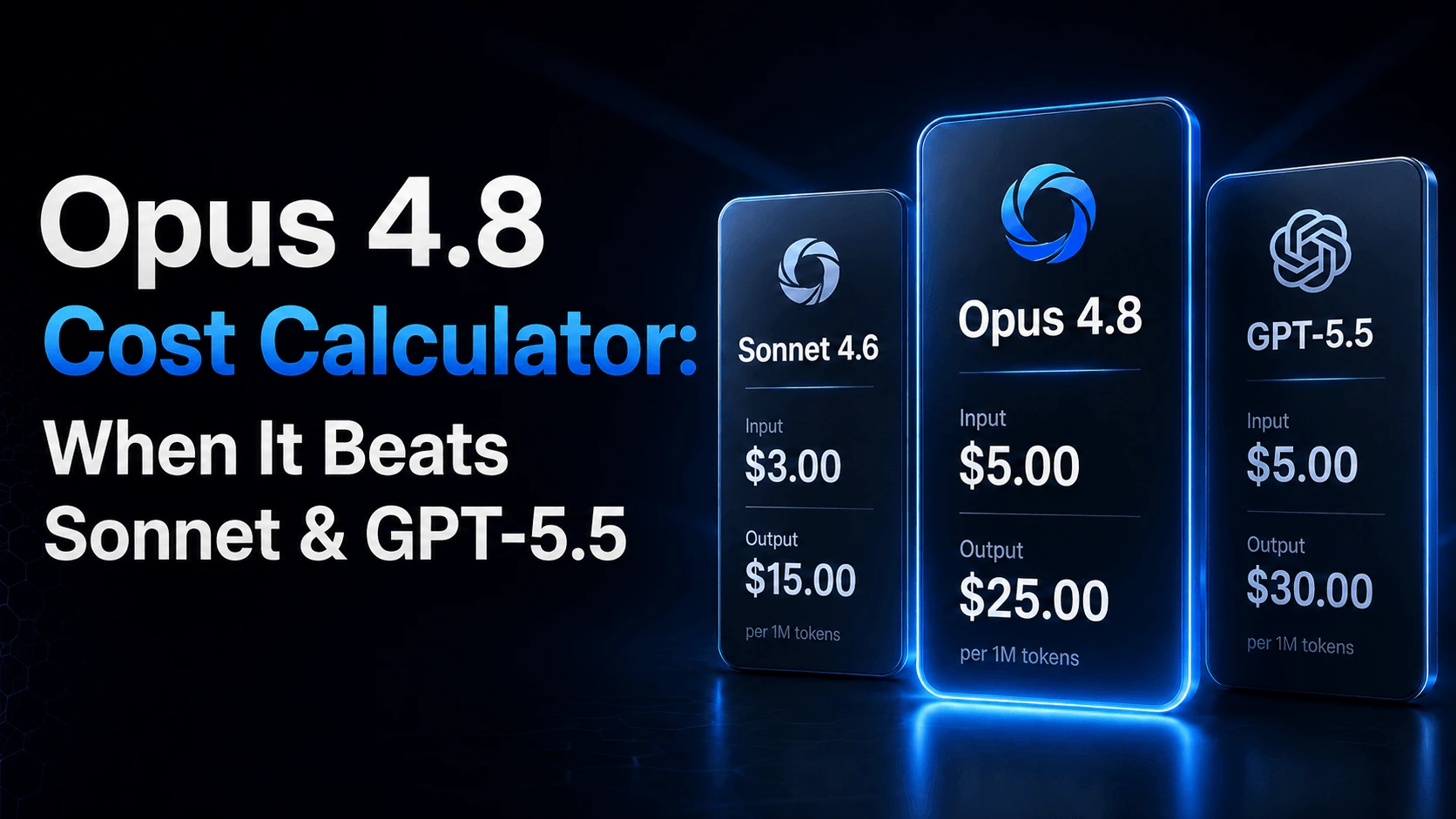
Last verified: 2026-05-31. Anthropic prices come from the Claude API pricing page, GPT-5.5 prices from OpenAI's pricing page, and benchmarks from the Opus 4.8 system card. Both vendors have released newer models since then, Claude Opus 5.5 and OpenAI's GPT-6 family among them, and our Claude Pro vs ChatGPT Plus comparison covers those. Vendor rates change, so check them again before you set a budget.
By Frankie C. · Senior Market Researcher, Mindber. Tracks 500+ AI/SaaS tools via the Mindber Innovation Index methodology.
How we assessed this: This is editorial analysis of official vendor pages, the Opus 4.8 system card and the Mindber product index as of 2026-05-31. It is not hands-on product testing. Anthropic and OpenAI prices and every benchmark score come from the vendor's own pages and are cited inline. DeepSeek's rates are self-reported by the vendor. The monthly totals are our arithmetic on those rates, not metered bills, and the capability scores follow the Mindber Innovation Index rubric explained with the scores further down.
You want to know what Claude Opus 4.8 will cost at your volume, and whether Sonnet 4.6, Haiku 4.5 or GPT-5.5 would do the same work for less. One workload, priced line by line, answers most of that.
Say your app sends 20M input tokens and 5M output tokens a month, and 60% of the input comes back from Anthropic's prompt cache. At Opus 4.8's list rates, the 8M uncached input tokens cost $40 at $5 per million. The cached share adds $6, because a cache read is billed at about a tenth of the input rate. Output is the big line. Five million tokens at $25 per million make up nearly three quarters of a monthly bill of about $171.
Send the same traffic to Sonnet 4.6 and the bill drops to about $103. Haiku 4.5 would charge about $34, though few apps can run everything on their smallest model. A split sits in between. Route 20% of requests to Opus and 80% to Sonnet, and the month costs about $116, roughly 32% below all-Opus.
Our call: keep Opus for the requests that need its reasoning and route the rest down. Anthropic shipped Opus 4.8 on 28 May 2026 at the same price as 4.7, so a team already on Opus gets a better model on the same invoice. That is a reason to change the model string. It is no reason to send more traffic up a price ladder that hasn't moved. Opus 4.8's gains are in coding, agentic work and flagging its own mistakes, and most chat, drafting and extraction traffic never draws on them.
Run the calculator on your own traffic
The calculator opens on the workload above. Drag the sliders to your monthly input, output and cache-hit rate, pick a currency, and it reprices six models at once.
MINDBER · COST TERMINAL LLM API spend / month · pick your currency
Rates verified 2026-05-31 · FX drifts daily — edit it
DeepSeek V3.2
$ 2.69
Haiku 4.5
$ 34.2
Sonnet 4.6
$ 103
Opus 4.8
$ 171
GPT-5.5
$ 205
Opus 4.8 Fast
$ 342
| Model | Use for | USD / mo | $ / mo |
|---|---|---|---|
| ★ DeepSeek V3.2 | cheapest workhorse | $ 2.69 | $2.69 |
| Haiku 4.5 | classify / route / extract | $ 34.2 | $34.2 |
| Sonnet 4.6 | price/quality sweet spot | $ 103 | $103 |
| Opus 4.8 | best reasoning / orchestrator | $ 171 | $171 |
| GPT-5.5 | competitor frontier ($5/$30) | $ 205 | $205 |
| Opus 4.8 Fast | 2.5x speed, latency-sensitive | $ 342 | $342 |
▶ Smart routing verdict
All-Opus 4.8: $ 171 · Opus orchestrator (20%) + Sonnet workers (80%): $ 116
Routing saves $ 54.72/mo (32%). Most workloads belong on Sonnet/Haiku — reserve Opus 4.8 for reasoning, orchestration, and code quality. Routing = your multi-model architecture via API, not a Claude Code native feature.
Bars run from cheapest to most expensive at your settings, and a ★ marks the cheapest model. The currency buttons cover USD, EUR, GBP, SGD, INR and MYR. Each one loads a fixed preset exchange rate, so overwrite it with today's rate before you quote a figure to finance. The green box at the bottom is the routing check: all-Opus against an Opus (20%) + Sonnet (80%) split at whatever volume you set.
No volume figures yet? Pull one ordinary day of token counts from your provider's usage export and multiply by 30. That is rough, but it beats guessing. Each Anthropic API response also reports cache-read tokens separately in its usage block, so your own logs give you the cache-hit rate.
List rates in USD per million tokens, read on 2026-05-31 from the Claude API and OpenAI pricing pages. DeepSeek rates are self-reported by the vendor. Monthly totals are Mindber arithmetic for 20M input, 5M output and a 60% cache-hit rate, not metered bills.
| Model | Input / output | Cached input | Month at example volume |
|---|---|---|---|
| DeepSeek V3.2 | $0.14 / $0.28 | $0.014 | about $2.69 |
| Haiku 4.5 | $1 / $5 | about 10% of input | about $34 |
| Sonnet 4.6 | $3 / $15 | $0.30 | about $103 |
| Opus 4.8 | $5 / $25 | about $0.50 | about $171 |
| GPT-5.5 (short context) | $5 / $30 | $1.25 | about $205 |
| Opus 4.8 Fast | $10 / $50 | modeled at 10% of input | about $342 |
DeepSeek V3.2 runs the example for about $2.69 a month, which makes it the cheapest workhorse for non-sensitive bulk jobs, provided its vendor provenance is acceptable to you. The most expensive line in the set is not GPT-5.5. It is Opus 4.8 Fast, which charges twice the standard Opus rate on every token.
Teams that budget in ringgit can skip the conversion. Our SEA cost teardown runs the same routing model in MYR for a Kuala Lumpur SME, with PDPA framing and Bahasa and Chinese workloads. If your team pays per seat rather than per token, the AI stack cost calculator adds up subscriptions instead.
Why output tokens and caching decide the bill
An API call is billed in three parts. Input tokens that miss the cache pay the full input rate. Input tokens that hit it pay a far lower cache-read rate. Output tokens pay the output rate, and at Anthropic's headline prices one output token costs as much as five input tokens. Add the exchange rate and you have the formula the calculator runs:
Cost formula:
cost = inputM × (1 − cacheHit) × inRate + inputM × cacheHit × cacheRate + outputM × outRate× FX. ThecacheRatediffers by vendor: about 10% of the input rate for Anthropic models, $1.25/M for GPT-5.5 and $0.014/M for DeepSeek.
Run the example through it and the output term swamps the rest. A pipeline that writes long answers pays for every word at the top rate, however little it sends in. Each extra million output tokens adds $25 on Opus and $15 on Sonnet, while an extra million cached input tokens on Opus adds about fifty cents. So the first lever on an Opus bill is usually the length of what you ask it to write. Ask for structured output instead of prose, and set a max-tokens cap that fits the task.
Caching is the second lever. Its value depends on the vendor. Anthropic bills a cache read at about 90% off the input rate, which puts Opus's cached input at about $0.50 per million. GPT-5.5 charges a flat rate that is 2.5 times higher, so a high cache-hit ratio helps it less. Push the calculator's cache slider up and the gap between the two models widens.
A cache hit needs an identical prompt prefix. Put the static part of every prompt first, such as system instructions and reference documents, and the parts that change last. Any edit to the cached block resets it, and the next call pays full input rates until the prefix is cached again.
The May launch also added a cost control for agents. The Messages API now accepts system entries inside the messages array without invalidating the prompt cache. Before, correcting an agent's instructions mid-run meant reprocessing the whole context at full input rates. Now the long, mostly static system prompt stays cached, and a correction costs about as much as appending one message. It does nothing for throughput. The saving shows up in long agent sessions with a large system prompt.
Token rates are only part of what an LLM feature costs. Our true cost of AI tools report lists seven costs that sit outside the per-token rate, from retries and tokenizer drift to implementation labor.
Which jobs need Opus
Workload → correct tier
Agentic coding + hard reasoning
Opus 4.8
- Multi-step planning, debugging, contract or financial logic
- Orchestrator that dispatches cheaper worker models via the API
- Code review: 4x fewer unflagged flaws than Opus 4.7
- Any task where a wrong output has a measurable downstream cost
Chat, drafting, RAG, summaries
Sonnet 4.6
- Multi-turn chat, CRM responses, document summarisation
- Price/quality sweet spot at roughly 60% of Opus cost
- Worker model for the bulk 80% in a routed architecture
- RAG retrieval: combine with structured prompt caching
High-volume classification + extraction
Haiku 4.5
- Intent detection, tagging, routing, entity extraction
- About 5x cheaper than Opus at the same volume
- Escalate only the fraction that exceeds a confidence threshold
- Batch jobs: combine with the Batch API for 50% off headline rates
The Opus card rests on Anthropic's own evidence. Its system card for the model reports 88.6% on SWE-bench Verified and a leading 1890 Elo on GDPval-AA. For an engineering lead, the more useful figure is in the launch post: Opus 4.8 is 4× less likely than 4.7 to let a code flaw pass unflagged.
Opus 4.8: the numbers behind the decision
88.6%
SWE-bench Verified, per Anthropic's system card
Source: Anthropic Opus 4.8 system card, retrieved 2026-05-31
1890
GDPval-AA Elo, the leading score per Anthropic's system card
Source: Anthropic Opus 4.8 system card, retrieved 2026-05-31
4×
Less likely than 4.7 to let a code flaw pass unflagged
Source: Anthropic Opus 4.8 announcement, retrieved 2026-05-31
The same system card says the model fails to raise important issues with the user 3.7% of the time, and it scored 0% on uncritical reporting of flawed outputs. Both figures are Anthropic's own and had not been independently verified when we read them. If they hold up, an autonomous pipeline needs less QA, and a deployment is less likely to ship a flaw the model introduced and never mentioned. That is the case for paying Opus rates on code review and orchestration. It is no case at all for paying them on ticket tagging.
RAG and long-context work, which the cards leave out, belongs on Sonnet 4.6 with the prompt layout described above, so cache hits absorb the repeated context on every call. Without caching, long-context RAG is expensive on any tier. With it, Sonnet's $0.30/M cached reads keep the bill manageable. Batch and background work can run on any model that clears your quality floor, Haiku included, through Anthropic's Batch API at 50% off headline rates. What decides the tier there is how much output quality matters for the job, not which model is newest.
Sonnet's capability scores, which back the routing advice, are on its product listing. On bulk workloads Sonnet and Haiku both score high within their own tiers.
Building the routing layer
Without routing, every request goes to whichever model your code names, so an all-Opus app pays Opus rates to classify a support ticket. A routing layer sits in front of the models. It looks at each request, decides how much reasoning the request needs, and passes the cheapest adequate model ID to the Anthropic Messages API on that call. No vendor ships this as a switch. You build it.
Request
    │
    ▼
┌─────────────────────────────────────┐
│           Routing Layer             │
│  (classify complexity / task type)  │  ← you build this
└──────────────┬──────────────────────┘
               │
               ├─ complex / reasoning (~20%) ──▶  claude-opus-4-8      $5/$25
               │
               ├─ chat / draft / summarise (~60%) ▶  claude-sonnet-4-6  $3/$15
               │
               └─ classify / extract (~20%) ──▶  claude-haiku-4-5    $1/$5
The classifier can stay simple. It might be a task-type tag the caller sets, a quick Haiku call that estimates how much reasoning a request needs, or a rules-based threshold on prompt complexity. Test it on a sample of real requests before it touches production traffic. A classifier that sends hard requests to Sonnet saves money and loses quality where it matters most.
The calculator assumes a 20/80 split, and many production workloads need Opus less often than that. A coding pipeline might escalate failing tests and ambiguous requirements to Opus and send passing builds and boilerplate to Sonnet, which lands closer to one Opus request in ten.
An earlier version of this page said a 10/90 split saves more than 40% against all-Opus. It saves a little over a third. The calculator's own formula shows why: moving everything to Sonnet saves 40% at these rates, so any split that keeps some Opus traffic saves less. Matching the all-Sonnet bill with Opus still in the mix takes the third tier from the diagram. Keep a fifth of requests on Opus and send a fifth to Haiku, with the rest on Sonnet. The example then comes to about $103, the same as running everything on Sonnet.
All-Opus 4.820% Opus + 80% Sonnet
Monthly API spend
All-Opus 4.8
171 $
20% Opus + 80% Sonnet
116 $
Annual API spend (×12)
All-Opus 4.8
2052 $
20% Opus + 80% Sonnet
1392 $
Claude Code users on Team, Max and Enterprise plans will meet Dynamic Workflows, a research preview that fans a task out across hundreds of parallel subagents. It handles parallelism. It does not hand any subagent a cheaper model, so the model for each subagent is still a parameter you set in code. A single-threaded app that calls different model IDs for different task types gets the same economics without it.
Moving from Opus 4.7
For most teams the switch is one model string, and Sonnet and Haiku calls stay as they are. Measure anyway. The 4.6 → 4.7 move shipped a new tokenizer that inflated token counts by up to 35%. A budget built on the old counts could have missed by that much on the first invoice.
Secondary sources say the new model kept the old tokenizer, which would keep tokens per task close to your current baselines. We could not confirm that against a primary source when we wrote this, so check Anthropic's tokenizer documentation before you budget on it. Rebaseline cache reads as well, and watch the hit rate through the first billing day. If you edit prompts during the migration, each edit resets the cached prefix.
Config-only upgrade for most teams. Sources: Anthropic Opus 4.8 announcement + Claude API pricing page (2026-05-31).
| Step | What to verify |
|---|---|
| Swap the model string | Point Opus API calls at the 4.8 model ID. Sonnet and Haiku calls are untouched. |
| Rebaseline cache reads | Tokenizer likely unchanged 4.7→4.8 (per secondary sources; confirm against Anthropic's tokenizer docs). Cache hits need identical prompt prefixes. Monitor cache-hit rate for the first billing day. |
| Measure token-per-task | Re-run your top task templates against the 4.7 baseline. Expect parity; flag drift above a few percent. |
| Evaluate Fast Mode | For interactive flows where latency changes the outcome, price the $10/$50 Fast tier. For batch and background work, standard Opus is cheaper. |
| Validate routing model assignments | Confirm worker-model API calls go to Sonnet 4.6, not Opus. This is an app-level decision, and the bill is won or lost on this split. |
| Re-verify pricing and FX | Pull the live pricing page and today's FX before finalising any budget model. Both drift. |
If token counts come back at parity and cache-hit rates hold, the migration is done. A team that already routes across models can treat it as a routine ID swap. A team still sending everything to Opus should add routing while the code is open anyway. The percentage saving is the same at any volume, and it starts with the next bill.
Opus 4.8 vs Sonnet 4.6 vs GPT-5.5 for API buyers
The scores below are our editorial assessments, not benchmarks. They rate four things an API buyer weighs: cost per unit of traffic, reasoning ceiling, agentic capability, and value for the traffic mix most teams run. How the rubric works is set out on the Mindber methodology page.
How we score: Scores reflect documented capabilities, vendor-published benchmarks and pricing as of 2026-05-31. They do not come from hands-on product testing. Rubric: 1–3 limited or absent, 4–6 partial or inconsistent, 7–8 strong and production-ready, 9–10 leading. The Mindber Innovation Index weights novelty and technical differentiation. The Mindber Functionality Score weights breadth and reliability across core capabilities. A higher "Cost" score means the model is cheaper for typical API traffic.
Subjective 0–100 across four buyer axes. Higher cost-score = cheaper for typical traffic. Editorial, not a benchmark.
Opus 4.8: reasoning
95/100
Opus 4.8: agentic
93/100
Sonnet 4.6: value
92/100
GPT-5.5: reasoning
88/100
Sonnet 4.6: cost
80/100
Opus 4.8: value
74/100
Opus 4.8: cost
55/100
GPT-5.5: value
52/100
0255075100
Anthropic pricing per Claude API pricing page; GPT-5.5 per OpenAI pricing page. Editorial scores under the Mindber Innovation Index rubric (2026-05-31).
| Dimension | Opus 4.8 | Sonnet 4.6 | GPT-5.5 |
|---|---|---|---|
| Cost (typical API traffic) | Higher: $5/$25 per M tokens (Claude API pricing, 2026-05-31) | Best value: $3/$15 per M tokens (Claude API pricing, 2026-05-31) | $5/$30 standard; $10/$45 long-ctx over 272K (OpenAI pricing, 2026-05-31) |
| Reasoning ceiling | Leading on SWE-bench Verified and GDPval-AA (Anthropic system card, 2026-05-31) | Strong, a tier below Opus | Strong frontier model. Tops some, trails Opus on most per vendor reporting |
| Agentic / orchestration | Leading: Dynamic Workflows (Claude Code scale primitive) + mid-task steering | Capable worker model | Capable, different ecosystem |
| Best role | Orchestrator + reasoning slice | Default workhorse for most traffic | Teams standardised on OpenAI's ecosystem |
Sonnet 4.6 takes the value axis by a wide margin, which is why it carries the bulk of traffic in a routed setup. Opus leads on reasoning and agentic work.
GPT-5.5 is harder to place. Anthropic's own benchmarking puts Opus ahead on most published tests, but that is one vendor grading a rival, and OpenAI's model tops some of them. It is also the dearer of the two at every setting the calculator allows. We would pick it only for a team already standardised on OpenAI's platform and toolchain, where the cost of running two vendors can outweigh the gap on the invoice. Our Model Arena tracks frontier models by capability and price, and the Claude Opus 4.8 profile holds this model's Mindber listing.
Further reading on Mindber
The compare tool puts the two Claude models side by side by workload type, with capability and pricing data refreshed weekly. Every frontier model sits in the LLM category, ranked weekly on the rankings page, and the discover feed covers the wider field of models. The data sources page lists each feed behind Mindber's figures, and our scoring methodology explains how the Functionality Score is calculated. More head-to-heads sit in the comparisons hub.
Frequently asked questions
Is Claude Opus 4.7 obsolete now that 4.8 is out?
No. Existing 4.7 deployments keep working, so nobody is forced to move on a deadline. Nothing favours the older model for new work either. The two bill the same per token and 4.8 scores higher, so a fresh project on 4.7 buys nothing.
How does Opus 4.8 compare to GPT-5.5 on price?
GPT-5.5 matches Opus 4.8 on input and charges more for everything else. OpenAI lists $5 input and $30 output per million tokens for standard short-context requests, so output costs a fifth more than on Opus. Requests over 272K tokens move to $10/$45. At the example volume, GPT-5.5 runs about $205 a month against about $171 for Opus.
Is Opus 4.8 Fast Mode worth it?
Often yes, for flows where a slow reply loses the user. Anthropic repriced Fast Mode at $10 input and $50 output per million tokens and kept its 2.5× speed. That is three times cheaper than the old Fast tier, but still double standard Opus on every token, so it doubles the bill at any volume. A customer-facing reasoning agent that loses the session after a four-second wait can justify that. A batch job or background analysis can't, because nobody is waiting for it.
Does Opus 4.8 fix the vision gap versus Gemini?
Not entirely. Anthropic's own materials still put Gemini ahead on some multimodal and vision tasks, and this release's gains are concentrated in coding, agentic work and honesty. For an image-heavy pipeline, such as document OCR, chart interpretation or screenshot analysis, benchmark Opus 4.8 against a Gemini baseline on your own production data before you commit.
When does Haiku 4.5 beat Opus 4.8?
Whenever a better answer would not change the outcome. Classification, intent detection, entity extraction, routing decisions and keyword tagging all run well on Haiku at about a fifth of the Opus cost. The usual pattern sends all inbound work to Haiku first and escalates anything that fails a confidence threshold. In most classification pipelines, fewer than 5% of requests escalate.
What does the calculator leave out?
Discounts, surcharges and uneven traffic. It prices every model at standard rates, so it ignores the Batch API discount, GPT-5.5's long-context pricing and any tax on your invoice. Its routing box also assumes the Opus share of requests carries the same share of input and output tokens. If your hardest requests are also your longest, the Opus slice will cost more than the box shows.
Sources & methodology
Sources & methodology
Every price, benchmark and feature claim cites a primary source inline. USD cost figures are vendor-published rates × the example volume (20M input / 5M output / 60% cache). The calculator applies the same formula with per-model cache-read rates. Capability scores follow the Mindber Innovation Index rubric and are editorial, not benchmarks. Audit trail as of 2026-05-31.
- [1]Opus 4.8 launched 28 May 2026; Fast Mode $10/$50 at 2.5x speed (3x cheaper than prior Fast tier); Dynamic Workflows scale primitive (research preview, Team/Max/Enterprise); mid-task system messages preserve cache; 4x fewer unflagged code flaws vs 4.7Anthropic: Introducing Claude Opus 4.8 · 2026-05-31
- [2]SWE-bench Verified 88.6%; GDPval-AA 1890 Elo (leading), per Anthropic's system card, not independently verifiedAnthropic: Claude Opus 4.8 system card · 2026-05-31
- [3]3.7% miss rate on raising important issues; 0% uncritical reporting of flawed results, per Anthropic's system card, not independently verifiedAnthropic: Claude Opus 4.8 system card · 2026-05-31
- [4]Opus 4.8 $5/$25; Sonnet 4.6 $3/$15; Haiku 4.5 $1/$5 per million tokens; Anthropic cache read ~90% off input rate (~$0.50/M for Opus 4.8)Claude API pricing page · 2026-05-31
- [5]GPT-5.5 $5/$30 standard short-ctx; cached input $1.25/M; long-ctx over 272K = $10/$45OpenAI pricing page · 2026-05-31
- [6]DeepSeek V3.2 $0.14/$0.28 per million tokens; cache $0.014/MOperator-supplied competitive context; rates self-reported by vendor · 2026-05-31
- [7]Tokenizer reportedly unchanged 4.7→4.8 (per secondary reporting; not confirmed against Anthropic's primary tokenizer documentation)Secondary reporting; primary source not confirmed at time of writing · 2026-05-31
- [8]Monthly cost figures (~$2.69/$34/$103/$171/$205/$342) and routing saving (~$116, ~32%) at 20M/5M/60% cacheMindber illustrative model: vendor rates x example volume. Not metered. Use the calculator for your volume. · 2026-05-31
- [9]Correction (2026-10-23): a 10/90 Opus/Sonnet split saves a little over a third against all-Opus, not more than 40%; a 20/60/20 Opus/Sonnet/Haiku split matches the all-Sonnet bill (~$103)Mindber illustrative model: same rates and formula as the calculator · 2026-10-23
- [10]Buyer-axis capability scores (cost / reasoning / agentic / value)Mindber editorial rubric, subjective 0–100. Mindber Innovation Index + Mindber Functionality Score. Not a benchmark. · 2026-05-31
Keep reading
Claude Opus 4.8 for SEA Teams: The Real MYR Cost Math
The MYR-specific routing guide: PDPA framing, Bahasa and Chinese workloads, KL SME cost model.

Manus vs Claude Cowork (2026): Cloud vs Desktop Agent
The agent layer that runs on top of models like Opus 4.8: cloud async vs local-first, with PDPA implications.
Learn the basics on Mindber
Background for this article, from the free Mindber learning hub.
Topic guides
AI Basics lessons
Share this article
Legal notice
This publication constitutes editorial commentary on publicly available information and does not constitute financial, legal, investment, or professional advice. Product names, trademarks, and registered trademarks referenced herein are the property of their respective owners; their appearance does not imply endorsement or affiliation. Mindber's analysis reflects editorial judgment based on public signals and is subject to change without notice. Scores are not buy, sell, or hold recommendations. No commercial relationship exists between Mindber and the vendors evaluated unless separately disclosed in writing. This publication is governed by the laws of Malaysia. Any dispute arising from or in connection with this publication shall be submitted to the exclusive jurisdiction of the courts of Malaysia.