Opus 4.8 Cost Calculator: When It Beats Sonnet & GPT-5.5
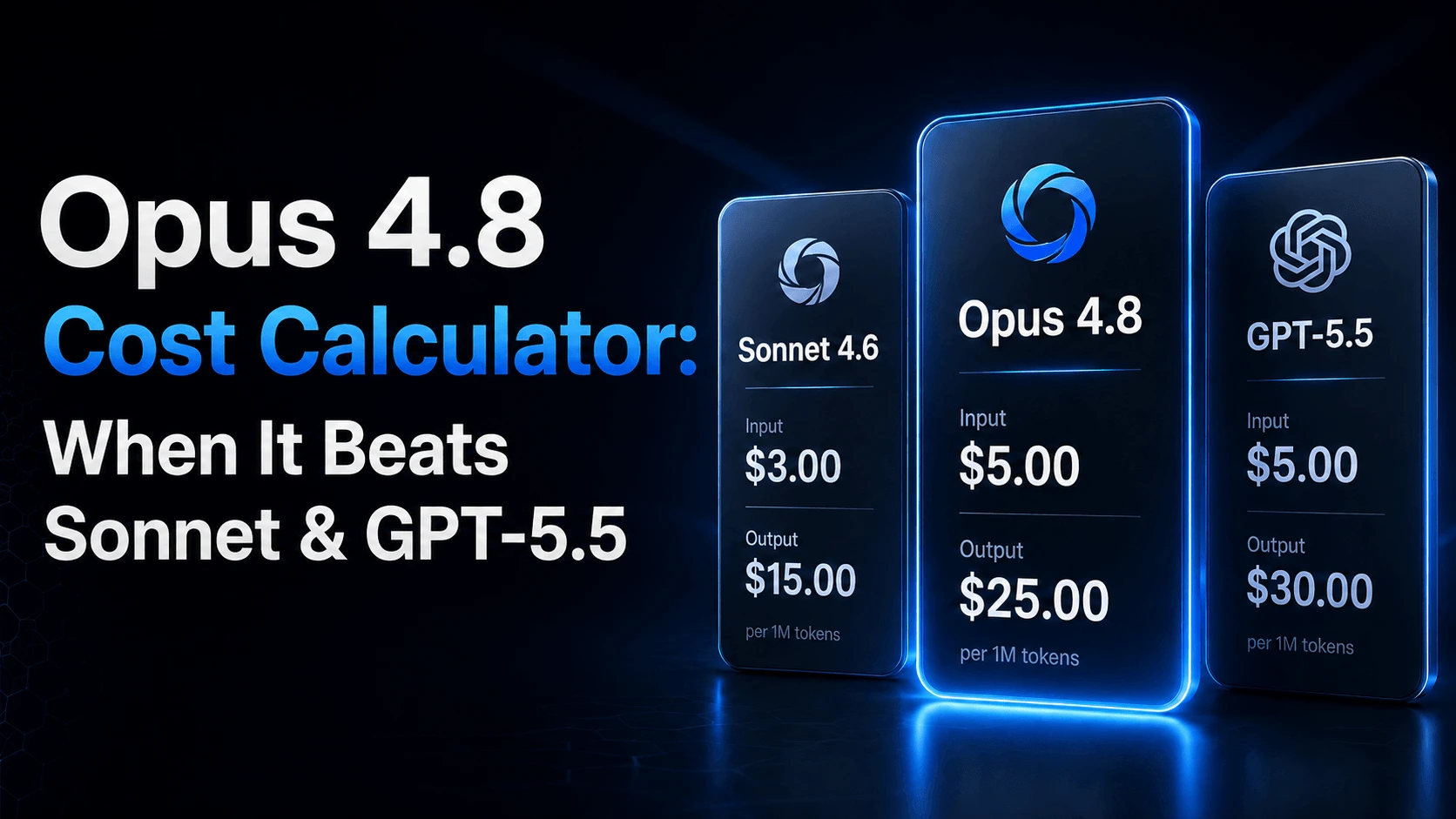
Opus 4.8 API cost calculator vs Sonnet 4.6, Haiku 4.5, GPT-5.5. Break-even workloads, smart-routing saves ~32%, per-model cache rates. Any currency.
Last verified: 2026-05-31. Anthropic pricing sourced from the Claude API pricing page; GPT-5.5 pricing from OpenAI's pricing page; benchmarks from the Opus 4.8 system card. Vendor rates move — verify before budgeting.
By 4lvin · Founder, Mindber. Tracks 500+ AI/SaaS tools via the Mindber Innovation Index methodology.
How we assessed this: AI-assisted editorial analysis of official vendor pages, the Opus 4.8 system card, and the Mindber product index as of 2026-05-31. Not hands-on product testing. Every dollar figure and benchmark score is sourced from a primary vendor page and cited inline. Capability scores follow the Mindber Innovation Index rubric (1–3 limited, 4–6 partial, 7–8 strong, 9–10 leading), not vendor marketing.
Anthropic shipped Opus 4.8 on 28 May 2026 at the same price as 4.7 — $5/$25 per million tokens, unchanged. For the Opus fraction of any stack, that is a pure quality gain at flat cost. For the rest of the stack, the logic flips: a same-price model upgrade is not a license to route more work to the most expensive tier.
This piece settles the numbers. The calculator below handles any currency — USD, EUR, GBP, SGD, INR, MYR — and models the real cost formula — including GPT-5.5's current price of $5/$30 short-context, not $10/$40. For the Southeast Asia-specific guide with MYR framing, see the Mindber SEA cost teardown. For the broader model landscape, see the LLM category rankings and the AI software comparisons hub.
Opus 4.8 is a same-price upgrade — but going all-Opus is the expensive mistake
The upgrade argument is simple: Opus 4.8 improves on 4.7 without changing the invoice, so any team already running Opus should swap the model string. What the upgrade does NOT justify is expanding what you send to the premium tier. The pricing ladder — Haiku $1/$5, Sonnet $3/$15, Opus $5/$25 — still exists, and routing everything to the best model is still the most expensive option in every currency.
At 20 million input tokens and 5 million output per month, with a 60% cache-hit rate, all-Opus 4.8 costs around $171. Sonnet 4.6 for the same volume runs around $103. Haiku 4.5 runs around $34. A routing architecture that sends ~20% of work through Opus and ~80% through Sonnet comes in near $116 — a saving of ~32% versus all-Opus. That differential scales linearly with volume and applies in every currency the calculator converts.
The rest of this article maps which workloads justify each tier, shows the routing architecture that produces the saving, and gives the migration checklist for 4.7 users.
On documented pricing as of 2026-05-31: these figures use per-model cache-read rates (Anthropic ~90% off, GPT-5.5 flat $1.25/M). The calculator applies those rates per model; this article's inline numbers use the same formula. Re-run with your own volume above.
What actually changed in Opus 4.8
Four operational shifts matter to anyone running LLM APIs. Three are pricing and architecture; one is a quality signal that affects procurement decisions.
Opus 4.8 — the numbers that anchor the decision
1. Fast Mode: $10/$50 at 2.5× speed, three times cheaper than before. Anthropic repriced Opus Fast Mode at $10 input / $50 output per million, keeping the 2.5× speed multiplier while dropping the price dramatically. On 4.7, Fast Mode was a premium-on-top-of-premium that few production teams could justify for interactive flows. On 4.8, it is financially defensible for any flow where latency changes the outcome: a reasoning agent in a customer conversation, a real-time code assistant, a pipeline where a four-second wait costs an abandoned session. For batch and background work where speed has no value, standard Opus remains cheaper.
2. Mid-task system messages preserve the cache. The Messages API now accepts system entries inside the messages array without invalidating the prompt cache. In practical terms: you can update an agent's steering instructions mid-run without paying to reprocess the full context. For long sessions where the system prompt is large and mostly static, in-session corrections shift from expensive cache-busting operations to near-free message appends. This is not a throughput feature; it is a cost-management feature for agentic workloads.
3. Honesty gains matter for code review and agentic pipelines. Per Anthropic's Opus 4.8 system card, the model fails to raise important issues to the user 3.7% of the time and scored 0% on uncritical reporting of flawed outputs — figures cited from the system card, not independently verified. The 4× reduction in unflagged code flaws versus 4.7 is the number engineering leads will care about: a model that catches its own errors more reliably reduces the QA overhead of any autonomous pipeline, and reduces the probability that a deployment carries a flaw the model itself introduced and then failed to flag. Vision still lags Gemini per Anthropic's own materials, so image-heavy pipelines should benchmark before committing.
4. Dynamic Workflows: scale primitive, not cost-router. Dynamic Workflows let Claude Code fan a task out across hundreds of parallel subagents, available as a research preview on Team, Max, and Enterprise plans. This is a scale feature — it handles parallelism and coordination across subagents, but it does not assign cheaper models to subagents. The routing saving in this article comes from a separate, app-level architecture decision (see the routing section below). Dynamic Workflows can execute that architecture at scale; the model assignments belong in your code.
Tokenizer note: Secondary sources indicate the tokenizer is unchanged between 4.7 and 4.8, meaning token-per-task counts should stay closer to 4.7 baselines than the 4.6 → 4.7 move (which shipped a new tokenizer and could inflate usage by up to 35%). A direct primary-source confirmation was not available at time of writing — confirm against Anthropic's tokenizer documentation before relying on it for budgeting. Rebaseline cache reads after switching: cache hits require identical prompt prefixes, and any prompt edit resets the cached prefix.
The real cost math
The per-token rate is not your cost. The real formula accounts for caching, output weighting, and FX:
Cost formula:
cost = inputM × (1 − cacheHit) × inRate + inputM × cacheHit × cacheRate + outputM × outRate× FX — wherecacheRatediffers by vendor: Anthropic models ~10% of input rate; GPT-5.5 $1.25/M; DeepSeek $0.014/M. Output tokens cost 5× input at the Anthropic headline rate — verbosity dominates the bill.
The calculator below applies those per-model cache rates and converts to your currency:
| Model | Use for | USD / mo | $ / mo |
|---|---|---|---|
| ★ DeepSeek V3.2 | cheapest workhorse | $ 2.69 | $2.69 |
| Haiku 4.5 | classify / route / extract | $ 34.2 | $34.2 |
| Sonnet 4.6 | price/quality sweet spot | $ 103 | $103 |
| Opus 4.8 | best reasoning / orchestrator | $ 171 | $171 |
| GPT-5.5 | competitor frontier ($5/$30) | $ 205 | $205 |
| Opus 4.8 Fast | 2.5x speed, latency-sensitive | $ 342 | $342 |
All-Opus 4.8: $ 171 · Opus orchestrator (20%) + Sonnet workers (80%): $ 116
Routing saves $ 54.72/mo (32%). Most workloads belong on Sonnet/Haiku — reserve Opus 4.8 for reasoning, orchestration, and code quality. Routing = your multi-model architecture via API, not a Claude Code native feature.
How to read the bars: sorted cheapest-to-most-expensive at your selected volume. The ★ marks the cheapest model at current settings. FX converts all figures live — edit the rate field to today's value before budgeting. The SMART ROUTING VERDICT shows the all-Opus cost versus an Opus (20%) + Sonnet (80%) split.
At the default settings (20M input / 5M output / 60% cache / USD), the model order is:
- DeepSeek V3.2 — ~$2.69/mo. Cheapest workhorse for non-sensitive bulk jobs where vendor provenance is acceptable.
- Haiku 4.5 — ~$34/mo. Classification, routing, intent detection, extraction.
- Sonnet 4.6 — ~$103/mo. Chat, drafting, summarisation, most production traffic.
- Opus 4.8 — ~$171/mo. Reasoning, orchestration, hard coding tasks.
- GPT-5.5 — ~$205/mo. Same input rate as Opus 4.8 ($5/M), higher on output ($30 vs $25), and a higher cached-input rate ($1.25/M vs ~$0.50/M for Opus).
- Opus 4.8 Fast — ~$342/mo. The most expensive option in this set at standard volume.
Two structural facts that make these numbers what they are. Output tokens dominate the bill at a 5× multiplier — a verbose pipeline is expensive regardless of input volume. Per-model cache rates matter: GPT-5.5's $1.25/M cached input is 2.5× higher than Opus 4.8's $0.50/M, which means the cache discount is smaller for GPT-5.5 at high cache-hit ratios. Both effects are modelled in the calculator.
When to use which tier
The correct tier is a workload decision, not a model-prestige one. Five patterns, five answers.
Workload → correct tier
Opus 4.8
- Multi-step planning, debugging, contract or financial logic
- Orchestrator that dispatches cheaper worker models via the API
- Code review: 4x fewer unflagged flaws than Opus 4.7
- Any task where a wrong output has a measurable downstream cost
Sonnet 4.6
- Multi-turn chat, CRM responses, document summarisation
- Price/quality sweet spot — roughly 60% of Opus cost
- Worker model for the bulk 80% in a routed architecture
- RAG retrieval: combine with structured prompt caching
Haiku 4.5
- Intent detection, tagging, routing, entity extraction
- About 5x cheaper than Opus at the same volume
- Escalate only the fraction that exceeds a confidence threshold
- Batch jobs: combine with the Batch API for 50% off headline rates
The other two workload patterns do not need a separate card. RAG / long-context belongs on Sonnet 4.6 with structured prompt caching: prefix the static context block so cache hits absorb the repeated tokens on every call. Without caching, long-context RAG on any tier is expensive; with caching, Sonnet at $0.30/M cached reads makes it tractable. Batch / background belongs on whichever model clears the quality floor, combined with Anthropic's Batch API (50% off headline rates). Any tier, including Haiku, qualifies — the decision is whether output quality matters for the batch job, not which model is newest.
For live capability scores per workload type, the Mindber compare tool refreshes weekly. The LLM rankings and discover feed cover the broader model landscape. The Mindber Innovation Index score for Opus 4.8 concentrates on reasoning, agentic breadth, and code quality — the three axes where the routing split creates the largest cost differential versus all-Opus. The Mindber Functionality Score weights breadth and reliability across the full capability range; for bulk workloads, Sonnet and Haiku both score high on their respective tiers.
Smart routing architecture
The ~32% saving in the calculator is an application-layer pattern, not a vendor feature. The structure: a routing layer classifies each incoming request and sends it to the cheapest model that clears the quality floor. Implemented with the Anthropic Messages API, with Opus and Sonnet each serving as named model parameters.
Request
    │
    ▼
┌─────────────────────────────────────┐
│           Routing Layer             │
│  (classify complexity / task type)  │  ← you build this
└──────────────┬──────────────────────┘
               │
               ├─ complex / reasoning (~20%) ──▶  claude-opus-4-8      $5/$25
               │
               ├─ chat / draft / summarise (~60%) ▶  claude-sonnet-4-6  $3/$15
               │
               └─ classify / extract (~20%) ──▶  claude-haiku-4-5    $1/$5
The routing layer can be as simple as a task-type tag set at the calling layer, a fast Haiku-based classifier that estimates reasoning requirements before dispatching, or a rules-based threshold on prompt complexity. The key invariant: only the fraction that genuinely requires Opus reasoning hits the Opus endpoint.
The 20/80 split used in the calculator is conservative — in practice, most production workloads have a smaller "needs Opus" fraction. Coding pipelines that escalate failing tests or ambiguous requirements to Opus, while routing passing builds and boilerplate to Sonnet, often land closer to 10/90. At that ratio, the saving versus all-Opus grows past 40%.
Monthly API spend
Annual API spend (×12)
Dynamic Workflows on Team/Max/Enterprise can execute this pattern across hundreds of parallel subagents. They handle the parallelism; the model assignment per subagent is a parameter you set in code. The routing saving does not require Dynamic Workflows — a single-threaded application layer calling different model IDs for different task types captures the same economics. For the SEA variant of this routing model with MYR cost figures, see the Mindber regional guide.
Migration checklist: config-only for Opus 4.7 users
Switching the Opus slice from 4.7 to 4.8 is a model-string change for most teams. Secondary sources indicate the tokenizer is unchanged, so token budgets should stay close to 4.7 baselines — but measure after switching, since the 4.6 → 4.7 move shipped a new tokenizer and inflated counts by up to 35%. Rebaseline cache reads: cache hits require identical prefixes, and any edit to a cached prompt resets the prefix.
Config-only upgrade for most teams. Sources: Anthropic Opus 4.8 announcement + Claude API pricing page (2026-05-31).
| Dimension | Step | What to verify |
|---|---|---|
| Swap the model string | Point Opus API calls at the 4.8 model ID. Sonnet and Haiku calls are untouched. | |
| Rebaseline cache reads | Tokenizer likely unchanged 4.7→4.8 (per secondary sources; confirm against Anthropic's tokenizer docs). Cache hits need identical prompt prefixes. Monitor cache-hit rate for the first billing day. | |
| Measure token-per-task | Re-run your top task templates against the 4.7 baseline. Expect parity; flag drift above a few percent. | |
| Evaluate Fast Mode | For interactive flows where latency changes the outcome, price the $10/$50 Fast tier. For batch and background work, standard Opus is cheaper. | |
| Validate routing model assignments | Confirm worker-model API calls route to Sonnet 4.6, not Opus. This is an app-level decision — the bill is won or lost on this split. | |
| Re-verify pricing and FX | Pull the live pricing page and today's FX before finalising any budget model. Both drift. |
If token counts come back at parity and cache-hit rates hold, the migration is done. Teams already running a multi-model routing layer can treat this as a routine model-ID swap. Teams running all-Opus should treat the migration as the moment to introduce routing — the 32% saving is available on day one for any volume. See the Claude Sonnet 4.6 product listing and Mindber methodology page for the capability scoring behind the routing recommendation.
The verdict: Opus 4.8 vs Sonnet 4.6 vs GPT-5.5
Four axes matter for API buyers: cost per unit of traffic, reasoning ceiling, agentic capability, and overall value for the traffic mix most teams actually run. Scores below are editorial assessments under the Mindber Innovation Index rubric — not benchmarks.
How we score: Scores reflect documented capabilities, vendor-published benchmarks, and pricing as of 2026-05-31 — not hands-on product testing. Rubric: 1–3 limited/absent, 4–6 partial/inconsistent, 7–8 strong/production-ready, 9–10 leading. The Mindber Innovation Index weights novelty and technical differentiation; the Mindber Functionality Score weights breadth and reliability across core capabilities. "Cost" scores higher when the model is cheaper for typical API traffic.
Subjective 0–100 across four buyer axes. Higher cost-score = cheaper for typical traffic. Editorial, not a benchmark.
Anthropic pricing per Claude API pricing page; GPT-5.5 per OpenAI pricing page. Editorial scores under the Mindber Innovation Index rubric (2026-05-31).
| Dimension | Opus 4.8 | Sonnet 4.6 | GPT-5.5 |
|---|---|---|---|
| Cost (typical API traffic) | Higher — $5/$25 per M tokens (Claude API pricing, 2026-05-31) | Best value — $3/$15 per M tokens (Claude API pricing, 2026-05-31) | $5/$30 standard; $10/$45 long-ctx >272K (OpenAI pricing, 2026-05-31) |
| Reasoning ceiling | Leading — 88.6% SWE-bench, 1890 GDPval-AA (Anthropic system card, 2026-05-31) | Strong; a tier below Opus | Strong frontier; tops some, trails Opus on most per vendor reporting |
| Agentic / orchestration | Leading — Dynamic Workflows (Claude Code scale primitive) + mid-task steering | Capable worker model | Capable; ecosystem differs |
| Best role | Orchestrator + reasoning slice | Default workhorse for most traffic | Teams standardised on OpenAI's ecosystem |
Opus 4.8 leads on reasoning and agentic capability outright. Sonnet 4.6 leads on value for typical traffic — the right default for the bulk 80% in any routed architecture. GPT-5.5 at $5/$30 has the same input rate as Opus 4.8 but is pricier on output ($30 vs $25) and carries a higher cached-input rate ($1.25/M vs $0.50/M); per Anthropic's own benchmarking, Opus 4.8 leads on most published benchmarks. GPT-5.5 earns a slot for teams already standardised on OpenAI's platform and toolchain.
Compare the live numbers before you commit
Editorial scores are a starting point. The Mindber compare tool refreshes weekly with live capability and pricing data. The LLM category page, Mindber rankings, and data sources page document the full methodology.
Where to dig deeper:
- Mindber compare — Opus 4.8 vs Sonnet 4.6 — weekly refresh
- LLM category rankings
- Claude Sonnet 4.6 product listing
- SEA cost guide — MYR framing + PDPA context
- Mindber scoring methodology
Frequently asked questions
Is Claude Opus 4.7 obsolete now that 4.8 is out?
Not obsolete, but superseded for new work. Opus 4.8 delivers better benchmarks at the same price — $5/$25 per million tokens — so there is no reason to start new projects on 4.7. Existing 4.7 deployments keep working; migration is effectively a model-string change. Secondary sources indicate the tokenizer is unchanged; confirm against Anthropic's tokenizer documentation before rebaselining token budgets.
How does Opus 4.8 compare to GPT-5.5 on price?
GPT-5.5 prices at $5 input / $30 output per million tokens for standard short-context requests — the same input rate as Opus 4.8, but $5 higher on output ($30 vs $25). Long-context requests (>272K tokens) rise to $10/$45. GPT-5.5's cached input rate is $1.25/M — 2.5× higher than Opus 4.8's ~$0.50/M — so the cache discount shrinks at high cache-hit ratios. At 20M/5M/60% cache, GPT-5.5 runs ~$205 versus Opus 4.8 at ~$171. Opus 4.8 leads on most published benchmarks per vendor reporting. GPT-5.5 earns a slot for teams already standardised on OpenAI's toolchain.
Is Opus 4.8 Fast Mode worth it?
For flows where latency changes the outcome, often yes. Fast Mode runs at $10/$50 per million tokens at 2.5× speed — three times cheaper than the prior Opus Fast tier. Break-even depends on what a slow reply costs: a customer-facing reasoning agent where a four-second wait loses the session is a clear yes. Batch processing and background analysis are clear nos — standard Opus at $5/$25 is cheaper when speed has no business value.
What does Opus 4.8 cost per month at typical developer volume?
At 20 million input and 5 million output tokens per month with 60% cache-hit rate: Opus 4.8 runs ~$171 USD. Sonnet 4.6 runs ~$103. Haiku 4.5 runs ~$34. A routed stack (20% Opus + 80% Sonnet) runs ~$116 — saving ~32% versus all-Opus. Use the calculator above for your own volume, cache rate, and currency.
What are Dynamic Workflows and do they reduce API costs automatically?
Dynamic Workflows let Claude Code run hundreds of parallel subagents — a research-preview scale primitive on Team, Max, and Enterprise plans. They handle parallelism and subagent coordination. They do NOT auto-route work to cheaper models. The routing saving in this article comes from a separate app-level architecture: calling Sonnet or Haiku for bulk worker tasks via the Messages API, and reserving Opus for orchestration and reasoning steps. Dynamic Workflows can execute that architecture at scale; the model assignments are yours to set in code.
Does Opus 4.8 fix the vision gap versus Gemini?
Not entirely. Anthropic's own materials still position Gemini ahead on some multimodal and vision tasks. Opus 4.8's gains are concentrated in coding, agentic work, and honesty. Image-heavy pipelines — document OCR, chart interpretation, screenshot analysis — should benchmark Opus 4.8 against a Gemini baseline on real production data before committing.
When does Haiku 4.5 beat Opus 4.8?
On every workload where reasoning quality does not change the outcome: classification, intent detection, entity extraction, routing decisions, and keyword tagging all run well on Haiku at roughly one-fifth the Opus cost. The standard pattern is to run Haiku for all inbound work and escalate the fraction that fails a confidence threshold to a higher tier. For most classification pipelines, that escalation rate is under 5%.
Where can I see live pricing and capability data for these models?
Use the Mindber rankings page for weekly capability scores, the compare tool for side-by-side data, and the LLM category for the full frontier model list. The data sources page documents every feed behind Mindber's figures.
Sources & methodology
Sources & methodology
Every price, benchmark, and feature claim cites a primary source inline. USD cost figures computed from vendor-published rates × example volume (20M input / 5M output / 60% cache); the calculator applies the same formula with per-model cache-read rates. Capability scores follow the Mindber Innovation Index rubric — editorial, not benchmarks. Audit trail as of 2026-05-31.
- [1]Opus 4.8 launched 28 May 2026; Fast Mode $10/$50 at 2.5x speed (3x cheaper than prior Fast tier); Dynamic Workflows scale primitive (research preview, Team/Max/Enterprise); mid-task system messages preserve cache; 4x fewer unflagged code flaws vs 4.7Anthropic — Introducing Claude Opus 4.8 — 2026-05-31
- [2]SWE-bench Verified 88.6%; GDPval-AA 1890 Elo (leading) — per Anthropic's system card, not independently verifiedAnthropic — Claude Opus 4.8 system card — 2026-05-31
- [3]3.7% miss rate on raising important issues; 0% uncritical reporting of flawed results — per Anthropic's system card, not independently verifiedAnthropic — Claude Opus 4.8 system card — 2026-05-31
- [4]Opus 4.8 $5/$25; Sonnet 4.6 $3/$15; Haiku 4.5 $1/$5 per million tokens; Anthropic cache read ~90% off input rate (~$0.50/M for Opus 4.8)Claude API pricing page — 2026-05-31
- [5]GPT-5.5 $5/$30 standard short-ctx; cached input $1.25/M; long-ctx >272K = $10/$45OpenAI pricing page — 2026-05-31
- [6]DeepSeek V3.2 $0.14/$0.28 per million tokens; cache $0.014/MOperator-supplied competitive context; rates self-reported by vendor — 2026-05-31
- [7]Tokenizer reportedly unchanged 4.7→4.8 (per secondary reporting; not confirmed against Anthropic's primary tokenizer documentation)Secondary reporting; primary source not confirmed at time of writing — 2026-05-31
- [8]Monthly cost figures (~$2.69/$34/$103/$171/$205/$342) and routing saving (~$116, ~32%) at 20M/5M/60% cacheMindber illustrative model — vendor rates x example volume. Not metered. Use the calculator for your volume. — 2026-05-31
- [9]Buyer-axis capability scores (cost / reasoning / agentic / value)Mindber editorial rubric — subjective 0–100. Mindber Innovation Index + Mindber Functionality Score. Not a benchmark. — 2026-05-31
Keep reading
Claude Opus 4.8 for SEA Teams: The Real MYR Cost Math
The MYR-specific routing guide: PDPA framing, Bahasa and Chinese workloads, KL SME cost model.
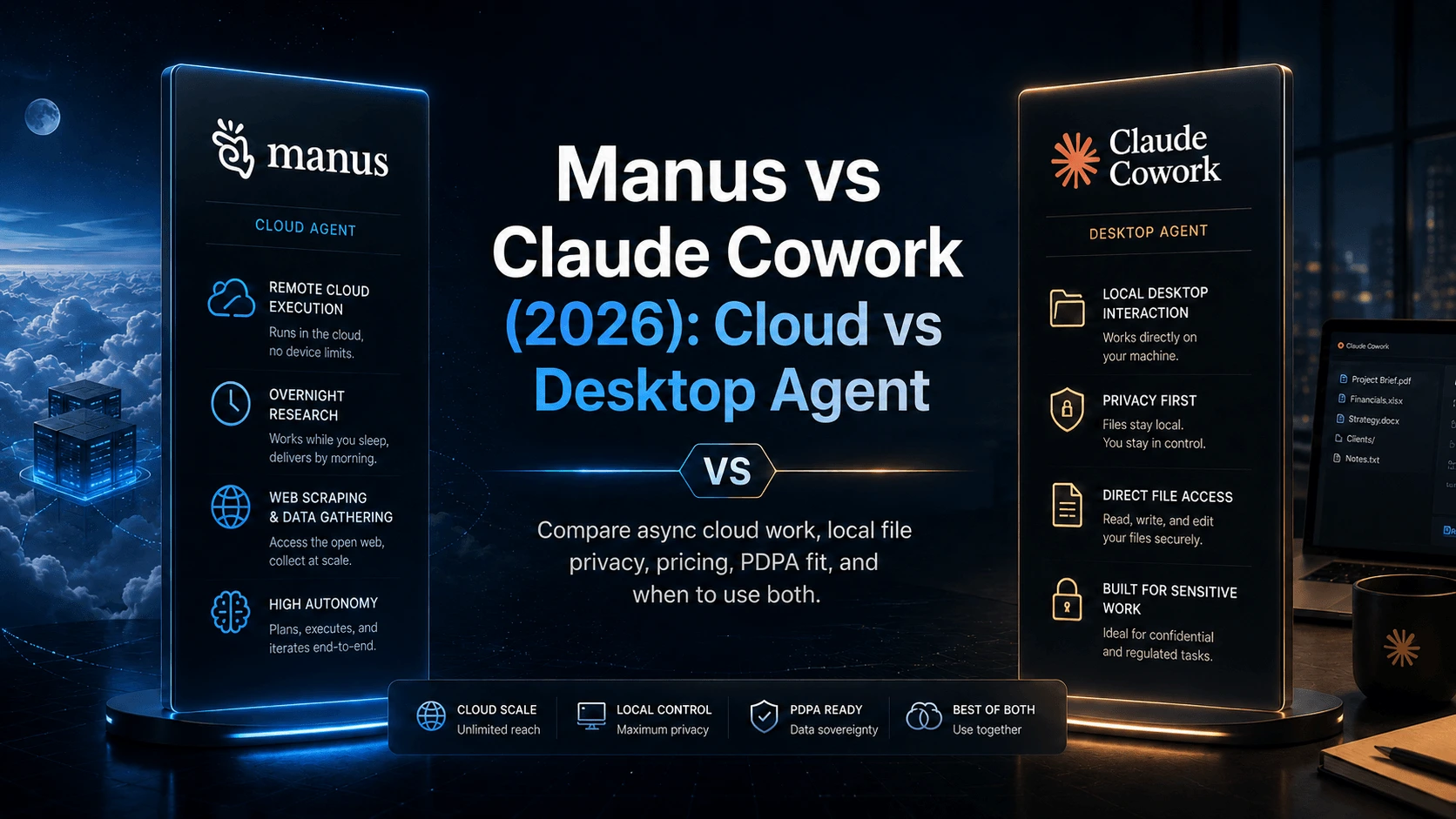
Manus vs Claude Cowork (2026): Cloud vs Desktop Agent
The agent layer that runs on top of models like Opus 4.8 — cloud async vs local-first, with PDPA implications.
Legal notice
This publication constitutes editorial commentary on publicly available information and does not constitute financial, legal, investment, or professional advice. Product names, trademarks, and registered trademarks referenced herein are the property of their respective owners; their appearance does not imply endorsement or affiliation. Mindber's analysis reflects editorial judgment based on public signals and is subject to change without notice. Scores are not buy, sell, or hold recommendations. No commercial relationship exists between Mindber and the vendors evaluated unless separately disclosed in writing. This publication is governed by the laws of Malaysia. Any dispute arising from or in connection with this publication shall be submitted to the exclusive jurisdiction of the courts of Malaysia.
AI-generated · This report was generated using AI language models trained on publicly available data. It reflects editorial analysis at the time of generation and is not the result of hands-on product testing, independent verification by a human analyst, or a commercial endorsement. All scores, assessments, and claims are derived from signals indexed by Mindber at generation time and are subject to change without notice. Mindber and its operators make no warranty of accuracy, completeness, or fitness for any commercial decision-making purpose. This report is for informational purposes only.
