
Manus vs Claude Cowork (2026): Cloud vs Desktop Agent
comparisonUpdated 12 min read
Compare Manus vs Claude Cowork for SEA teams: async cloud work, local file privacy, pricing, PDPA fit, and when to use both AI agents.
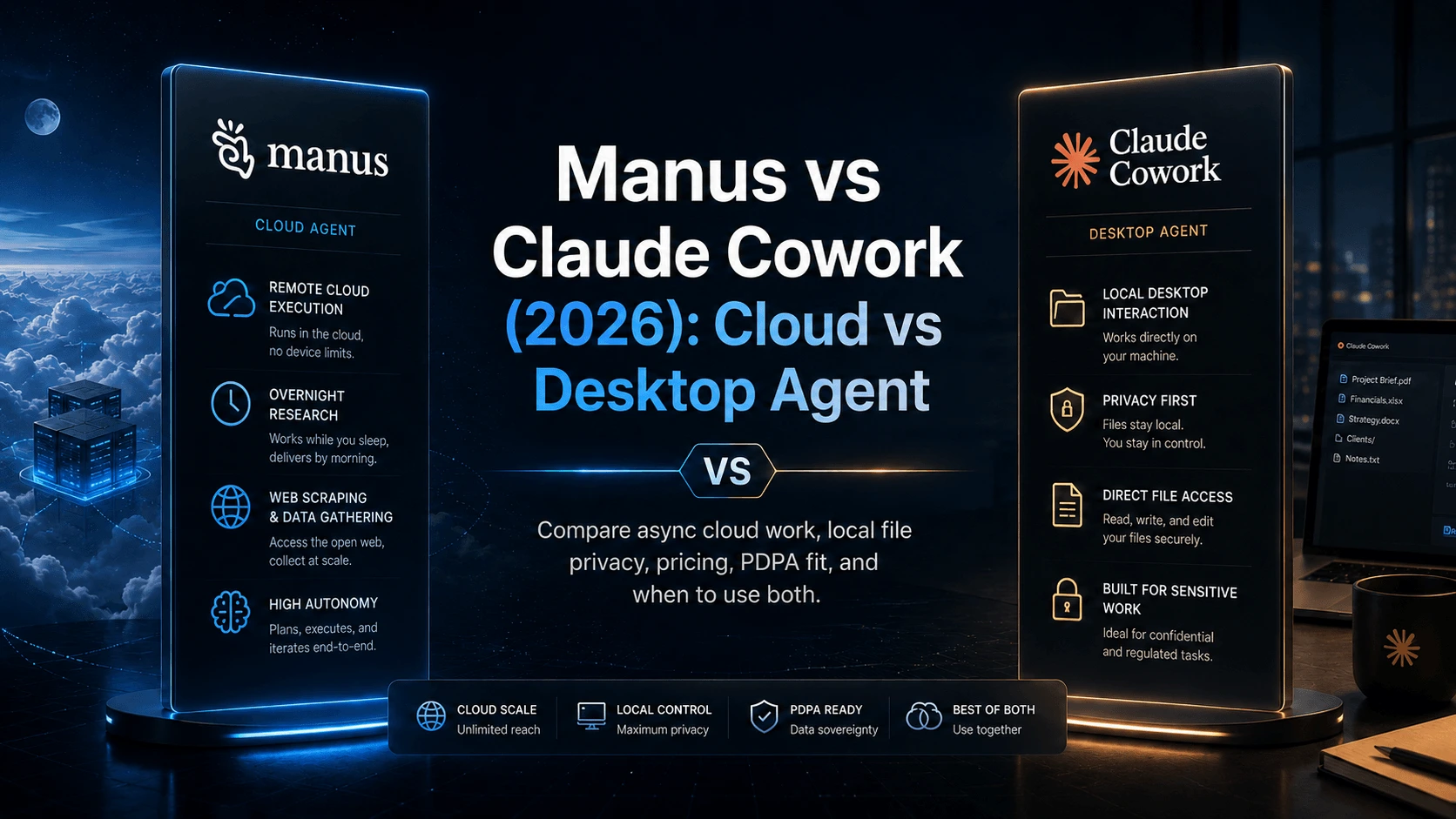
Last verified: 2026-05-11. One change since then: Anthropic has begun folding Cowork into the main Claude app, Pro and Max first, as our Claude Pro vs ChatGPT Plus comparison reported on 20 October. We have not re-checked this page's prices since May. Confirm them on the vendor pages before you budget.
By Frankie C. · Senior Market Researcher, Mindber. Tracks 500+ AI/SaaS tools across SEA markets via the Mindber Innovation Index methodology, covering MY/SG/ID/PH/TH compliance contexts.
How we assessed this: Editorial analysis of public sources read between 4 and 11 May 2026, not hands-on benchmark testing. The sources are the official vendor pages (manus.im and claude.com), Anthropic's announcements and API documentation, Perplexity announcements, independent reporting and the Mindber product index. We also read community evaluations on Hacker News, r/ClaudeAI and Product Hunt. Capability scores follow the Mindber Innovation Index rubric: 1-3 limited, 4-6 partial, 7-8 strong, 9-10 best in class. Where a vendor publishes no figure, we mark it unverified instead of estimating. The data sources page lists every feed we use.
Your team wants an agent to take work off its plate, and the two names that keep coming up were built on opposite ideas. Manus takes a task into a cloud sandbox and keeps working after you log off. Claude Cowork runs on your desktop and edits the files already on your disk. Choose badly and you either send a client folder to a third-party server or watch a laptop grind through a job that should have run overnight.
Our view, from the vendor documents we read in May: decide by where the data may go first, and by when the work runs second. Client files under an NDA and anything in PDPA scope belong in Cowork, because the raw files never leave the machine. Public research that can run for hours without you belongs in Manus, which was designed for exactly that. We'd expect most SEA teams to need both, and to route each job by how sensitive it is.
This comparison is for builders, ops teams and small businesses in Southeast Asia.
The table sets out the 14 dimensions buyers ask about most, with a source on each cell that carries a number.
Last reviewed May 2026. Each cell cites its source inline; unconfirmed figures are marked unverified.
| Dimension | Manus | Claude Cowork |
|---|---|---|
| Origin | Butterfly Effect Pte. Ltd. (SG/CN, launched 2025-03-06) (Wikipedia: Manus (AI agent), 2026-05-04) | Anthropic (research preview Jan 2026, GA Apr 2026) (claude.com/product/cowork, 2026-05-04) |
| Architecture | Cloud-first remote sandbox | Local-first desktop application |
| Underlying model(s) | Multi-LLM orchestration | Claude Opus / Claude Haiku |
| Execution environment | Remote VM (Linux sandbox) | User's local OS process |
| File access | Sandbox files only (uploads / generated) | Direct read/write to local filesystem |
| Long async runs | Designed for it | Limited (depends on local session) |
| Browser control | Headless browser in sandbox | Bridge to system browser |
| Pricing entry point | $20/month (Standard) (Manus Plans & Pricing, 2026-05-04) | $20/month (Claude Pro, Cowork bundled) (claude.com/pricing, 2026-05-04) |
| Privacy posture | Data leaves device → Manus cloud | Data stays on device by default |
| SEA support | Strong CN ecosystem, EN UI | Strong EN, CN locale rollout |
| Multi-agent / parallel | Multiple sandbox sessions | Single-process at a time |
| Best at | Long async research, scraping, content workflows | File-bound work, drafts, NDA-sensitive tasks |
| Worst at | Local-only file workflows | Multi-hour async background jobs |
| Open source | Closed | Closed (desktop app) |
Where your data goes
Every Manus task starts its own Linux machine in Manus' cloud. Files you upload are copied into that sandbox for the length of the run, and the browser, the shell and any code all execute there. Underneath, Manus orchestrates several models and hands each subtask to Claude, GPT or DeepSeek. That mix has a side effect, listed in the failure table further down: when the orchestrator switches models mid-task, the output's style and quality can shift.
Cowork has no sandbox to copy into. It runs as a desktop app, opens your files where they already sit and sends Anthropic's API only the parts the model needs as context. It stays on Anthropic's own models, Opus and Haiku.
Manus: Cloud Sandbox
Remote agent, remote data
- Each task spins up a Linux VM in Manus' cloud
- Multi-LLM orchestration (Claude / GPT / DeepSeek depending on subtask)
- Files you upload live in sandbox storage during the run
- Browser, shell, and code-exec all run remotely
- Ideal for long-horizon work, problematic for confidential data
Cowork: Local Desktop
Local agent, local data
- Runs as a native desktop application (macOS and Windows, Linux not confirmed)
- Reads and writes files directly on the user's filesystem
- Model inference still calls Anthropic's API, but file content is sent only as context
- No persistent cloud sandbox, no remote shell
- Ideal for file-bound work and NDA-sensitive sessions
That copy step is what legal teams look at. Malaysia's PDPA 2010 and Singapore's PDPC, which enforces Singapore's PDPA 2012, both require a lawful basis for moving personal data across a border. Manus' primary infrastructure is in Singapore and China. A client file uploaded to a task makes that trip. Legal then has to review the pipeline before anyone approves it, and our PDPA and PDPC procurement guide lists the DPA clauses and residency questions to raise in that review. Many legal teams never get that far. They routinely block a cloud-sandbox tool as soon as "Singapore/China sandbox", or similar third-country processing, appears in the vendor's privacy documents. How productive the tool is doesn't change that decision.
For NDA-bound, regulated or PDPA-sensitive files, that usually leaves Cowork or a self-hosted setup. Cowork avoids the question for a large class of work, though not for all of it. Anthropic's API still sits in the loop, so the model context crosses the network while the raw filesystem stays put. Some teams cannot send data off the device at all. For them, that one API call is sometimes the only network traffic they can accept.
Data that must stay in EU jurisdictions is a narrower problem. When we checked in May, Manus published no EU data residency option. Cowork's equivalent gap is Linux. Anthropic had not confirmed support for it, and a Linux-only team should check with Anthropic before committing.
Overnight runs or a live session
Manus is fire-and-forget. You hand over a task, close the laptop and read the result hours later, and several sandbox sessions can run in parallel meanwhile. The price is control. Manus is not a chat interface and doesn't support steering a task once it has started, so a vague brief can burn a whole run before you see the problem. Put the sources and the output format in the brief, because there is no second chance mid-run.
Cowork works the other way round. It answers while you watch, which suits drafting and editing, and it handles one task at a time in a single desktop process. It also needs your local session alive. An overnight job means leaving the machine on, which rules Cowork out for 24/7 unattended automation. For web work it bridges to your system browser, where Manus drives a headless browser inside its sandbox. Since 23 March 2026, Pro and Max users can also let Claude operate the computer itself through Cowork or Claude Code, a research preview that CNBC reported the next day.
Both designs are bets, as we read them. Manus wagers that for most knowledge work, hours of unwatched progress are worth the data leaving the device. Anthropic is betting on non-developers such as lawyers, finance teams and ops staff. Their work is file-bound and sensitive where it sits, so the agent stays there too.
Nobody has published how fast "interactive" is. Anthropic uses the word for Cowork but, as of early May, gave no time-to-first-token benchmark. An earlier version of this page described Cowork's feedback as sub-second. No published figure supports that, so we took it out.
Throughput claims for Manus are no cleaner. In 2026 vendor reporting, "tasks per day" can mean anything from API-billed runs to free-tier exploration. We don't quote one.
What $20 a month buys on each side
The two bills are built differently because the costs are. Manus runs cloud compute on your behalf and sells it as credits, which each task burns. Cowork mostly costs model inference, so Anthropic folds it into Claude Pro and above, as its pricing page shows. There is no separate Cowork plan, and the free Claude tier leaves it out.
Sourced from vendor pricing pages. Cowork bundled into Claude Pro+; no separate Cowork SKU.
| Dimension | Manus | Claude Cowork |
|---|---|---|
| Free | $0/mo · 300 credits · 5 tasks (manus.im/pricing, 2026-05-04) | $0/mo · Cowork NOT included (claude.com/pricing, 2026-05-04) |
| Entry paid | $20/mo Standard · 4,000 credits (manus.im/pricing, 2026-05-04) | $20/mo Claude Pro · Cowork bundled (claude.com/pricing, 2026-05-04) |
| Mid tier | $40/mo Customizable · 8,000 credits (manus.im/pricing, 2026-05-04) | $100+/mo Claude Max · 5× or 20× Pro (claude.com/pricing, 2026-05-04) |
| Heavy | $200/mo Extended · 40,000 credits (manus.im/pricing, 2026-05-04) | Covered by Max |
| Team (per seat) | $40/seat/mo · min 2 members (manus.im/pricing, 2026-05-04) | $25/seat/mo Standard · $125/seat/mo Premium (claude.com/pricing, 2026-05-04) |
| Enterprise | n/a | $20/seat + usage (claude.com/pricing, 2026-05-04) |
| Annual discount | ~17% off (≈ 2 months free) (manus.im/pricing, 2026-05-04) | 15% off Pro ($20 → $17/mo) (claude.com/pricing, 2026-05-04) |
| Refunds | See footnote ↓ | See footnote ↓ |
Paying yearly takes about 17% off Manus, roughly two months free, and brings Claude Pro down to $17 a month. The credit math is where agent budgets slip. Manus' plan page gives Standard 4,000 credits a month, but neither vendor publishes what a typical task costs. For bulk, repetitive work, Claude Pro's message limits run out sooner than those credits do.
Teams pay per seat on both sides. Manus Team costs $40 a seat with a two-member minimum. Claude Team is $25 a seat on Standard and $125 on Premium, or $20 and $100 when billed yearly, and Enterprise adds usage charges to a per-seat fee. A heavy solo user chooses between Manus' $200 Extended plan and Claude Max, which starts at $100 for five or twenty times Pro's usage.
Cost per task is the more honest unit for an agent, since a tier hides how much work the money buys. We have not run a metered side-by-side test. The bars below are our own illustrative estimates for three jobs, good for their shape and nothing finer.
ManusCowork
Web research, 30 sources
Manus
$0.42
Cowork
$0.18
Refactor 12 markdown files
Manus
$0.28
Cowork
$0.08
Long async report (8 hr)
Manus
$1.85
Cowork
n/a
$0.00Source: Mindber illustrative cost estimates, not benchmarks or metered runs., May 4, 2026
Turning either bill into a per-task figure takes two guesses: how fast Manus burns credits, and how far the Pro allowance stretches. We'd still trust the shapes. A Manus run costs more than a Cowork edit of the same files. The third row shows Cowork at $0.00 only because it cannot run an unattended eight-hour job at all. That gap is why teams that need async work accept the Manus premium.
How the two score
Every number in this section is editorial judgment, scored from documented features rather than from runs of our own. Set side by side on six dimensions, the two tools come out close to mirror images. On this chart 10 means a tool was explicitly designed for the job and 7 that it handles it well. A 4 means constrained, and 1 means not supported.
Manus
Cowork
9Async / unattended runs3
3Privacy posture9
1Local file access10
8Web / browser tasks5
6Cost per task at scale8
5Latency in interactive use8
Comparison between Manus and Cowork across 6 dimensions, scored out of 10.
The gaps on unattended runs, privacy and local file access are wide. Cost and latency lean toward Cowork by smaller margins, and neither rests on a measurement: cost comes from our estimates above, and nobody has published latency figures.
Only one side has a published benchmark. At its March 2025 launch Manus reported GAIA scores of 86.5% at Level 1, 70.1% at Level 2 and 57.7% at Level 3, all self-reported. Cowork had published nothing comparable by early May. No test yet puts the two on one scale.
The Intelligence Score adds a second editorial layer. It combines the Mindber Innovation Index, which weights novelty and technical differentiation, with the Functionality Score, which weights how broad and reliable the core capabilities are. Both values below are placeholders until the v4.2 benchmark is published. The methodology page shows how each one is weighted and how we score privacy posture, so you can see exactly where you disagree.
Mindber Intelligence Score: editorial rubric (subjective)
Manus
Innovation Index™
82
Functionality Score™
76
Strong on async + parallel, weak on local FS access. Self-reported GAIA L1 86.5% (March 2025).
Claude Cowork
Innovation Index™
74
Functionality Score™
71
Strong on privacy + local FS, weak on long async runs. GA April 2026 per Anthropic.
Where each one breaks
How an agent fails matters more than what it does well, because the failure sets the cost of recovery. Manus fails out of sight, inside a run nobody is watching, and you learn about it from the output or the bill. Cowork fails in front of you and stalls the session until you step in.
Neither replaces engineering judgment. Both are built to help non-developers and speed up developers, and their output needs review before it reaches a client.
Two characteristic failure modes per tool. The rest are listed below for subscribers.
| Dimension | Manus failure | Cowork failure |
|---|---|---|
| State loss / context loss | Sandbox state loss: long-running tasks can lose intermediate scratch state if the VM is recycled mid-run. | Model context limits: large file edits (codebases, transcripts) hit the context ceiling and need manual chunking. |
| Output reliability | Tool drift: if the multi-LLM orchestrator switches models mid-task, output style and quality can shift. | Local-only knowledge gaps: there is no sandbox, so it can only act on files you give it or fetches through its bridge. |
Two of these deserve a plan before the first run. A recycled VM can wipe the scratch state of a long Manus task, which is why the FAQ below recommends checkpoints. On Cowork, a whole codebase or a long transcript hits the context ceiling, and the fix is splitting the job into chunks by hand.
Members only
See the full failure-mode breakdown
The remaining failure modes for both tools, for subscribers.
Free. Unsubscribe any time.
Which jobs go to which agent
Overnight competitor research is the job Manus was built for. Send it a scan of 20 SaaS products before bed and read the report over breakfast. Marketing teams scraping booking sites, marketplaces and public records get the headless browser, retries and rotation those jobs can't do without. A researcher can split five questions across parallel sandboxes and compare the answers, which saves real time when the questions don't depend on each other. Indie hackers fit the same pattern when they scrape, summarise and rewrite across hundreds of items with no human in the loop.
Cowork earns its place wherever the files are the work:
- NDA-bound client work. Legal research on private filings and financial diligence on internal documents can't go to a third-party cloud, so local read and write is the only route.
- Patient data. Healthcare operations in Malaysia and Singapore should keep it out of any external sandbox.
- Local repos. Engineering teams refactoring code skip the upload, edit and download loop, with nothing to sync and nothing to re-upload.
- Drafts built from what you have. Proposals, slide decks and knowledge bases already on disk feed the draft without going anywhere.
For someone just exploring, we'd start with Cowork for its gentler interface and smaller surface area. An earlier version also credited Cowork with the lower entry cost. That was wrong. Manus is the one with a free tier, and we dropped the claim.
Running both in one working day
The split we'd recommend for teams with both kinds of work follows the clock. Research goes to Manus before close of day, and the sensitive last mile happens in Cowork the next morning. The split holds as long as traffic runs one way: public research comes down from Manus, and the client brief never goes up. Several SEA teams already run a four-step version of this pattern, laid out below for subscribers.
Members only
Read the full hybrid workflow walkthrough
The four-step pattern with the handoff snippets, for subscribers.
Free. Unsubscribe any time.
Frequently asked questions
Is Manus better than Claude Cowork?
Not on any test both have taken. Manus published GAIA scores at launch, while Cowork had released no comparable benchmark when we checked in May. The two also do different jobs, which is why this page weighs design and price instead of a shared score.
Is Manus available outside China?
Yes. Manus has an English interface and serves users worldwide, and SEA teams generally reach it without trouble. Its documentation and community are still stronger in Chinese, and payment methods and support hours lean toward Chinese time zones.
Does Claude Cowork work offline?
No, and Manus doesn't either. The "local" in Cowork describes file access, while the model still runs on Anthropic's side, so the agent needs a connection to think. Manus needs its cloud sandbox for every task and has no offline or local mode. Fully offline AI means looking beyond both.
Are there free tiers for both?
Only Manus has one. Its free plan gives a small credit allowance for evaluation, with the limits in the pricing table above. Claude's free tier leaves Cowork out, so a fair trial means paying for a month of Claude Pro. Pricing changed often in 2026. Check current limits in each vendor's dashboard first.
What happens if Manus' sandbox crashes mid-task?
Manus retries the failed steps and keeps the task metadata, but scratch state inside the VM can be lost. Build long tasks to write checkpoints to a stable output, such as a markdown bundle or a JSON file, instead of relying on memory in the VM.
What's the difference between Claude Cowork and Claude Desktop?
Desktop is the chat client, and Cowork is the agent that works on your local files. Both run on Anthropic's models, but Cowork reads and modifies files, which the chat client largely cannot. The merge noted at the top of this page is folding the two into one Claude app.
Does Claude Cowork support Mandarin?
Yes, for input and output, and its Mandarin output is strong. The interface follows your system locale, and the agent reasons the same way whatever language you write in.
More head-to-heads sit in our comparison category, and the autonomous agents tag gathers the rest of our agent research. Both tools are listed in the AI agents category, and the categories page narrows the field further. The rankings page scores both every week, while Compare puts their listings side by side with live data. Discover shows recently shipped tools, and Reports holds our sector-wide Mindber Innovation Index studies. Our scoring methodology and editorial methodology are public for anyone who wants to check how we reached the numbers on this page.
Sources & methodology
Every numerical claim cites a primary source where one exists. Where none exists, the value is marked unverified. This list is the audit trail, checked on 2026-05-04 unless a row says otherwise.
- [1]Manus origin: Butterfly Effect Pte. Ltd. (Singapore, China-founded), launched 2025-03-06Wikipedia: Manus (AI agent) · 2026-05-04
- [2]Meta acquisition of Manus blocked by China NDRC on 2026-04-27Wikipedia: Manus (AI agent) + CNBC reporting · 2026-05-04
- [3]Manus self-reported GAIA scores at March 2025 launch: L1 86.5%, L2 70.1%, L3 57.7%Wikipedia: Manus (AI agent) · 2026-05-04
- [4]Manus pricing: Free 300 daily credits / Standard $20 4K credits / Customizable $40 8K credits / Extended $200 40K credits / Team $40/seat (min 2)Manus Plans & Pricing · 2026-05-04
- [5]Manus annual discount: 17% (≈ two months free)Manus Plans & Pricing · 2026-05-04
- [6]Claude Cowork: research preview Jan 2026, GA April 2026, included in Pro tier and aboveAnthropic: Cowork product page · 2026-05-04
- [7]Claude pricing: Free $0 / Pro $20/mo ($17 annual) / Max from $100/mo / Team $25/seat ($20 annual) / Premium Team $125/seat ($100 annual) / Enterprise $20/seat + usageClaude pricing page · 2026-05-04
- [8]Claude Cowork is bundled in Pro tier and above (no separate Cowork SKU)Claude pricing page · 2026-05-04
- [9]Claude Computer Use feature launched in research preview 2026-03-23, available to Pro/Max via Cowork or CodeAnthropic announcements (CNBC report 2026-03-24) · 2026-05-04
- [10]Anthropic folding Cowork into the main Claude app, Pro and Max first
- [11]PDPA / cross-border data implications for SEA enterpriseMY PDPA 2010 + SG PDPA 2012 (general guidance, not legal advice) · 2026
- [12]Relative-strength chart (async runs, privacy, local file access, web tasks, cost per task, interactive latency)Mindber editorial rubric: subjective 1-10 weights of documented features. Not a benchmark. · 2026-05-04
- [13]Cost-per-task chart (3 tasks × 2 tools)Mindber illustrative cost estimates, not metered. · 2026-05-04
- [14]Intelligence Score panel (Innovation Index + Functionality Score)Mindber editorial rubric: subjective 1-100 scoring of documented features. Not a benchmark. · 2026-05-04
Keep reading

Learn the basics on Mindber
Background for this article, from the free Mindber learning hub.
Topic guides
AI Basics lessons
Share this article
Legal notice
This publication constitutes editorial commentary on publicly available information and does not constitute financial, legal, investment, or professional advice. Product names, trademarks, and registered trademarks referenced herein are the property of their respective owners; their appearance does not imply endorsement or affiliation. Mindber's analysis reflects editorial judgment based on public signals and is subject to change without notice. Scores are not buy, sell, or hold recommendations. No commercial relationship exists between Mindber and the vendors evaluated unless separately disclosed in writing. This publication is governed by the laws of Malaysia. Any dispute arising from or in connection with this publication shall be submitted to the exclusive jurisdiction of the courts of Malaysia.