
The AI Shelfware Epidemic: Why 46% of Software Licenses Go Dark (2026 Data)
guideUpdated 11 min read
AI shelfware drains budgets: 46% of SaaS licenses sit unused monthly and 72% of enterprise AI initiatives destroy value. The 2026 data and a 30-minute audit.
Last verified: 2026-06-05. Every figure below is cited to its named publisher on the date shown; sources are primary where the publisher is the originator, secondary where noted. Spend and adoption numbers move fast — follow the linked sources for current figures.
By Frankie C. · Senior Market Researcher, Mindber. Tracks 500+ AI and SaaS tools through the Mindber Innovation Index and Mindber Functionality Score methodology.
How we assessed this: This is AI-assisted editorial analysis of public research, not a study Mindber ran. Each statistic was cited to its primary or named secondary source (Zylo, Gartner, S&P Global, Mavvrik, Larridin, Harness, Happily.ai, IDC), restated in our own words, and dated. Any figure we couldn't confirm against a named source was dropped, not guessed.
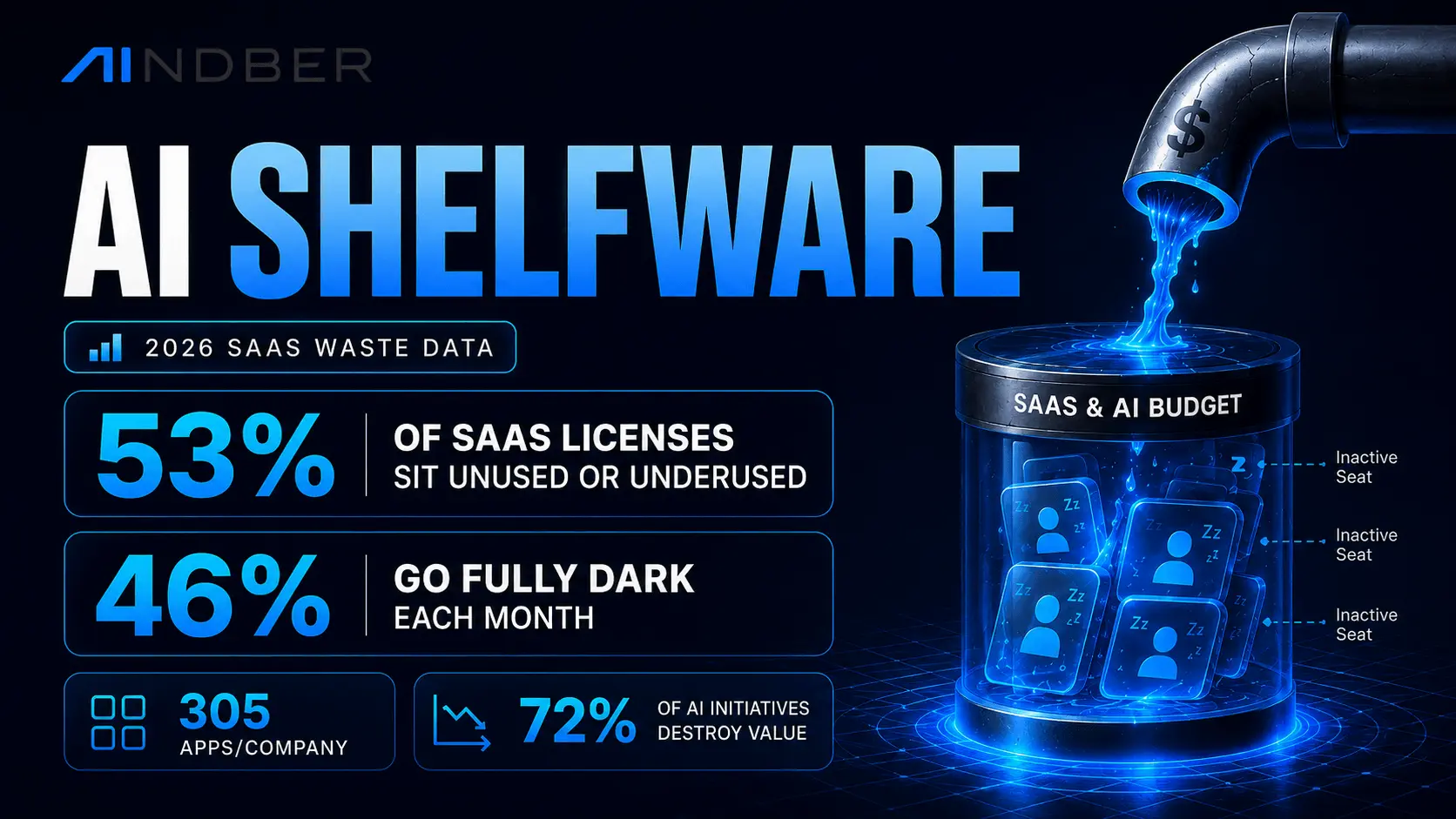
Most software budgets are buying things nobody opens. AI shelfware is the paid AI and SaaS tooling that sits unused, barely adopted, or quietly destroying value. It's now the default state of the corporate stack, not the exception. Start with two numbers. Across enterprises, 53% of SaaS licenses are unused or underused (~46% fully unused in a given month), and 72% of enterprise AI initiatives are actively destroying value (Larridin, 2026) rather than producing it.
Companies aren't underspending on software. They're overspending on software they never switch on.
This is a global problem, and it's getting worse as AI budgets balloon. The point of this report is simple: show you the verified data, then hand you a 30-minute audit you can run today. Mindber's reason for existing is the same — vet a tool transparently before the invoice, not after the renewal. Browse the Mindber directory or the live rankings to see what that looks like in practice.
What counts as AI shelfware?
AI shelfware is any paid AI or SaaS tool that fails to reach sustained, value-producing use after purchase. It splits into three failure modes: licenses nobody activates, tools that get used but tied to no measurable outcome, and AI systems that run up cost while producing work nobody ships. The baseline is brutal. Zylo's 2026 SaaS Management Index puts 53% of SaaS licenses unused or underused (~46% fully unused in a given month), against an average portfolio of 305 applications per company.
The SaaS waste baseline — 2026
53%
SaaS licenses unused or underused (~46% fully unused in a given month)
Source: Zylo 2026 SaaS Management Index, retrieved 2026-06-05
305
Apps in the average company's portfolio
Source: Zylo 2026 SaaS Management Index, retrieved 2026-06-05
15%
Share of SaaS spend IT actually controls
Source: Zylo 2026 SaaS Management Index, retrieved 2026-06-05
So who's buying all of it? Not IT. Zylo reports that business units now drive 81% of SaaS spend, individual employees expense another 4%, and central IT manages just 15% while owning 13% of applications. Spend has decentralized to the people closest to the work and furthest from the renewal math. That's the soil shelfware grows in.
Why AI waste is worse than classic SaaS waste
AI doesn't just repeat the SaaS waste pattern; it amplifies it, because the cost meter runs even when the output is worthless. A dormant SaaS seat costs a fixed monthly fee. A misfiring AI agent burns tokens on every retry, every bloated prompt, every expensive model call — whether or not a single line of its work ever ships. Harness found that AI token spend has never been connected to outcomes, and 94% of engineering leaders say the metrics that matter most are missing from how they measure it (Harness, 2026).
The waste then compounds across three layers that classic SaaS never had.
Sources: Zylo 2026 Index, Mavvrik State of AI Cost Governance, Gartner (June 2025), S&P Global Market Intelligence. Retrieved 2026-06-05.
| Dimension | Classic SaaS waste | AI-era waste |
|---|---|---|
| Cost behaviour | Fixed seat fee, predictable | Usage-metered; 80–85% of firms miss AI infra forecasts by >25% |
| Failure point | Seat never activated | Project dies between pilot and production |
| Scale of abandonment | 53% of licenses unused/underused | 42% of firms abandoned most AI initiatives in 2025 (up from 17%) |
| Forward outlook | Renews quietly each year | >40% of agentic AI projects canceled by end-2027 (Gartner) |
| Value tie-out | Adoption rate measurable | Token spend untethered from outcomes (Harness) |
Look at the pilot-to-production cliff. S&P Global Market Intelligence found that 42% of companies abandoned the majority of their AI initiatives in 2025, up from 17% the year before, with roughly 46% of AI proofs of concept scrapped before broad adoption. Gartner's read on the next wave is harsher: more than 40% of agentic AI projects will be canceled by the end of 2027, blamed on escalating costs, unclear business value, and inadequate risk controls. That forecast came from a poll of more than 3,400 organizations already investing in the technology. For the full token cost breakdown, see our AI total cost of ownership report and AI TCO calculator.
Why it happens
Shelfware isn't a discipline problem; it's a structural one, built into how software gets bought and adopted. Four forces drive it, and only one of them is about the tool itself.
Decentralized purchasing. When 81% of SaaS spend lives outside IT (Zylo, 2026), nobody owns the portfolio. A marketing lead, a sales ops manager, and a data team can each buy an overlapping tool in the same quarter and never know it. We expected the waste to concentrate inside IT-bought platforms. The data says the opposite: most of it is purchased where the renewal is invisible.
The last-mile adoption tax. Buying a tool is one decision; getting people to use it is a hundred small ones. Happily.ai, drawing on Josh Bersin's research, reports that average adoption of culture and engagement tools sits near 25% — three of every four licensed seats never meaningfully used, with roughly 75% of those tools becoming shelfware within 12 months. These figures are specific to HR, culture, and engagement tooling and generalise to the broader enterprise software stack with caution — they are not a cross-industry benchmark.
The black-box trust problem. Buyers can't verify what they can't see. Vendor pages sell outcomes; they rarely show the failure modes, the real token economics, or the production caveats. That opacity is exactly why agentic projects stall after the demo. The fix is independent, sourced evaluation before purchase, which is the entire premise behind the Mindber Innovation Index methodology.
The skills gap. Tools need operators. IDC projects that IT skills shortages, including AI, cloud, and data, will affect roughly nine in ten organizations by 2026, at a cost near $5.5 trillion in delays, quality problems, and lost revenue. A tool no one is trained to run is shelfware with extra steps.
The true cost of shelfware
The real bill has three layers, and only the first one shows up on an invoice. Direct license waste is the visible part. Opportunity cost and distorted decisions are larger, and they hide.
The three cost layers — 2026 figures
~$1.76T
Revised total worldwide AI spending in 2025 (Gartner) — the base from which +47% YoY growth reaches $2.59T in 2026
Source: Gartner May 2026 AI spending forecast; 2025 revised estimate reverse-calculated from +47% growth (Gartner's September 2025 forecast was $1.5T, subsequently revised upward), retrieved 2026-06-05
$2.59T
Total worldwide AI spending forecast in 2026, +47% YoY — infrastructure-led (>45% of total). Not AI software only.
Source: Gartner, May 2026, retrieved 2026-06-05
<1%
Share of firms reporting AI ROI of 20% or more
Source: Mavvrik State of AI Cost Governance, retrieved 2026-06-05
Separately, Larridin reports that 72% of enterprise AI initiatives are actively destroying value through waste and weak governance — and fewer than 1 in 5 firms track AI investment against measured benefit (Larridin, State of Enterprise AI 2026). The dollar-scale of that waste: Gartner pegs worldwide genAI spend at $644 billion in 2025 (Gartner figure cited by Larridin as "industry-wide genAI spend" — a focused subset of total AI spending, distinct from the $1.76T→$2.59T total series).
Layer one: direct license waste. This is the dead seat, the duplicate tool, the auto-renewed contract. At an average company, Zylo ties unused licenses to ~$19.8 million in annual waste, and the figure scales with headcount.
Layer two: opportunity cost. Money spent on shelfware is money not spent on the tool that would have worked, or on the training that would have made an existing tool stick. With total worldwide AI spending forecast at $2.59 trillion in 2026 (Gartner, May 2026), the gap between what's bought and what's used is the largest discretionary line item most finance teams aren't tracking.
Layer three: distorted data. This one's the quiet killer. When a tool runs at low adoption — a fraction of licensed seats actually active — every dashboard it produces is built on a partial picture. Leaders then make staffing, budget, and strategy calls on data that looks complete and isn't. Call it being data-deceived: confident decisions, hollow inputs.
The 5-signal shelfware self-audit
You can find most of your shelfware in 30 minutes without a tool, using five signals. Pull your app list, your SSO login logs, and last quarter's renewals, then run each tool against the checks below. Any tool that trips two or more is a strong candidate to cut, renegotiate, or re-onboard.
Mindber buyer-protection checklist, 2026. A tool tripping 2+ rows is a shelfware candidate.
| Dimension | The 30-minute check | You likely have shelfware if… |
|---|---|---|
| Seat activation | Pull SSO/login data for the last 30 days | Fewer than 40% of licensed seats logged in |
| Named owner | Ask who owns the renewal decision | No single person can name themselves |
| Overlap | List tools by job-to-be-done | Two or more tools do the same job |
| Outcome metric | Find the metric the spend is tied to | No outcome is attached to the cost |
| Usage review | Check the last renewal's notes | It renewed with no usage review |
The activation threshold matters most. Below 40% seat usage, you're usually paying for an aspiration, not a workflow.
How to buy AI tools without creating shelfware
The cure for shelfware is bought, not enforced — it happens at procurement, before the contract, not in a usage review after it. Vet the tool against evidence first. Three questions catch most future shelfware before it ever lands on a shelf.
Three questions before you buy
Evidence over vendor copy
Is the value provable?
- Ask for the production caveats, not just the demo
- Check independent evaluation, not the sales deck
- Tie the purchase to one named outcome metric
Adoption is the real cost
Will it actually get used?
- Name the owner and the first 10 users before buying
- Confirm it doesn't overlap a tool you already own
- Budget for onboarding, not just the license
Especially for AI
Can you see the real cost?
- Model the token or usage cost at real volume
- Set a forecast and a kill threshold up front
- Re-check at renewal against measured usage
This is where Mindber fits. The platform exists as the transparent vetting layer: every tool is scored against the Mindber Innovation Index (novelty and technical differentiation) and the Mindber Functionality Score (breadth and reliability of core capabilities), with the sources shown rather than asserted. Start a shortlist from the AI agents category, compare candidates in the Mindber directory, and pressure-test a single tool the way we did in our Manus vs. Claude Cowork breakdown before anyone signs anything. Buy on evidence, and shelfware mostly stops at the door.
Source confidence tiers — figures in this report draw on three confidence levels.
High confidence (primary, large-sample): Gartner, S&P Global, IDC, Zylo. Publisher is the originator; sample sizes are large and methodology is documented.
Medium confidence (vendor/consulting analysis): Harness, Mavvrik, Larridin. Research the publisher conducted — methodology is less transparent or sample sizes are not disclosed.
Domain-specific, use with caution: Happily.ai (HR-tech only). Findings reflect culture and engagement tools specifically; they generalise to enterprise software with care, not as cross-industry benchmarks.
Tier assignment is editorial, not a formal audit. Every cited source is linked inline.
Methodology
Every figure in this report is cited to its named publisher and was verified on 2026-06-05. Sources are from vendor pages, analyst reports, and SaaS-management benchmarks; primary where the publisher is the originator, secondary where noted. We paraphrased rather than quoted, attached a source and date to each number, and dropped any statistic we couldn't confirm against a named source. The most load-bearing claim, that over 40% of agentic AI projects will be canceled by end-2027, comes directly from Gartner's own June 2025 press release, not a secondary write-up. The full audit trail is below; it is the point of the piece.
Sources & methodology
Every statistic in this report, mapped to its originating source and the date we verified it (2026-06-05). Figures we could not confirm against their publisher were dropped rather than estimated. This is AI-assisted editorial analysis of public research, not a Mindber-run study. Sources are primary where the publisher is the originator; secondary where noted.
- [1]53% of SaaS licenses unused or underused (~46% fully unused in a given month); 305 apps average per company; IT controls 15% of SaaS spend and owns 13% of apps (business units 81%, individuals 4%); ~$19.8M average annual waste per enterpriseZylo — 2026 SaaS Management Index — 2026-06-05
- [2]72% of enterprise AI initiatives actively destroying value through waste and weak governance; fewer than 1 in 5 firms track AI investment vs. measured benefit; worldwide genAI spend $644B in 2025 (Gartner figure, cited by Larridin as 'industry-wide genAI spend' — distinct from total AI spending of ~$1.76T)Larridin — State of Enterprise AI 2026 — 2026-06-05
- [3]Over 40% of agentic AI projects will be canceled by end-2027 on cost, unclear value, weak risk controls; based on a poll of 3,400+ organizationsGartner — press release, 25 June 2025 — 2026-06-05
- [4]Total worldwide AI spending in 2026 forecast at $2.59T (+47% YoY, Gartner May 2026). Gartner's Sep 2025 forecast for 2025 was $1.5T; by May 2026 this was revised upward to ~$1.76T (the base from which +47% reaches $2.59T). Category breakdown (2025→2026): infrastructure $975.6B→$1.43T, services $436.4B→$585.5B, software $282.9B→$453.2B, cybersecurity $25.9B→$51.3B (Gartner breakout data, secondary sourced via itbrief.co.nz).Gartner — AI Spending Forecast, May 2026 — 2026-06-05
- [5]80–85% of enterprises miss AI infrastructure forecasts by more than 25%; 84% report gross-margin erosion from AI workloads; fewer than 1% report ROI of 20%+Mavvrik — State of AI Cost Governance — 2026-06-05
- [6]42% of companies abandoned the majority of AI initiatives in 2025 (up from 17%); ~46% of AI proofs of concept scrapped before broad adoption
- [7]AI token spend not connected to outcomes (abandoned code, bloated prompts, expensive models); 94% of engineering leaders say key metrics are missing
- [8]~75% of HR, culture, and engagement tools become shelfware within 12 months; average adoption ~25% (three of four seats never meaningfully used), attributed to Josh Bersin. Domain-specific to HR/culture tools — these figures generalise with caution, not as a cross-industry benchmark.
- [9]IT skills shortages (AI, cloud, data) projected to affect ~90% of organizations by 2026, costing $5.5 trillion in delays, quality issues, and lost revenueIDC — via BusinessWire — 2026-06-05
Key takeaways
- Half your software stack is probably dark: 53% of SaaS licenses go unused or underused (~46% fully unused per month), and the average company runs 305 apps.
- AI makes it worse, not better — 72% of enterprise AI initiatives destroy value (Larridin), and >40% of agentic projects will be canceled by 2027 (Gartner).
- The cause is structural: 81% of spend is bought outside IT, adoption averages ~25%, and token cost is untethered from outcomes.
- The fix is procurement-side. Run the 5-signal audit, then buy on independent evidence — not vendor copy. Start with the Mindber directory and the LLM rankings.
Frequently asked questions
What is AI shelfware?
AI shelfware is any paid AI or SaaS tool that never reaches sustained, value-producing use. It covers three cases: licenses nobody activates, tools used but tied to no measurable outcome, and AI systems that burn cost while producing work nobody ships. Across enterprises, 53% of SaaS licenses (~46% fully unused in a given month) already fit the unused-or-underused definition (Zylo, 2026). See the Mindber rankings for tools with verified production track records before you add to the stack.
How much SaaS spend is actually wasted?
Zylo's 2026 SaaS Management Index puts 53% of licenses as unused or underused (~46% fully unused in a given month), against an average of 305 apps per company. Because IT controls only 15% of spend, most waste sits in tools bought by business units, where no one tracks the renewal. The dollar figure averages ~$19.8M annually at a typical enterprise and scales with headcount.
Why is AI waste worse than ordinary SaaS waste?
A dormant SaaS seat costs a flat fee. A misfiring AI tool keeps charging — for every retry, bloated prompt, and expensive model call — even when nothing useful ships. Harness found AI token spend has never been tied to outcomes, and 80–85% of firms miss their AI infrastructure forecasts by more than 25% (Mavvrik). The meter runs whether or not the work is valuable.
How do I audit my AI and SaaS stack for shelfware?
Run the 5-signal audit in this report. Pull 30 days of login data, your app list, and last quarter's renewals, then check each tool for: under-40% seat activation, no named owner, overlap with another tool, no outcome metric tied to spend, and renewal with no usage review. Any tool tripping two or more signals is a candidate to cut, renegotiate, or re-onboard.
What is a healthy software utilization rate?
There's no universal number, but seat activation below 40% is a reliable warning sign that you're paying for an aspiration rather than a workflow. The more useful target is outcome-tied usage: can you name the metric this tool moves? If not, the utilization rate almost doesn't matter, because the spend has no anchor.
Why do so many AI agent projects fail?
Gartner expects over 40% of agentic AI projects to be canceled by the end of 2027, citing escalating costs, unclear business value, and weak risk controls. S&P Global found 42% of companies abandoned most of their AI initiatives in 2025. The common thread is buying on hype, with no measurable outcome and no visibility into real cost until the bill arrives.
Whose problem is shelfware — IT or the business?
Increasingly the business. IT controls only 15% of SaaS spend and owns 13% of apps; business units drive 81% (Zylo, 2026). That decentralization is why portfolios fill with overlapping, unowned tools. Fixing shelfware means giving spend an owner and a usage review, wherever in the org the purchase happens.
How does Mindber help avoid shelfware?
Mindber is built as the transparent vetting layer before purchase. Each tool is scored on the Mindber Innovation Index and the Mindber Functionality Score, with the underlying sources shown rather than asserted, so you can judge a tool on evidence instead of vendor copy. Browse the Mindber directory, check tool rankings, and read the scoring methodology before you buy. Buying on verified data — and the 5-signal audit here — is how shelfware gets stopped before the contract, not discovered after the renewal.
Keep reading
Manus vs Claude Cowork (2026): Cloud vs Desktop Agent
How to pressure-test two AI agents on evidence before you commit budget to either.
The True Cost of AI Tools in 2026
A fully-sourced TCO teardown: LLM API pricing, 7 hidden costs, and how to model the real bill before you sign.
Claude Opus 4.8: The Real Cost Math (2026)
What heavy AI usage actually costs once you account for real-world volume.
Share this article
Legal notice
This publication constitutes editorial commentary on publicly available information and does not constitute financial, legal, investment, or professional advice. Product names, trademarks, and registered trademarks referenced herein are the property of their respective owners; their appearance does not imply endorsement or affiliation. Mindber's analysis reflects editorial judgment based on public signals and is subject to change without notice. Scores are not buy, sell, or hold recommendations. No commercial relationship exists between Mindber and the vendors evaluated unless separately disclosed in writing. This publication is governed by the laws of Malaysia. Any dispute arising from or in connection with this publication shall be submitted to the exclusive jurisdiction of the courts of Malaysia.
AI-generated · This report was generated using AI language models trained on publicly available data. It reflects editorial analysis at the time of generation and is not the result of hands-on product testing, independent verification by a human analyst, or a commercial endorsement. All scores, assessments, and claims are derived from signals indexed by Mindber at generation time and are subject to change without notice. Mindber and its operators make no warranty of accuracy, completeness, or fitness for any commercial decision-making purpose. This report is for informational purposes only.