
Binance Hack: $6.3 Billion Stolen in the Largest Crypto Theft on Record
newsUpdated 15 min read
Attackers took about $6.3 billion from Binance on ten blockchains on 29 October 2026. Withdrawals are paused, $3 billion is frozen and North Korea is blamed.
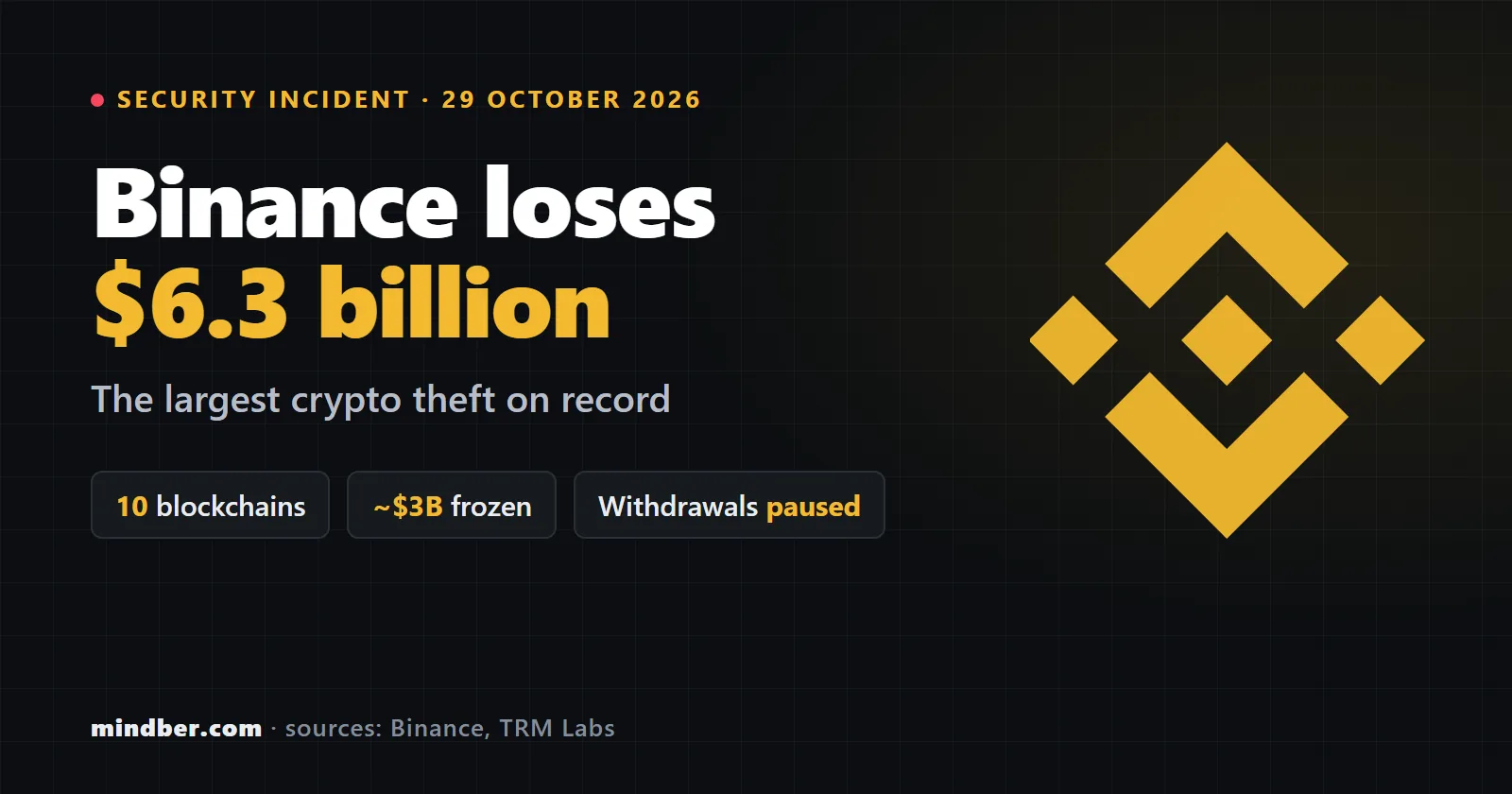
Developing story. Last verified: 30 October 2026, 15:10 UTC. First published at 09:20 UTC. The 15:10 update adds Binance's "additional points of breach", the $6.34 billion it set aside, the 45-hour withdrawal target and the FBI's statement. An earlier version of this update put Binance's post at 08:37 UTC, the time a live blog gave. Binance's own post is stamped 08:47 UTC, so we corrected it. Binance's own posts on X carry the latest word.
By Frankie C. · Senior Market Researcher, Mindber. Tracks 500+ AI/SaaS tools across SEA markets via the Mindber Innovation Index methodology.
How we assessed this: On 30 October 2026 we read Binance's posts on X, TRM Labs' incident report and an on-chain write-up by drk. News coverage came from NBC News, AFP, CoinDesk, TechCrunch and Cointelegraph's live blog. At 09:19 UTC we queried the Ethereum chain through a public node to check the hot wallet and the contract the attack used. Everything else comes from the sources linked below. Where they disagree, the article gives each figure with its source. The Binance logo on the cover comes from Wikimedia Commons (public domain), and the mark belongs to Binance.
If you keep crypto on Binance, you can deposit and trade right now, but you cannot withdraw. The exchange stopped withdrawals after attackers pulled about $6.3 billion out of its hot wallets on Thursday, 29 October 2026, the largest crypto theft on record. Binance says it will cover every loss, and by 10:55 UTC on Friday it had set aside more than $6.34 billion of company funds to do it. At 08:47 UTC it said withdrawals were on track to resume in 45 hours, after "a security revamp of the withdrawal service and its related addresses". That points to early Sunday, 1 November, UTC.
Our read, as of Friday afternoon UTC: for most Binance customers the near-term risk is delay, not loss. Binance made its pledge in public and put a number on it, stablecoin issuers froze close to half the money within hours, and deposits have reopened. That view changes if withdrawals slip far past Sunday, or if the root-cause report shows that the system signing Binance's withdrawals is still exposed.
What to do if your money is on Binance
Five points, in the order they matter this week.
- Leave the balance alone until withdrawals reopen. Your account balance is a claim on Binance, and Binance has said in public that it will pay all losses. Selling bitcoin for USDT inside Binance moves nothing off the exchange, so it protects you from nothing here. Changpeng Zhao, Binance's founder and largest shareholder, wrote: "As a shareholder, I expect all user funds will be fully covered."
- Ignore refund and recovery offers. On Thursday Binance told users to "remain cautious of scams" and not to trust unofficial links. It says updates will come only through its official channels. A message offering a refund, a recovery service or a faster withdrawal is a scam. Nobody needs your password, your 2FA code or a fee to release a withdrawal.
- Decide now what you will move when withdrawals return. Expect a queue in the first hours. Our view: coins you plan to hold for months belong in a wallet you control, and an exchange should hold what you trade. While you wait, turn on Binance's withdrawal address whitelist, so coins can only leave for addresses you saved in advance.
- Binance TH and Binance.US are separate companies. Binance TH, the Thai exchange run by Gulf Binance, paused crypto deposits and withdrawals on Friday as a precaution. Trading there continues, and it says its cold wallets are kept apart from Binance's and that it is a separate legal entity. Thailand's SEC had made no public statement by the time The Thaiger reported the pause. Binance.US said on Thursday that it was not affected.
- If you run a trading venue or a payments business, screen incoming deposits. TRM Labs has labeled the attacker's addresses. It expects coins from the bitcoin wallets and the ether consolidation wallets to reach exchanges, swap services and OTC brokers in the coming days.
How $6.3 billion left in 36 hours
The theft was planned. TRM Labs traced the attacker's operator wallet back to three small withdrawals from Tornado Cash, the Ethereum mixing service, on the morning of 28 October. Early the next day the operator deployed a first version of the attack code and tried it on two wallets. Later it rehearsed the final version on a third and routed the test funds back to itself. About four hours after that rehearsal, the same code went live against a Binance hot wallet.
A hot wallet is the internet-connected wallet an exchange keeps online to pay out customer withdrawals as they come in, and Binance runs them on many chains at once. The striking part of the timeline is how many of them paid the attacker within the same half hour.
From the first test to the withdrawal target
- 1
28 October: the operator wallet is funded
Three small withdrawals from Tornado Cash pay for the operator's transactions. - 2
29 October, before the theft: rehearsals
The attack code is deployed and tried on two wallets, then the final version is rehearsed on a third. - 3
20:05 UTC: XRP Ledger
Five Binance wallets send 233.46 million XRP to one attacker address in four minutes, leaving each with only its minimum balance. - 4
20:10 to 20:22 UTC: Solana, Optimism, Bitcoin and Tron
Solana and Optimism wallets are drained first. A Binance bitcoin hot wallet sends 18,270 BTC at 20:20, and within two minutes a Tron hot wallet sends 612.7 million USDT and 46.4 million TRX. - 5
20:20 UTC: Ethereum
One transaction carries 50 authorizations signed by a Binance hot wallet. Three minutes and 24 seconds later the wallet's whole balance leaves. - 6
21:01 and 21:04 UTC: the first freezes
Tether freezes 971.1 million USDT in the main receiving wallet. Circle freezes the USDC three minutes later. - 7
23:05 UTC: a second wave
Binance wallets on Avalanche and Polygon are drained. - 8
30 October, 00:07 to 10:55 UTC: Binance responds
Deposits and withdrawals are suspended and the verified frozen total reaches about $3 billion. Deposits reopen, Binance targets withdrawals in 45 hours and sets aside $6.34 billion.
How a Binance hot wallet handed itself over on Ethereum
Normally an exchange hot wallet on Ethereum is an ordinary account controlled by one private key. Binance's withdrawal system signs each customer payout with that key, and every transaction moves a counter called the nonce up by one. The account holds no code. It sends what its key signs, and nothing else.
EIP-7702, added to Ethereum in the Pectra upgrade of May 2025, changed that. An ordinary account can now sign an authorization that points it at a smart contract. From then on, calls to the account run that contract's code, until the account signs a new authorization. The proposal was written for batched transactions and sponsored fees. Used by an attacker, it turns a wallet into a remote-controlled one.
The catch for the attacker is the nonce. An authorization works only at the nonce the account has reached when it executes, and a busy hot wallet moves its nonce with every withdrawal. So the attacker came with 50 signatures from the hot wallet Etherscan labels Binance 14, covering nonces 18,914,775 to 18,914,824. The batch landed at 20:20 UTC in one transaction. One of the 50 matched the live nonce. From that moment Binance 14 ran a sweeper contract that took orders from a single address: the attacker's.
Three minutes and 24 seconds later the operator told the wallet to send everything to an attacker address. That one call moved 167,464 ETH and 63 tokens, 1.615 billion USDT among them. The delegation stayed in place, so Binance's own systems kept topping up a wallet the attacker now steered, and TRM counts six more sweeps, the last at 23:56 UTC. Binance 14 also acted as the operator of a separate Binance smart-contract wallet. The attacker used that link to pull 823 million USDC out of it, which Circle froze shortly afterward.
We checked both ends on the chain at 09:19 UTC on 30 October, through a public Ethereum node. Binance 14 now returns empty code, so the delegation is gone. The drk write-up puts the revocation by 01:54 UTC. The sweeper contract is still deployed. Its bytecode has the operator's address, 0x7C8601d4…2e6B5CA0, written into it, along with the function selector 0x043ff9d2 that drk traced in the USDC drain. Anyone can run the same check on an address they care about:
check-7702-delegation.sh
# Ask a public Ethereum node for the code stored at an address (Binance 14 here)
curl -s https://ethereum-rpc.publicnode.com -H 'content-type: application/json' --data '{"jsonrpc":"2.0","id":1,"method":"eth_getCode","params":["0x28C6c06298d514Db089934071355E5743bf21d60","latest"]}'

# Our result at 09:19 UTC on 30 October, after Binance revoked the delegation:
# {"jsonrpc":"2.0","id":1,"result":"0x"}
A plain wallet returns 0x. A delegated one returns 0xef0100 followed by the 20-byte address of the contract it points to, which is how EIP-7702 marks a delegation. TRM's advice for treasury teams builds on that check:
- Alert the moment code appears at a wallet that should have none.
- Refuse any 7702 authorization nobody planned, and treat a request to sign many authorizations across a run of nonces as a sign of compromise.
- Keep a tested, pre-approved way to sign a revocation.
- Separate signing systems and approval paths by chain and wallet tier.
Laptop, keys or signing system: what is confirmed
Three accounts of the cause are going around, and they conflict less than they seem to.
Binance's account, preliminary. Around 02:25 UTC on Friday, Binance said its first findings pointed to a compromised laptop belonging to a DevOps engineer. That laptop gave the attacker access to a service container, which was used to submit unauthorized withdrawals. Binance said it found no evidence that any wallet private key had leaked. By 04:36 UTC its wording had widened: the incident "stems from multiple factors", and the compromised computer "may be the entry point". Co-CEO Richard Teng added at 07:37 UTC that it was "a more complex attack process" than a single click, and that the investigation "has not attributed responsibility to any individual".
At 08:47 UTC Binance went further. Its later investigation had "uncovered additional points of breach" beyond the laptop, it said on X. It has not said what they are.
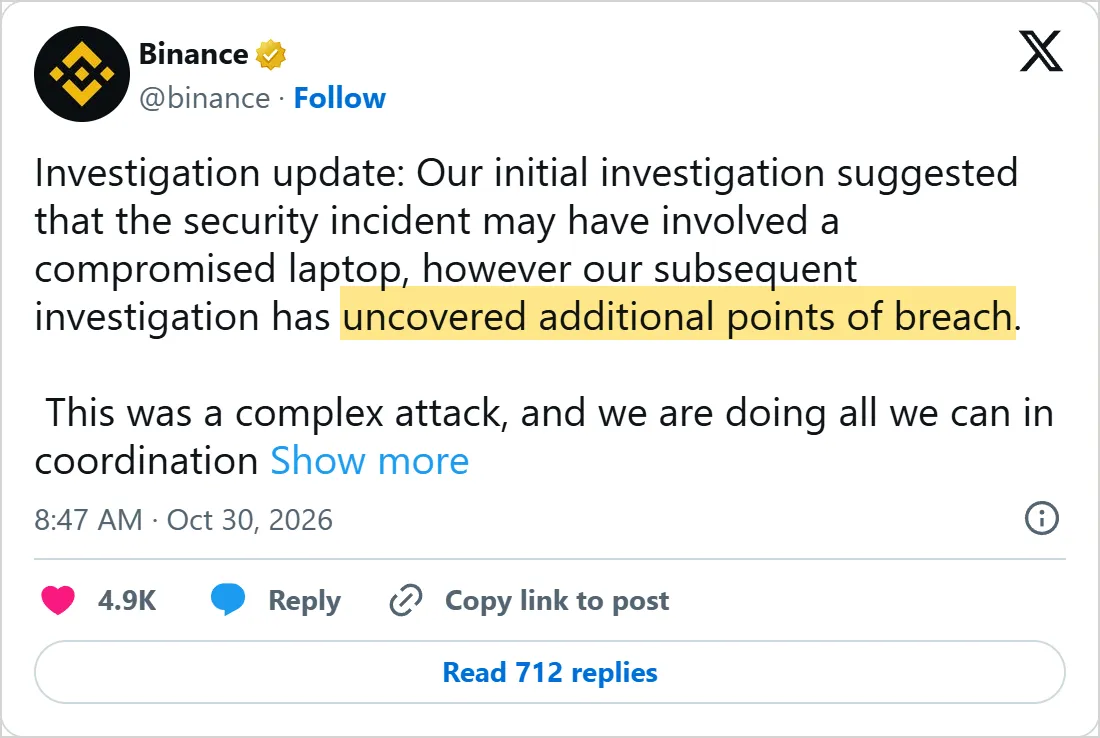
Posted 30 October 2026 at 08:47 UTC, times shown in UTC. The embed cuts the post after its first lines, and its announcement image is hidden. Source: x.com/binance/status/2116089661408108712
TRM Labs' assessment, an outside analysis. The Ethereum delegation looked at first like a phished signature. TRM says that cannot explain the other nine chains. There, Binance wallets on the XRP Ledger, Bitcoin, Tron, Solana, Arbitrum, Avalanche, Optimism and Base sent funds through ordinary signed transfers, with no delegation at all. A second Ethereum hot wallet did the same with 28,006 ETH. Those wallets use different chains, key types and signing schemes. Yet all of them produced valid signatures for the attacker within about half an hour.
TRM's conclusion is that the attacker most likely gained the ability to make Binance's hot-wallet signing system sign transactions of its choosing. It reads the batch of pre-signed authorizations as a hint that the access was limited in time, or that signatures had to be requested through a system.
Blockaid's early read. Its chief executive, Ido Ben-Natan, called it "key misuse" involving signing infrastructure and said: "We don't think a key was leaked".
These accounts fit together. A key never had to leave Binance for this to happen. If an attacker can get the system that holds the keys to sign for them, "no private key leak" is true and still not reassuring. That is our reading, and it is why we care more about the root-cause report than the final loss figure. Binance has promised a detailed report once its investigation ends. Until then, nobody outside the company can say how one compromised computer led to valid signatures on ten chains.
What was taken, chain by chain
Ethereum carried about 60% of the theft by value: roughly $3.79 billion of TRM's total, made up of 200,630 ETH and 185 other tokens. Stablecoins were a big share. Across Ethereum and Tron the attacker took about 2.49 billion USDT, plus the USDC and 88.5 million RLUSD. That is around $3.4 billion in coins whose issuers can freeze them.
That mix explains how so much was frozen so fast. Bitcoin, ether, XRP and SOL have no issuer, and they make up most of what is still loose.
US dollars in billions, at each asset's price when it was taken
Ethereum
$3.79B
Bitcoin
$1.47B
Tron
$0.63B
XRP Ledger
$0.3B
Solana
$0.1B
Arbitrum/OP/Base
$0.04B
Avalanche
$0.03B
Polygon
$0.01B
$0B$1B$2B$3B$4B
Source: TRM Labs incident report, on-chain data as of 30 October 2026, 00:30 UTC, Oct 30, 2026
The bitcoin left in one burst at 20:20 UTC. CoinDesk followed it: 11 transactions moved just over 18,270 BTC to one address, all confirmed in block 973,732, and the coins were split at once into 19 wallets. Seventeen hold exactly 1,000 BTC each. One holds 832.5 and the last 437.7. None had moved as of 04:23 UTC on Friday. Strangers had sent only dust. Each transfer looked like an ordinary Binance withdrawal and carried a valid signature from Binance-controlled addresses.
How $3 billion got frozen, and why that is not the same as recovered
Within an hour of the main Ethereum sweep, stablecoin issuers were blacklisting addresses. Tether's chief executive, Paolo Ardoino, announced the company's freeze on X at 21:25 UTC. His figure then was more than 1.567 billion USDT, below TRM's later count.
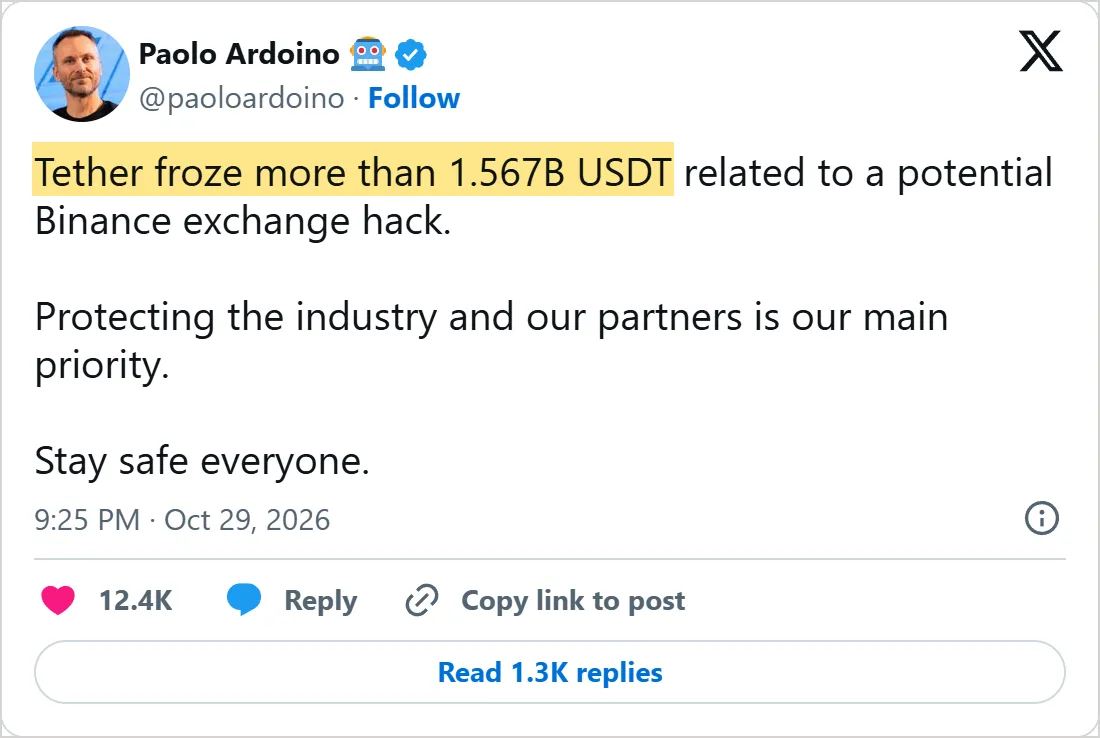
Posted 29 October 2026 at 21:25 UTC, times shown in UTC. Source: x.com/paoloardoino/status/2115918000373346709
Binance reported $2.54 billion verified as frozen at 23:35 UTC and about $3 billion at 00:52 UTC. TRM's own count at 00:30 UTC was about $2.7 billion, split like this:
| Who froze it | What | First freeze (UTC) |
|---|---|---|
| Tether | about 1.77 billion USDT on Ethereum, Tron, Avalanche and Polygon | 21:01, 29 October |
| Circle | about 825 million USDC | 21:04, 29 October |
| Ripple | 40.5 million RLUSD, plus RLUSD in the compromised hot wallet | 22:01, 29 October |
| World Liberty Financial | 27.8 million USD1 | 22:10, 29 October |
| Arbitrum Security Council | 8,426 ETH and 74.6 million ARB, about $30 million | 00:08, 30 October |
| First Digital | FDUSD, amount not disclosed | before 02:21, 30 October |
Binance co-CEO Yi He credited Ripple with stopping about $200 million from moving. TRM could confirm 40.5 million RLUSD frozen on the chain, and the difference is still unexplained.
A freeze stops coins from moving. It does not send them back. Getting frozen USDT or USDC back to Binance is a separate step. It runs through the issuer and, in Circle's case, the law enforcement agencies it says it is working with. So the frozen total is best read as money the attacker can no longer spend. It is not money back in Binance's hands.
The attacker moved fast against the freezes. TRM saw about 325 million USDT sold through UniswapX and other intent-based contracts to market makers and solvers, for about 122,300 ETH. That works out to roughly $2,650 per ether while the market sat near $2,300 to $2,350. The attacker gave up more than 10% to turn freezable dollars into ether nobody can freeze.
Another wallet put 60 million USDT into Aave and borrowed about 19,760 ETH against it, before Aave froze the affected markets. Aave lifted that freeze at 13:57 UTC on Friday and said its contracts were not affected. On Tron, 300 million USDT went into the JustLend lending protocol. The RLUSD was sold on decentralized exchanges for 19 minutes until Ripple froze the rest.
What remains is the hard part. Bitcoin and ether can be stopped only when they touch a business that screens deposits: an exchange, an OTC desk or a swap service. When the same group robbed Bybit, it took about 10 days to convert the stolen ether into bitcoin, CoinDesk notes. That makes the next week or two the window in which screening at those choke points can still catch the coins.
Who TraderTraitor is, and how sure anyone is
No government has named the attacker. On Friday the FBI said it was "aware of the incident" and working with public and private partners on investigative steps, CNN reported. The attribution so far comes from private firms, at different levels of confidence:
- TRM Labs: high confidence that TraderTraitor did it, based on on-chain and off-chain intelligence. It sees the playbook of the Bybit theft and the KelpDAO hack of April 2026: small Tornado Cash withdrawals to fund an operator wallet and staging well before the theft. The signatures were gathered in advance, then used in one burst.
- Chainalysis: likely, then high confidence. Chief executive Jonathan Levin said TraderTraitor was likely responsible, citing links to a previous hack. Later a spokesperson told CNN the firm had "high confidence" that North Korea was behind it.
- Blockaid: a resemblance. Ben-Natan said the attack resembled North Korean operations.
- ZachXBT, the on-chain investigator, said funds from this attack and from Bitget's hack of about $388 million had been mixed together at one address. He wrote: "This indicates the same actor is likely behind both incidents". Bitget's chief executive and the tracing firms Elliptic and Chainalysis had already tied that hack to North Korea, Decrypt reported.
- Binance has not named anyone.
ZachXBT's link rests on one shared address. That points to one actor without proving it.
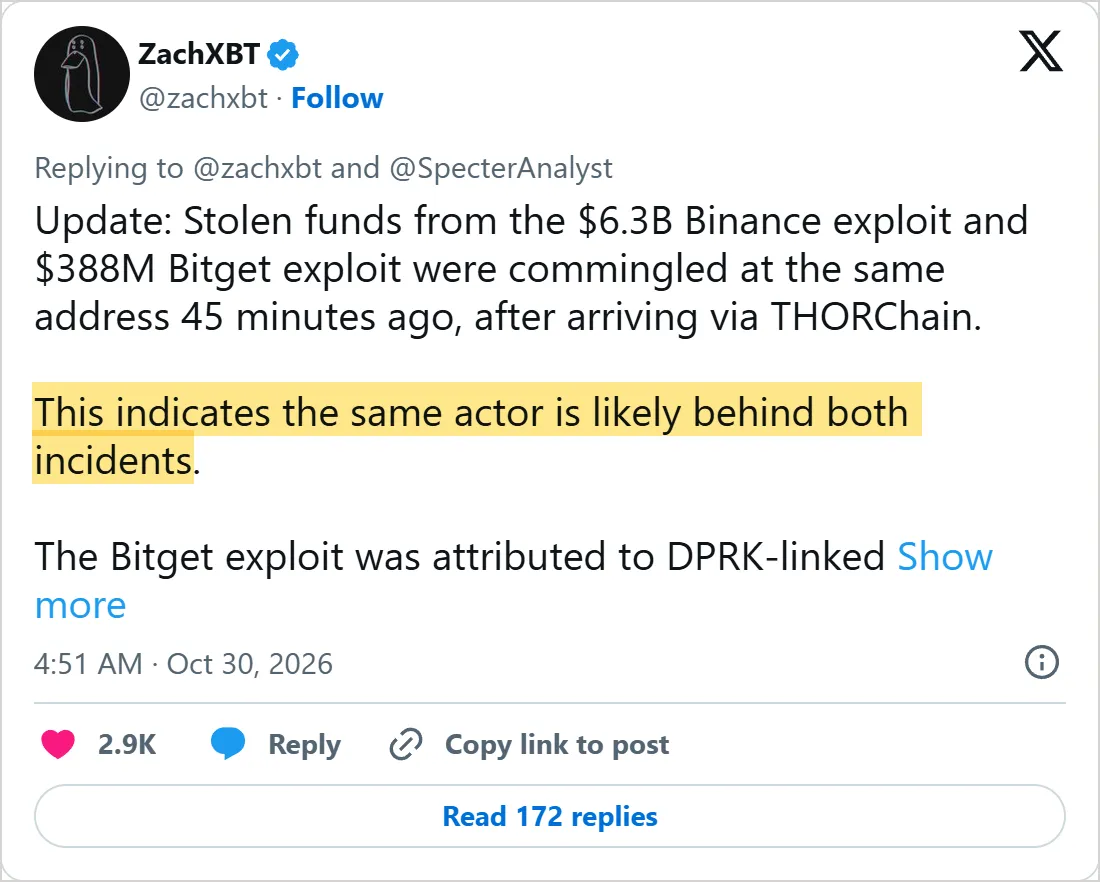
Posted 30 October 2026 at 04:51 UTC, times shown in UTC. The embed cuts the post: its full text names the shared address and links his thread on the Bitget exploit. Source: x.com/zachxbt/status/2116030284261179538
TraderTraitor is a North Korean state hacking unit, also tracked as Jade Sleet, UNC4899 and Slow Pisces, and widely placed within the Lazarus Group. The FBI has named it in official statements twice. The first was the $1.5 billion Bybit theft in February 2025, the second the roughly $308 million taken from Japan's DMM Bitcoin in May 2024. Those make up the official record. This attack is not on it yet.
The largest crypto theft on record, by a wide margin
TRM's figure is about four times the Bybit theft, the previous record. Even after the freezes, TRM notes, what the attacker still holds is more than any earlier theft took in total.
Value when taken. Binance 2026 is TRM Labs' count; the others are the amounts reported at the time.
Binance 2026
$6.36B
Bybit 2025
$1.5B
Ronin 2022
$0.62B
BNB bridge 2022
$0.57B
DMM Bitcoin 2024
$0.31B
Binance 2019
$0.04B
$0B$1.75B$3.5B$5.25B$7B
Binance has been robbed twice before, at a much smaller scale. In May 2019 hackers took 7,000 BTC, about $40 million at the time, from a hot wallet in a single transaction. In October 2022 an attacker exploited the BNB Chain cross-chain bridge and minted 2 million BNB, worth about $570 million. Most of that never left the chain, because validators halted the network, and Binance estimated $70 million to $80 million was taken off it.
Four of the six thefts in the chart are tied to North Korea. The FBI named it for Ronin, Bybit and DMM Bitcoin. For this one, so far, the attribution comes only from private firms.
What it did to prices
Prices fell on the news, then won back part of the drop within hours. At 01:19 UTC on Friday, Cointelegraph's live blog had bitcoin near $76,937, down 4.9% in 24 hours. Ether was down 5.7% at about $2,211, and BNB, Binance's own token, was down 8% at about $693. DeFi tokens fell harder, AAVE by 11.3% and UNI by 10.7%, and the Crypto Fear & Greed Index dropped to 30, its lowest reading since August.
By about 04:00 UTC, AFP reported bitcoin and ether down only 0.8%, and BNB up 2.7% after a fall of nearly 10%.
Two large market makers disclosed exposure to Binance, GSR below 5% of its net equity and Wintermute below 20%, and both said they expected no major disruption to their business. Standard Chartered's Geoffrey Kendrick suggested the hack could push trading toward decentralized exchanges such as Uniswap.
Can Binance pay for it?
On its own numbers, yes. At 10:55 UTC on Friday Binance said it had set aside more than $6.34 billion of company funds. Of that, $5 billion is already held in the same tokens that were stolen, Cointelegraph's live blog reported. Co-CEO Yi He said Binance is buying the rest through OTC deals and exchanges, ahead of an updated proof of reserves. A spokesperson said the $5 billion sits in Binance's custody and that Binance reports weekly to Abu Dhabi's regulator. It withheld the wallet addresses for security reasons.
That leaves SAFU, the Secure Asset Fund for Users, as a backstop rather than the main source. Binance set up the emergency reserve in 2018. It finished moving it from stablecoins into bitcoin in February 2026: 15,000 BTC, worth about $1 billion at the time, The Block reported. At about $77,700 per bitcoin, CoinDesk's price early on Friday, that is roughly $1.17 billion, less than a fifth of the loss.
The check comes later. Until Binance publishes the updated proof of reserves it has promised after remediation, the $5 billion is Binance's statement, and outsiders cannot match it to wallets on the chain.
What we don't know yet
- The root cause. The report should name the additional breach points, show whether the attacker's route into Binance's signing system is closed, and say whether other wallets were in reach.
- The final loss. Chainalysis first put it at $5.912 billion at the time of the theft, below the figures from Binance and TRM. Levin later cited $6.4 billion.
- How much of the frozen money comes back, and how fast.
- Whether withdrawals reopen on schedule.
- Official attribution. The FBI is engaged but has named no one.
More from Mindber
- Our October 2026 security roundup ranks a week of web-stack fixes by urgency, with PHP2Shell first.
- The PHP2Shell guide has the commands to check and patch a PHP server.
- Claude Fable 5 suspended covers why Anthropic kept its cyber-capable model for vetted defenders.
- NemoClaw looks at NVIDIA's open-source security controls for AI agents that act on your machines.
- The ASEAN AI compliance guide sets out breach-notification rules in Malaysia, Singapore and the Philippines.
- Our AI agent procurement guide lists the security and breach questions to ask a vendor that holds your data.
- Is AI safe? explains the main risks of AI tools in plain terms.
- AI coding agents, Claude Code among them, can read a deployment or key-access config and point out who is able to sign what. Give them read-only access.
- Tools for traders sit under AI investing and AI for finance.
- Follow-ups land on the news desk and in What's new. Rankings, discover and our methodology cover the AI tools we track.
Frequently asked questions
Is it safe to keep crypto on Binance after the hack?
Binance says customer balances are safe and that it will cover every loss, and deposits work again. What nobody outside Binance can judge yet is whether the signing system the attacker reached is now closed off. Until the root-cause report is out, we would keep on any exchange only what you plan to trade.
When exactly could Binance withdrawals come back?
Binance said at 08:47 UTC on 30 October that withdrawals were on track to resume in 45 hours, which points to about 05:47 UTC on Sunday, 1 November. Its 04:36 UTC post had said 48 hours, which lands at almost the same time. Yi He said they would come back gradually. Treat the time as a target.
Did the hackers take customer accounts or personal data?
Nothing Binance has published says so. Its statements describe unauthorized withdrawals from its own hot wallets, and it says user funds are safe. If accounts or data were touched, the root-cause report is where that would show up.
How can Tether and Circle freeze stolen coins when nobody can freeze bitcoin?
USDT and USDC are tokens issued by companies, and their smart contracts let the issuer blacklist an address so its balance can no longer move. Bitcoin and ether have no issuer and no such switch. Stolen bitcoin can be stopped only when it reaches a business that screens deposits, such as an exchange or an OTC desk.
Is this the same group that hacked Bybit?
TRM Labs says yes, with high confidence, and the FBI named TraderTraitor for Bybit in February 2025. The laundering looks different so far. Bybit's stolen funds moved mostly through cross-chain bridges, while this attacker has sold stablecoins to market makers and borrowed against them on lending protocols.
Sources & methodology
Editorial analysis of Binance's statements, TRM Labs' incident report and news coverage, read on 30 October 2026, plus our own read of the Ethereum chain at 09:19 UTC. Loss and freeze figures were still moving when we published. Follow each link for the current position.
- [1]Deposits normal; withdrawals paused for a security revamp, expected to resume within 48 hours; incident stems from multiple factors; compromised computer may be the entry pointBinance on X, 04:36 UTC · 2026-10-30https://x.com/binance/status/2116026356740034858
- [2]$6.36B total on ten chains, timeline, EIP-7702 mechanism, per-chain amounts, freezes, laundering, TraderTraitor attribution, signing-system assessment, recommendationshttps://www.trmlabs.com/resources/blog/north-korea-steals-usd-6-36-billion-from-binance-in-the-largest-hack-in-history
- [3]Nonce range, delegate contract, operator address, function selector, revocation by 01:54 UTChttps://drk.vc/news/binance-14-eip-7702-drain
- [4]Delegation designator 0xef0100 followed by the contract address; purpose of the proposalEIP-7702 specification · 2026-10-30https://eips.ethereum.org/EIPS/eip-7702
- [5]$6.3B estimate, laptop and service container, cover all losses, Zhao quote, Tether and Circle freezesNBC News · 2026-10-29https://www.nbcnews.com/business/markets/binance-hack-tether-circle-stablecoins-rcna606445
- [6]No private key leak, DOJ and FBI no immediate comment, prices at 04:00 GMTAFP via Yahoo Finance · 2026-10-30https://finance.yahoo.com/markets/crypto/articles/crypto-platform-binance-confirms-major-013059975.html
- [7]Teng, Levin, Ben-Natan and ZachXBT statements; freeze totals at 23:35 and 00:52 UTC; market moves at 01:19 UTC; market maker exposureCointelegraph live updates · 2026-10-30https://cointelegraph.com/news/live-updates-binance-63b-hack-linked-to-north-koreas-tradertraitor
- [8]18,270 BTC split into 19 wallets, block 973,732, no movement as of 04:23 UTC, Bybit conversion took about 10 daysCoinDesk · 2026-10-30https://www.coindesk.com/markets/2026/10/30/binance-hacker-splits-usd1-4-billion-of-bitcoin-into-19-wallets-that-no-one-can-freeze
- [9]Binance warning on scams and unofficial links; withdrawals suspended on multiple networksTechCrunch · 2026-10-29https://techcrunch.com/2026/10/29/binance-pauses-withdrawals-as-hackers-suspected-of-stealing-billions-in-crypto/
- [10]Binance TH pauses crypto deposits and withdrawals; separate cold wallets; Thai SEC silentThe Thaiger · 2026-10-30https://thethaiger.com/news/business/binance-th-pauses-crypto-transfers-after-hack
- [11]Binance.US not affectedCryptonews: Binance security incident timeline · 2026-10-29https://cryptonews.net/news/security/33674161/
- [12]SAFU holds 15,000 BTC after conversion; top-up rule below $800 millionThe Block · 2026-02-12https://www.theblock.co/post/389567/binance-finalizes-1-billion-safu-reserve-conversion-into-bitcoin
- [13]FBI attributes the $1.5B Bybit theft to TraderTraitorFBI public service announcement · 2025-02-26https://www.ic3.gov/PSA/2025/PSA250226
- [14]FBI links the $308M DMM Bitcoin theft to TraderTraitorBleepingComputer · 2024-12-24https://www.bleepingcomputer.com/news/security/fbi-links-north-korean-hackers-to-308-million-crypto-heist/
- [15]FBI attributes the $620M Ronin theft to Lazarus Group and APT38BleepingComputer · 2022-04-14https://www.bleepingcomputer.com/news/security/fbi-links-largest-crypto-hack-ever-to-north-korean-hackers/
- [16]BNB Chain bridge exploit, 2 million BNB, $70M to $80M taken off-chainDecrypt · 2022-10-07https://decrypt.co/111433/binance-smart-chain-hack
- [17]Binance 2019 hot wallet theft of 7,000 BTCFinextra · 2019-05-08https://www.finextra.com/newsarticle/33786/hackers-breach-binance-to-steal-40-million-of-bitcoin-in-a-single-transaction
- [18]Additional points of breach beyond the laptop; on track to resume withdrawals in 45 hours; cover all losses from SAFU and company funds; around $3 billion frozenBinance on X, 08:47 UTC · 2026-10-30https://x.com/binance/status/2116089661408108712
- [19]Teng: not one engineer's permissionsThe Next Web · 2026-10-30https://thenextweb.com/news/binance-hack-6-3bn-north-korea-tradertraitor
- [20]$6.34B of company funds set aside, $5B held in matching tokens, buying the rest, weekly reporting to Abu Dhabi's regulator; withdrawals in 45 hours; Aave lifts its freeze at 13:57 UTCCointelegraph live updates (TradingView) · 2026-10-30https://www.tradingview.com/news/cointelegraph:3a8f5c45b094b:0-live-updates-binance-uncovers-more-breach-points-in-6-3b-hack/
- [21]FBI aware of the incident and engaged; Chainalysis high confidence North KoreaCNN · 2026-10-30https://edition.cnn.com/2026/10/30/tech/binance-crypto-heist-hnk-intl
- [22]Tether froze more than 1.567B USDT, posted 21:25 UTC on 29 OctoberPaolo Ardoino (@paoloardoino) on X · 2026-10-29https://x.com/paoloardoino/status/2115918000373346709
- [23]Binance and Bitget exploit funds commingled at one address; same actor likely; posted 04:51 UTC on 30 OctoberZachXBT (@zachxbt) on X · 2026-10-30https://x.com/zachxbt/status/2116030284261179538
- [24]Bitget's $387M hack tied to North Korea by Bitget's CEO, Elliptic and ChainalysisDecrypt · 2026-10-05https://decrypt.co/380092/zachxbt-fronted-350k-pose-client-lazarus-chinese-crypto-launderers
Keep reading
October 2026 Security Roundup: Updates Across PHP, Node.js, NGINX, Go and GitLab
A week of web-stack security fixes, ranked by what to patch first.
Claude Fable 5 suspended
Why Anthropic held back its cyber-capable model for vetted defenders.
ASEAN AI Compliance Guide 2026
Breach notification and data rules SaaS teams in the region need to know.
Learn the basics on Mindber
New to AI? These free Mindber pages explain the ideas behind articles like this one.
Share this article
Legal notice
This publication constitutes editorial commentary on publicly available information and does not constitute financial, legal, investment, or professional advice. Product names, trademarks, and registered trademarks referenced herein are the property of their respective owners; their appearance does not imply endorsement or affiliation. Mindber's analysis reflects editorial judgment based on public signals and is subject to change without notice. Scores are not buy, sell, or hold recommendations. No commercial relationship exists between Mindber and the vendors evaluated unless separately disclosed in writing. This publication is governed by the laws of Malaysia. Any dispute arising from or in connection with this publication shall be submitted to the exclusive jurisdiction of the courts of Malaysia.