
ChatGPT Images 2.6: GIFs in Chat, Pricier Drafts in the API
newsUpdated 15 min read
ChatGPT Images 2.6 adds GIFs and saved reference images. In the API, a low-quality image now uses four times the tokens of 2.5. What changed and what to use.
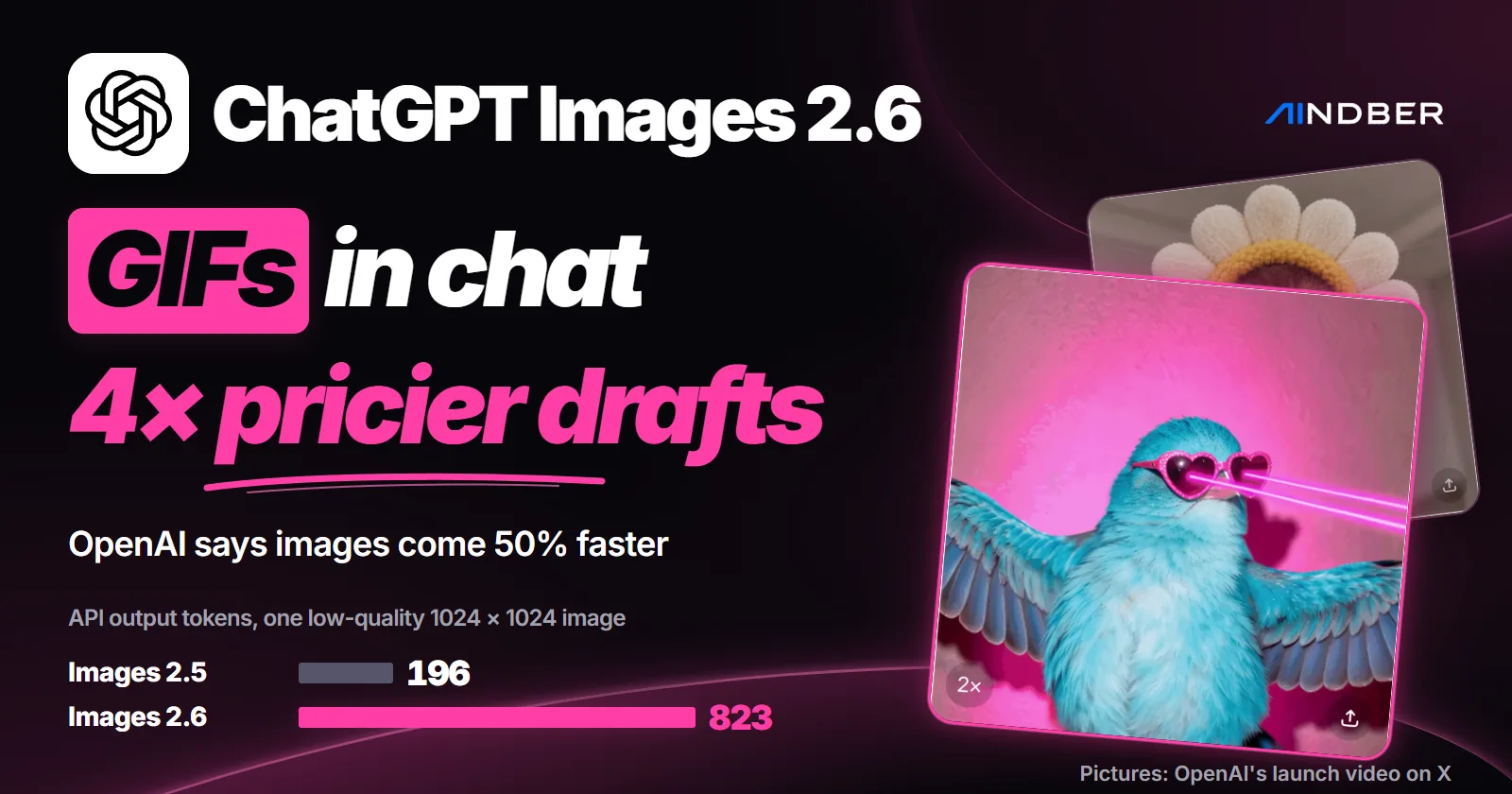
Last verified: 6 November 2026, 12:10 UTC. The token counts and prices come from OpenAI's API pricing page and the cost calculator in its image generation guide, read at that time. Arena's scores for the 2.6 models are marked preliminary and move as votes arrive. We will update this post when OpenAI publishes plan limits for GIFs and saved reference images.
By Frankie C. · Senior Market Researcher, Mindber. Tracks 500+ AI/SaaS tools across SEA markets via the Mindber Innovation Index methodology.
How we assessed this: On 6 November 2026 we read OpenAI's launch post on X, its developer forum announcement, the two GPT Image 2.6 model pages, the API pricing page and the image generation guide. We also read the guide's cost calculator for every model, quality setting and size it offers. OpenAI's announcement page would not load in our reader, so its wording here comes from the post on X, the forum announcement and the reports that quote it. We read the Hacker News discussion and Arena's text-to-image leaderboard the same day. We did not generate images or GIFs with Images 2.6 for this article, and we spoke to no one at OpenAI. The cover shows two frames from OpenAI's launch video, and the OpenAI mark on it comes from Lobe Icons and belongs to OpenAI.
ChatGPT can now make animated GIFs. OpenAI released Images 2.6 on 4 November. You turn a prompt or a photo into a short loop, change its speed and edit single frames, and you can save pictures of yourself, a pet or a character to reuse later. OpenAI says the update reaches every ChatGPT plan, Free included, on web, desktop and mobile, and that it makes images 50% faster.
If you only use ChatGPT, there is nothing to decide. The new model replaces the old one in the same chat box, and OpenAI has announced no new charge for it. Developers have a real choice. The two API models, GPT Image 2.6 Flare and Sunburst, keep 2.5's price per token, yet OpenAI's own calculator shows a low-quality square image now uses 823 output tokens where 2.5 used 196.
We would keep GPT Image 2.5 for cheap drafts for now and try 2.6 wherever you already pay for high quality. At that setting the two versions use the same number of tokens, so the speed costs nothing extra. Early votes support the caution: on Arena's text-to-image board, each 2.6 model sits just below its 2.5 version, on scores Arena still calls preliminary.
What to do with Images 2.6 this week
In ChatGPT, ask for a GIF in plain words: OpenAI's demo simply asked for a dancing cat GIF. The answer plays as a loop with a speed button, and you can step through the frames and change one. You can also start from a photo you upload. On launch day the rollout was uneven. Decrypt tried it and got a set of frames rather than an animation. Stills in your reply mean the feature has not reached your account yet.
One Hacker News user found a catch when sharing from a phone: the share button creates a chatgpt.com link that shows a still image, not the animation. Saving the GIF to your photos and sending the file is the way around it.
Developers should decide by the quality setting they use today. OpenAI bills GPT Image models by the token, and the token count of each image is what changed:
| Quality setting | Cost of one 2.6 image against 2.5 | What we would call |
|---|---|---|
| low | About 4.2 times as much | gpt-image-2.5-flare, unless a faster draft is worth the money |
| medium | About 3.3 times as much | 2.5, and test 2.6 Sunburst on a sample of your own prompts |
| high | The same | 2.6: OpenAI says it is faster, at no extra cost |
| xhigh and max | The same | 2.6 Sunburst, built for detailed work |
| GIF or SVG output | Only 2.6 offers it | 2.6, the only GPT Image models the guide documents for these formats |
Check the usage field in the first responses you get back, whichever model you call. OpenAI's guide says token use differs by model, quality and size, and the calculator gives estimates for fixed settings, not for auto.
The GIF format works through the same Image API you may already call. A request needs output_format set to gif, and two optional fields set the frame count and how long each frame stays on screen:
make-a-gif.sh
# Request shape from OpenAI's image generation guide. We did not run it for this article.
# 9 frames at 200 ms each are the API's defaults: a 1.8-second loop.
curl https://api.openai.com/v1/images/generations \
-H "Authorization: Bearer $OPENAI_API_KEY" \
-H "Content-Type: application/json" \
-d '{
  "model": "gpt-image-2.6-flare",
  "prompt": "A paper lantern swaying in the wind, ending where it started",
  "output_format": "gif",
  "frame_count": 9,
  "frame_duration_ms": 200,
  "size": "512x512"
}' | jq -r '.data[0].b64_json' | base64 --decode > lantern.gif
To animate from a still you already have, send it to the edits endpoint (/v1/images/edits) with the same three fields. Frame sizes must be multiples of 16, and the guide says to lower the frame count or the size when a request exceeds the model's pixel budget.
Same price per token, three to four times the tokens
OpenAI charges $30 per million image output tokens for both 2.6 models, exactly what it charges for GPT Image 2.5. Its pricing page also lists the same $8 rate for image input and $5 for text input. Read only that page, and 2.6 looks like a free upgrade. The guide's cost calculator tells a different story, because it estimates how many output tokens one image takes.
We read the calculator on 6 November for each model and quality setting. For a 1024 × 1024 image, it gives 2.6 the counts below:
GPT Image 2.5 and 2.6 at the three most used quality settings. The calculator gives Flare and Sunburst the same counts within each version. Read 6 November 2026, 12:04 UTC.
High, Images 2.5
1756 tokens
High, Images 2.6
1756 tokens
Medium, Images 2.6
1449 tokens
Low, Images 2.6
823 tokens
Medium, Images 2.5
439 tokens
Low, Images 2.5
196 tokens
0 tokens450 tokens900 tokens1350 tokens1800 tokens
Source: OpenAI image generation guide, cost calculator, read 6 November 2026, Nov 6, 2026
At $30 per million tokens, those counts work out to about $0.006 for a low-quality 2.5 image and $0.025 for the same setting on 2.6. The gap grows with volume. A batch of 1,000 low-quality square drafts comes to $5.88 on 2.5 and $24.69 on 2.6. At medium quality the same batch costs $13.17 on 2.5 and $43.47 on 2.6. Those totals cover image output only: your prompt's text tokens and any input images are billed on top.
A 2.6 image at low quality now uses more tokens than a 2.5 image at medium. If your app makes thumbnails, previews or variations in bulk at low quality, your image bill could roughly quadruple on the day you switch the model name. At high quality and above, nothing changes, and the full table of counts sits in the reference section at the end of this post.
OpenAI hasn't said why 2.6 spends more tokens at the low end. We found no statement on it in the guide, the model pages or the forum announcement. Arena's leaderboard adds a clue without settling it. It lists both 2.6 models with "(Medium)" after their names, so their scores come from a setting where 2.6 costs about 3.3 times as much as 2.5.
Speed is the other half of the trade. OpenAI says Images 2.6 generates images 50% faster, and its developer forum post says Flare can return an image in as little as six seconds. A Hacker News user posted timings from one workflow on launch night: 12.0 seconds for a 2.5 image at medium, against 6.7 seconds at low, 7.9 at medium and 8.9 at high on 2.6. Those are one person's figures from one setup. On those numbers, 2.6 at high finished faster than 2.5 at medium and used four times the output tokens.
Is 2.6 better than 2.5? Early votes say not yet
Arena ranks image models by blind votes: two images from the same prompt, a person picks the better one, and the scores move like chess ratings. On 6 November, the top of its text-to-image board looked like this:
Blind pairwise votes. The first five are OpenAI GPT Image models, and Arena tested both 2.6 models at medium quality. The 2.6 entries are marked preliminary, with a margin of ±13 points on about 3,000 votes each. Read 6 November 2026.
2.5 Sunburst
1427/1450
2.6 Sunburst
1409/1450
2.5 Flare
1399/1450
2.6 Flare
1384/1450
GPT Image 2
1382/1450
Microsoft MAI-Image-2.6
1331/1450
Google Nano Banana 2.1
1325/1450
036372510881450
Source: Arena text-to-image leaderboard, read 6 November 2026, Nov 6, 2026
GPT-Image-2.6 Sunburst scores 1409 against 1427 for 2.5 Sunburst. That 18-point gap is barely larger than the ±13 margin on the 2.6 score, and 2.5 Sunburst has 54,913 votes behind it against 2,967 for the new model. The order can still change. For now, 2.6 is not a clear step up on the pictures people vote on. OpenAI's five GPT Image models hold the top five places, 51 points clear of Microsoft's model in sixth. Our model arena page mirrors the same board with live scores.
Builders who switched on launch night split along the two models. One of them runs a site that turns prompts into designs, and after an hour with Flare rolled the site back to 2.5:
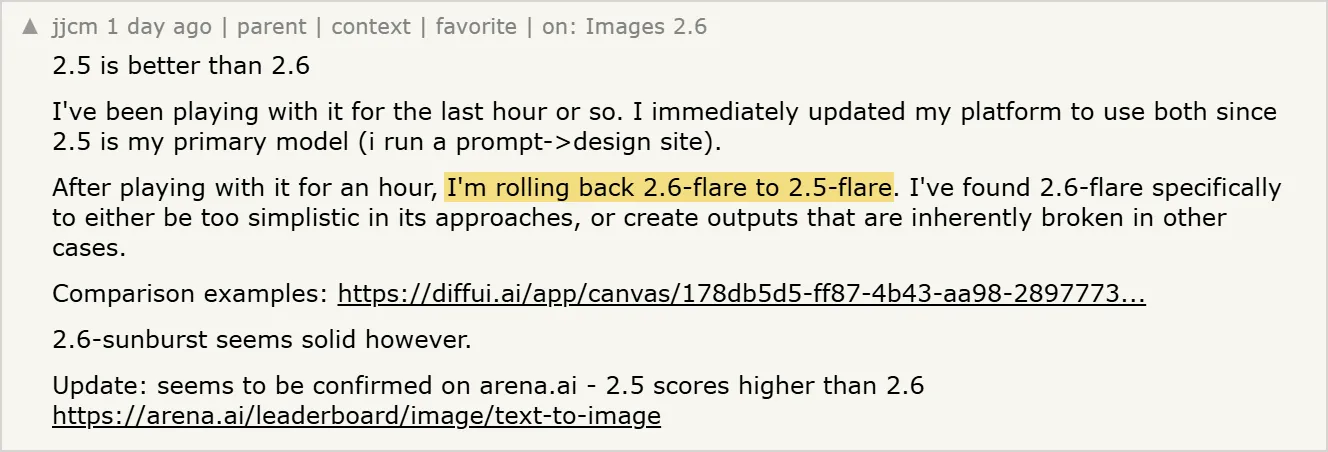
Posted 5 November 2026 at 00:33 UTC, about an hour after the launch post. The update about Arena was added later. Source: news.ycombinator.com/item?id=50373420
The comment found 2.6 Flare "too simplistic" or broken in some outputs, and called 2.6 Sunburst solid. A later reply in the thread linked a post from DesignArena, a benchmark for design work, that may explain part of it:
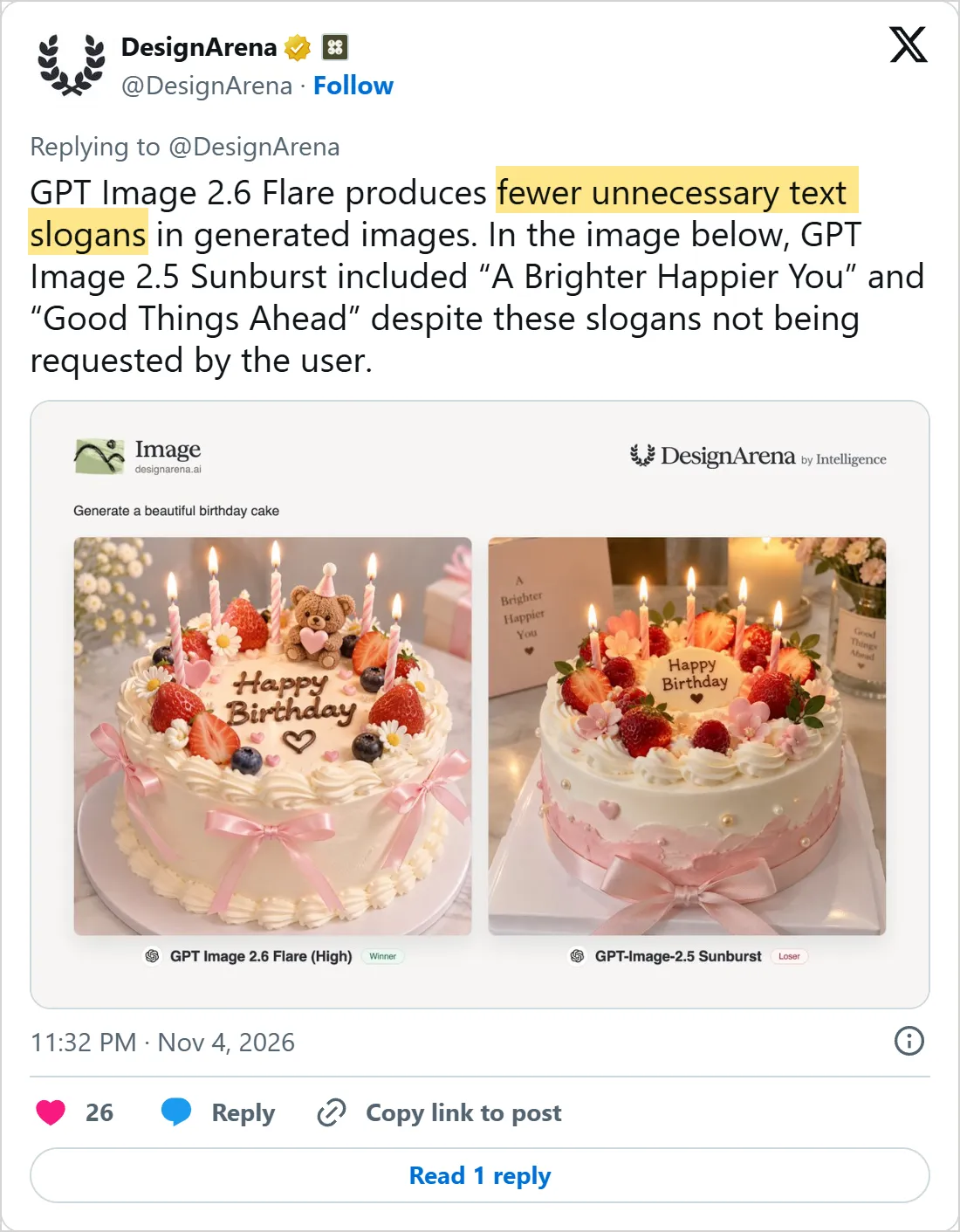
Posted 4 November 2026 at 23:32 UTC, two minutes before OpenAI's launch post. The comparison pits 2.6 Flare at high quality against 2.5 Sunburst on one prompt. Source: x.com/DesignArena/status/2118124381155303918
For a prompt as plain as "Generate a beautiful birthday cake", the older model added two signs nobody asked for. 2.6 left them out. The builder's reading is that 2.6 was trained to put less text in pictures, which would also explain why the site's user-interface mockups came back with less detail. That is the builder's inference, not OpenAI's statement.
It points to a simple test. If your prompts ask for words in the picture, such as a poster, a menu or an app screen, run a sample through both models before you switch. If you have been editing slogans out of product shots, 2.6 may save you that step.
How the GIFs work
OpenAI announced the update on X with a 35-second demo, leading with the two features ChatGPT users will notice first:
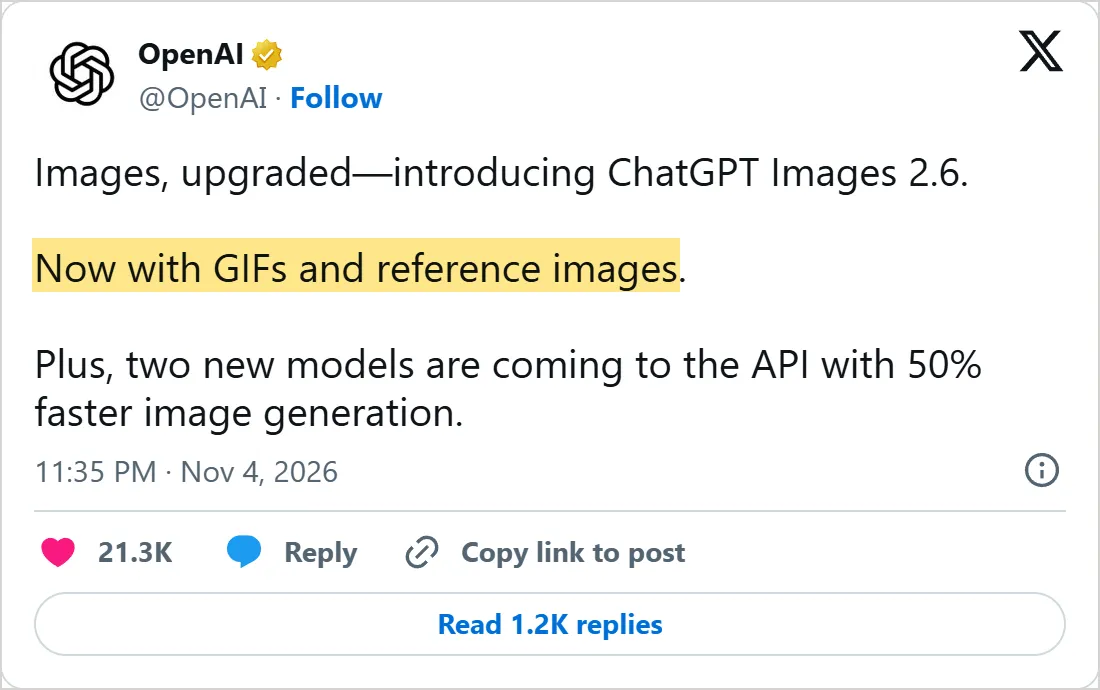
Posted 4 November 2026 at 23:35 UTC. The shot leaves out the post's demo video. It had about 2.94 million views when we read it on 6 November. Source: x.com/OpenAI/status/2118124944928432327
ChatGPT shows the finished loop with a speed control, a frame view for edits and a share button, as in OpenAI's launch video. OpenAI pitches the format at reactions, brand mascots and product visuals, and calls GIFs "a playful way to communicate", in DataNorth's quote of the announcement. It has published no limits on how many GIFs you can make on each plan.
The API guide shows how small these animations are. A request sets between 2 and 16 frames and gives each frame between 20 and 2,000 milliseconds on screen. The defaults, 9 frames at 200 milliseconds, make a loop of 1.8 seconds. A smooth animation at 100 milliseconds a frame tops out at 1.6 seconds with 16 frames. Stretch each frame to two seconds and you get a 32-second slideshow, not a video. That makes Images 2.6 a sticker and reaction maker. OpenAI closed Sora, its standalone video app, in March, Decrypt notes, and a 16-frame loop does not replace it.
Frame-to-frame consistency is where early users disagreed. One Hacker News commenter pointed out that drawing animation frames as a grid of images is an old trick, and that OpenAI's own examples showed "a lot of noise between frames". Another user posted test GIFs, among them a chess animation and a still photo of a husky in a snow globe turned into a moving loop. That user had expected less and was surprised it worked at all. The first commenter looked at the chess loop and called its splotchiness a nonstarter.
If you work in Codex, check before you plan around it. OpenAI says Images 2.6 is in Codex, yet one Hacker News user on Codex CLI 0.166.0 could not make GIFs on launch night. The open-source Codex CLI added optional GIF output to its image tool on 3 November, and on 6 November its source still named gpt-image-2 as the model it asks for. Whether OpenAI's servers route that name to 2.6 isn't documented. If you need 2.6 from code, call the API with the model name.
Saved reference images: what OpenAI has and hasn't said
OpenAI's description is short: you can "keep reference images of yourself, pets, and characters ready to reuse in new creations", and its tagline reads "Save once. Create again and again." Until now, keeping a character consistent meant uploading the same picture to every new chat.
Everything a careful user would ask next is missing. OpenAI has not said how many references you can save, where they live in the app, how long it keeps them, how you delete one, or whether they connect to ChatGPT's memory. It also hasn't said what stops someone from saving another person's face.
For a brand mascot, a product photo or a cartoon character you own, saved references are an easy win. For photos of people, we would save only your own until OpenAI publishes where the files are kept and how to remove them. On a company plan, ask your workspace admin first.
SVG and markup edits, for developers
Two smaller API features change what an image model can hand to a designer.
SVG output returns a vector file, the format icons and logos are drawn in, with shapes and colours you can edit. It takes two steps. The API draws a normal image first, then a second, text-writing model traces it as SVG, and you pay both models for their tokens. One Hacker News user who tested it got an error until naming that second model (svg.model), and found the results "nothing spectacular" with GPT-5.5 and GPT-5.6 Sol. SVG requests take one image at a time and no streaming, and the edits endpoint can't output SVG. For a first logo draft it may help, while dedicated AI logo generators still do more of the job.
Markup-guided edits let you scribble on a transparent layer where a change should go and describe the change in words, instead of building an exact mask. The first image and the markup layer can each hold up to 16,777,216 pixels, a 4096 × 4096 square, and the layer file can be up to 50 MB. Markup costs nothing beyond normal edit tokens, and it works with 2.5 models too.
A new complexity field, set to low, medium or high, controls how much the model plans before it draws. It defaults to high and has no fee of its own. The guide suggests low for focused edits, such as a new background or sign, and warns that high can add latency and unwanted changes.
Three GPT Image versions in seven months
OpenAI has shipped three image model versions since April, two of them in the last two months.
GPT Image releases in 2026
- 1
GPT Image 2
AprilStill fifth on Arena's text-to-image board in November, at medium quality. - 2
Images 2.5, with Flare and Sunburst
SeptemberOpenAI split the model in two, one for speed and one for edit precision. People were making 3 billion images a week across ChatGPT and the API. - 3
Images 2.6
4 NovemberGIFs, saved references, SVG output and markup edits. Over 4 billion images a week across ChatGPT and the API.
The usage figure explains why OpenAI keeps shipping. Over 4 billion images a week, the figure OpenAI gave The Verge, means more than 570 million a day, up from 3 billion a week in September. The competition at the top is mostly OpenAI against itself: Decrypt's own head-to-head of Images 2.5 and Google's Nano Banana 2 ended three categories each, and on Arena, Google's best-placed model sits seventh. If you use ChatGPT for pictures today, the reason to keep watching rivals like Midjourney is style and control, more than raw votes.
What we don't know yet
- Plan limits. How many GIFs and saved references a Free, Go or Plus account gets before it hits a cap.
- Where saved references live. No word yet on storage, retention, deletion or memory.
- Why low and medium cost more. The calculator shows the jump. No OpenAI page explains it.
- Codex. Whether the Codex CLI's image tool calls 2.6 behind the
gpt-image-2name it requests. - The ranking. Whether 2.6 overtakes 2.5 on Arena once its scores stop being preliminary.
More from Mindber
- Our Claude Pro vs ChatGPT Plus comparison sets out what the $20 ChatGPT plan includes beyond images.
- The true cost of AI tools in 2026 shows how token prices turn into a monthly bill, and our LLM cost calculator runs the numbers for text models.
- How much does AI cost? explains tokens and plans for readers new to API pricing.
- New to the product itself? Start with what ChatGPT is, and the glossary entry on multimodal AI covers models that read and draw images.
- The AI image generator category and the text-to-image category list the tools we track, and DesignArena has its own page.
- Our AI model rankings history follows Arena's #1 text model since 2023, and the image edit arena tracks editing models.
- Last week's OpenAI story was a hire: Cat Wu left Claude Code for OpenAI.
- Follow-ups land on the news desk and in What's new. Rankings and our methodology cover how we score the AI tools we track.
Reference: output tokens per image
Every row comes from the cost calculator in OpenAI's image generation guide, read on 6 November 2026. Costs are image output only, at $30 per million tokens. The calculator gives the same counts for 1536 × 1024 and 1024 × 1536.
| Quality | Images 2.6, 1024 × 1024 | Images 2.5, 1024 × 1024 | Images 2.6, 1536 × 1024 | Images 2.5, 1536 × 1024 | GPT Image 2, 1024 × 1024 |
|---|---|---|---|---|---|
| low | 823 ($0.0247) | 196 ($0.0059) | 664 ($0.0199) | 158 ($0.0047) | 196 ($0.0059) |
| medium | 1,449 ($0.0435) | 439 ($0.0132) | 1,132 ($0.0340) | 343 ($0.0103) | 1,756 ($0.0527) |
| high | 1,756 ($0.0527) | 1,756 ($0.0527) | 1,372 ($0.0412) | 1,372 ($0.0412) | 7,024 ($0.2107) |
| xhigh | 3,122 ($0.0937) | 3,122 ($0.0937) | 2,459 ($0.0738) | 2,459 ($0.0738) | Not offered |
| max | 7,024 ($0.2107) | 7,024 ($0.2107) | 5,488 ($0.1646) | 5,488 ($0.1646) | Not offered |
GPT Image 2's quality names don't line up with the newer models: its medium image takes as many tokens as a 2.5 or 2.6 image at high, and its high matches their max.
Frequently asked questions
Is ChatGPT Images 2.6 free?
Yes, a Free account gets the new model: OpenAI lists every subscription tier. What it hasn't published is the volume. Nothing says how many images, GIFs or saved references a Free account gets before a paid plan becomes the answer.
How long can a ChatGPT GIF be?
OpenAI hasn't published GIF limits for ChatGPT. Through the API, a GIF holds 2 to 16 frames, each shown for 20 to 2,000 milliseconds, and the default is 9 frames at 200 milliseconds, a 1.8-second loop.
What is the difference between GPT Image 2.6 Flare and Sunburst?
Flare is the quick one, meant for drafts and iteration. Sunburst is meant for detailed work and steadier results when you edit the same picture several times. They share token rates and, in OpenAI's calculator, token counts, so the choice is speed against detail, not price.
Is GPT Image 2.6 more expensive than GPT Image 2.5?
Per token, no: the rates are identical. Per image, yes at low and medium quality, where 2.6 uses about 4.2 and 3.3 times as many output tokens. At high, xhigh and max, an image costs the same on both.
Can I use Images 2.6 through Codex?
OpenAI lists Codex beside ChatGPT for the rollout. The command-line version is the one to check: update it first, then ask for a GIF. From your own code, the model names gpt-image-2.6-flare and gpt-image-2.6-sunburst give you 2.6 directly.
Sources & methodology
Editorial analysis of OpenAI's posts and API documentation, Arena's leaderboard, news reports and public comments, read on 6 November 2026. Mindber generated no images for this article and spoke to no one at OpenAI. Token counts and scores change, so follow each link for current figures.
- [1]Images 2.6 introduced; GIFs and reference images; two API models with 50% faster image generation; posted 23:35 UTC on 4 NovemberOpenAI (@OpenAI) on X · 2026-11-04https://x.com/OpenAI/status/2118124944928432327
- [2]Flare for fast generation in as little as six seconds; Sunburst for higher quality and consistency across edits; links to model pages, pricing and guideOpenAI Developer Community announcement · 2026-11-04https://community.openai.com/t/images-upgraded-introducing-chatgpt-images-2-6/1412901
- [3]OpenAI's announcement page (would not load in our reader on 6 November)OpenAI: Introducing Images 2.6 · 2026-11-04https://openai.com/index/introducing-images-2-6/
- [4]Model ID, token rates, image generation and edit endpoints, complexity, markup, SVG and GIF outputOpenAI API docs: GPT-Image-2.6 Flare · 2026-11-06https://developers.openai.com/api/docs/models/gpt-image-2.6-flare
- [5]Model ID and token rates for SunburstOpenAI API docs: GPT-Image-2.6 Sunburst · 2026-11-06https://developers.openai.com/api/docs/models/gpt-image-2.6-sunburst
- [6]$8 image input, $30 image output, $5 text input per million tokens for 2.6 and 2.5OpenAI API pricing · 2026-11-06https://developers.openai.com/api/docs/pricing
- [7]GIF fields and defaults; SVG requirements and billing; markup limits; complexity levels; cost calculator token countsOpenAI API docs: image generation guide · 2026-11-06https://developers.openai.com/api/docs/guides/image-generation
- [8]GIFs with speed and frame edits; rolling out to all ChatGPT and Codex users; over 4 billion images a week, up from 3 billion in SeptemberThe Verge · 2026-11-04https://www.theverge.com/ai-artificial-intelligence/1026474/openai-chatgpt-animated-gifs-images-2-6
- [9]Well over four billion images a week; Flare and Sunburst first introduced with Images 2.5The Decoder · 2026-11-04https://the-decoder.com/chatgpt-can-now-turn-text-prompts-and-photos-into-animated-gifs-with-openais-images-2-6-model/
- [10]GIF maker not yet on Decrypt's accounts; Images 2.5 released in September; 2.5 vs Nano Banana 2 tied three to three; Sora closed in MarchDecrypt · 2026-11-04https://decrypt.co/382574/chatgpt-gif-maker-openai-unannounced-images-2-6-model
- [11]OpenAI's quotes on GIFs as a playful way to communicate and on reusable reference imagesDataNorth · 2026-11-05https://datanorth.ai/news/chatgpt-images-2-6-gifs
- [12]OpenAI's tagline "Save once. Create again and again." and the all-tiers availability quoteFello AI · 2026-11-05https://felloai.com/chatgpt-images-2-6/
- [13]Scores, margins, vote counts and preliminary labels for the top seven text-to-image modelsArena text-to-image leaderboard · 2026-11-06https://arena.ai/leaderboard/image/text-to-image
- [14]2.6 Flare leaves out unrequested slogans in a birthday cake comparison with 2.5 SunburstDesignArena (@DesignArena) on X · 2026-11-04https://x.com/DesignArena/status/2118124381155303918
- [15]Rolled back 2.6 Flare to 2.5 Flare; 2.6 Sunburst solid; less text in UI designsHacker News: jjcm · 2026-11-05https://news.ycombinator.com/item?id=50373420
- [16]Launch thread: 381 points and 233 comments when read; phone sharing makes a chatgpt.com link with a still image; Codex CLI 0.166.0 could not make GIFsHacker News: Images 2.6 thread · 2026-11-05https://news.ycombinator.com/item?id=50372945
- [17]Timings of 12.0 s (2.5 medium) and 6.7, 7.9, 8.9 s (2.6 low, medium, high) for one workflowHacker News: bnmathm · 2026-11-05https://news.ycombinator.com/item?id=50373535
- [18]Grid trick for frames; noise between frames; SVG is raster to vectorHacker News: minimaxir · 2026-11-05https://news.ycombinator.com/item?id=50373156
- [19]GIF tests including a husky in a snow globe; SVG needs svg.model; results with GPT-5.5 and GPT-5.6 SolHacker News: vunderba · 2026-11-05https://news.ycombinator.com/item?id=50373694
- [20]Codex CLI image tool requests gpt-image-2 (IMAGE_MODEL constant)openai/codex on GitHub: image-generation tool.rs · 2026-11-06https://github.com/openai/codex/blob/main/codex-rs/ext/image-generation/src/tool.rs
- [21]Optional animated GIF output added to the Codex CLI image tool on 3 Novemberopenai/codex pull request #59073 · 2026-11-03https://github.com/openai/codex/pull/59073
Keep reading
AI Model Rankings History, 2020 to 2026: Every #1 From GPT-3 to Gemini 4
Who held Arena's top text spot month by month, with every score sourced.
Claude Pro vs ChatGPT Plus (2026): Same $20, Different Strengths
What each $20 plan includes, image tools among them.
The True Cost of AI Tools in 2026: Sticker vs Reality
How per-token prices turn into the bill you actually pay.
Learn the basics on Mindber
Background for this article, from the free Mindber learning hub.
Topic guides
AI Basics lessons
Share this article
Legal notice
This publication constitutes editorial commentary on publicly available information and does not constitute financial, legal, investment, or professional advice. Product names, trademarks, and registered trademarks referenced herein are the property of their respective owners; their appearance does not imply endorsement or affiliation. Mindber's analysis reflects editorial judgment based on public signals and is subject to change without notice. Scores are not buy, sell, or hold recommendations. No commercial relationship exists between Mindber and the vendors evaluated unless separately disclosed in writing. This publication is governed by the laws of Malaysia. Any dispute arising from or in connection with this publication shall be submitted to the exclusive jurisdiction of the courts of Malaysia.