
Claude Fable 5.5 Before Launch: What the Leaks and Test Videos Show
newsUpdated 16 min read
Claude Fable 5.5 is not out yet. What the Azure listing, the Onigiri codename and The Information's report show, and how the viral test videos were made.

Developing story. Last verified: 24 October 2026, 05:08 UTC. Anthropic's newsroom and model list did not include Claude Fable 5.5 at that time. We will update this page when that changes.
By Frankie C. · Senior Market Researcher, Mindber. Tracks 500+ AI/SaaS tools across SEA markets via the Mindber Innovation Index methodology.
How we assessed this: On 24 October 2026 we read Anthropic's newsroom, its models overview and the Claude Motion help page. We also read the two LiteLLM pull requests behind the Azure entry, LuminaBench's write-up of the Onigiri code and TestingCatalog's report on partner access. The Information's 19 October post and AI超元域's notes on the eight test videos filled in the rest. The screenshots below were captured the same day between 05:41 and 05:44 UTC, and the yellow highlights are ours. The cover banner is an AI-generated illustration, not a screenshot. Mindber has no access to Fable 5.5 and did not run any of the prompts. Each claim below says whether it is confirmed, reported or still open.
If a video told you Claude Fable 5.5 was hours from launch, you can stop refreshing. Anthropic has not announced it, its API serves no model by that name, and there is nothing to sign up for. The newest Fable you can use is Claude Fable 5.1, released on 1 September.
Our read: Fable 5.5 is close. Three signals point the same way. Microsoft's Azure catalog briefly listed the model, an early-access codename falls back to Opus 4.8 much as Fable 5 did before its launch, and leakers say partners already have it. The viral videos are the weakest evidence in the story. They show Claude writing animations as code and exporting MP4 files, a workflow Anthropic has offered in beta on Team and Enterprise plans since 8 October as Claude Motion. Plan your work on Fable 5.1 and Opus 5.5 today, and switch when the new ID appears in Anthropic's own model list.
What to do before Fable 5.5 ships
The only check that settles the question is Anthropic's own model list. The Models API returns every model your API key can call, so a new Fable appears there the moment it is live for you.
check-fable.sh
# list every model ID your key can call, keep the Fable ones
curl -s "https://api.anthropic.com/v1/models?limit=100" \
-H "x-api-key: $ANTHROPIC_API_KEY" \
-H "anthropic-version: 2023-06-01" | jq -r '.data[].id' | grep fable

# no claude-fable-5-5 line means it is not live for your key yet
Search results already show reseller pages that advertise discounted "Fable 5.5" API access. Until Anthropic lists the ID, you have no way to check which model such a page sends your prompts to. Keep your keys and card details away from them.
For work you need to ship now, pick from the current lineup:
| Model | Released | Price per million tokens (input / output) | Context / max output | Anthropic's suggested use |
|---|---|---|---|---|
| Claude Fable 5.1 | 1 Sep 2026 | $10 / $50 | 1M / 128K | Demanding reasoning and long-horizon agentic work |
| Claude Opus 5.5 | 22 Sep 2026 | $4 / $20 | 1M / 128K | The default starting point for most workloads |
| Claude Sonnet 5.5 | 28 Sep 2026 | $2 / $10 | 1M / 128K | Speed and intelligence together |
| Claude Haiku 5.5 | 7 Oct 2026 | From $0.10 / $0.50 | 1M / 128K | High-volume, latency-sensitive tasks |
Prices and limits from Anthropic's models overview. Haiku 5.5's rates rise to $0.50 / $2.50 for prompts over 100K tokens.
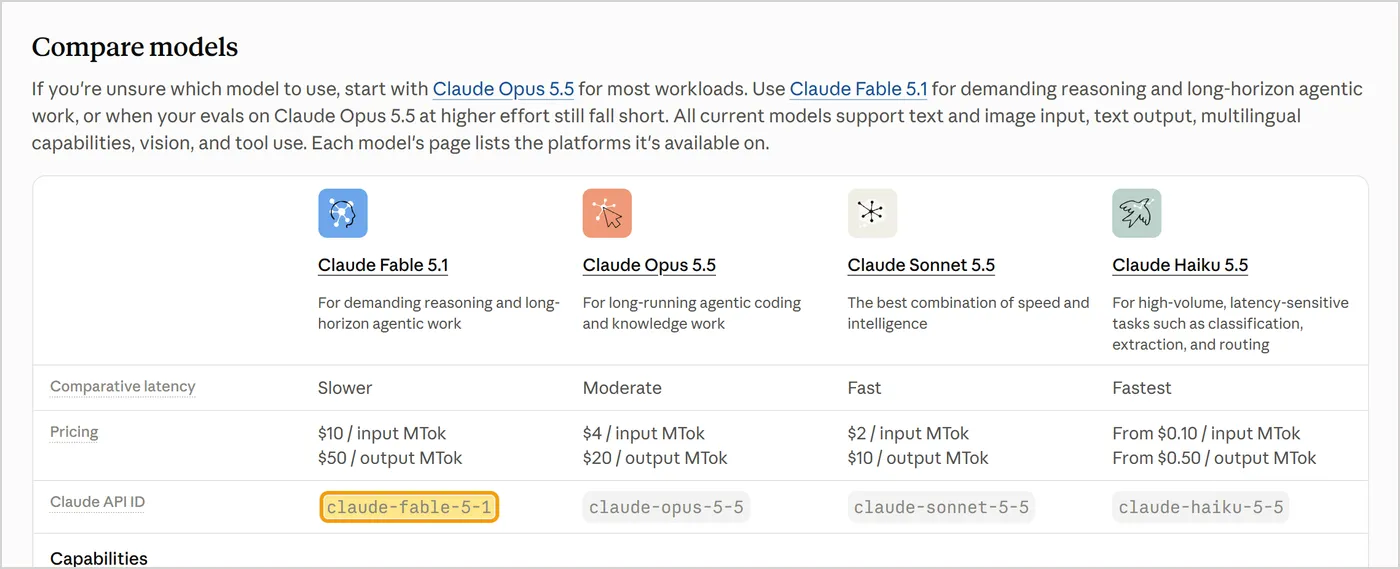
Anthropic's model table starts at Fable 5.1 and has no Fable 5.5 column. Source: platform.claude.com/docs/en/models/overview
Anthropic's own advice is to start on Opus 5.5 and move up to Fable 5.1 only when your evaluations on Opus at higher effort still fall short. Its launch post puts Opus 5.5 ahead of Fable 5.1 on all nine benchmarks in its table. Anthropic adds that the gap looks narrower in its own use. On GDPval-AA, an Elo-rated benchmark of professional tasks, the scores were 1846 and 1735, at well under half the per-token price.
Two habits make the switch cheap when Fable 5.5 lands. Keep the model ID in one config value rather than scattering it through your code. Then re-run your own test prompts before you switch. The move from Fable 5 to 5.1 brought four breaking API changes, including errors on forced tool use, and a 5.5 release could bring its own.
Every Fable 5.5 sighting so far
The 5.5 generation reached every Claude tier except Fable within 15 days, and that gap is where the expectation started.
From Fable 5.1 to the test videos
- 1
1 September: Fable 5.1
Anthropic releases Claude Fable 5.1 with its sibling Mythos 5.1, the same model with different safeguards. - 2
22 September to 7 October: the 5.5 family
Opus 5.5, Sonnet 5.5 and Haiku 5.5 arrive in turn. Fable stays at 5.1. - 3
2 October: a surprise-launch headline
Chinese tech sites headline a Fable 5.5 launch. The 新智元 article under one such headline describes a quiet test rollout, not a release. - 4
8 October: Claude Motion
Anthropic launches code-built animations with MP4 export, in beta for Team and Enterprise plans. - 5
13 October: the Azure entry
LiteLLM's sync bot adds azure_ai/claude-fable-5-5 after Azure's Models API lists it as generally available. - 6
14 October: entry removed
An audit of four Azure regions finds no such model, and calls to it return 404 DeploymentNotFound. - 7
15 October: Onigiri
LuminaBench finds claude-onigiri-eap-2 in Artificial Analysis's site code, with Opus 4.8 as its fallback. - 8
17 October: partner access reported
TestingCatalog cites leakers who say partners have the model and expect a release the following week. - 9
19 October: The Information
A report describes an unreleased Anthropic model that better infers intent from vague instructions. - 10
21 October: the eight videos
AI超元域 publishes animations it says came from a Fable 5.5 test in the Claude desktop app.
The Azure entry: the strongest signal, with borrowed numbers
We read both LiteLLM pull requests in full. LiteLLM is an open-source gateway that keeps a public file of prices and limits for the models it supports, and a bot syncs that file with provider catalogs. On 13 October at 12:09 UTC, the bot opened pull request #46201 to add azure_ai/claude-fable-5-5. Its description says Azure's Models API in East US 2 listed the model as Anthropic version 1, with the status GenerallyAvailable. A maintainer merged it 18 minutes later.
The numbers in the row came from elsewhere. Every field except the deprecation date is marked as inherited from Fable 5.1. The description itself says no source had yet stated a price, context window or capability for the new model. The one value Azure supplied was that deprecation date, 5 December 2027.
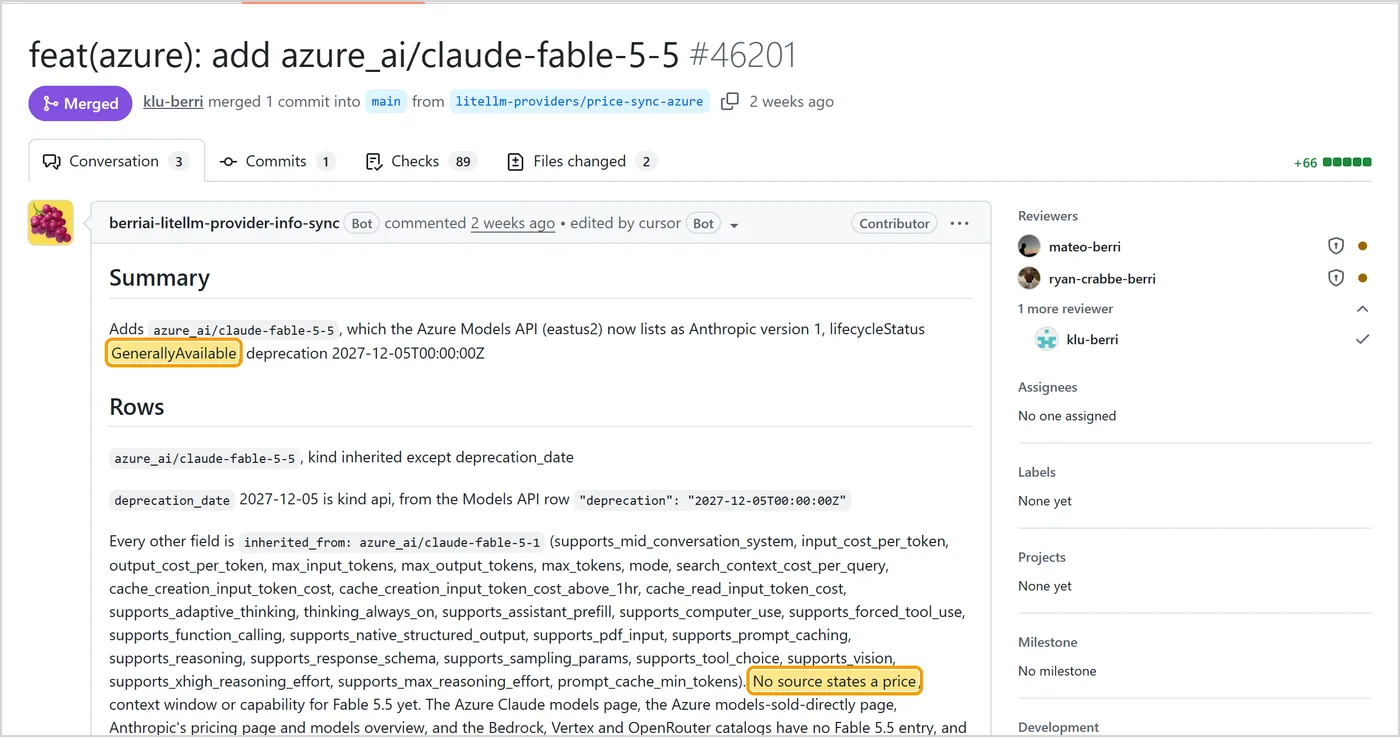
The sync bot's own description: listed by Azure, every value but the deprecation date copied from Fable 5.1. Source: github.com/BerriAI/litellm/pull/46201
The next day, pull request #46428 took the row out. Its audit of Azure's Models API in East US 2, East US, West US 3 and Sweden Central found the model in none of them. A chat call to it returned 404 DeploymentNotFound both before and after the change.
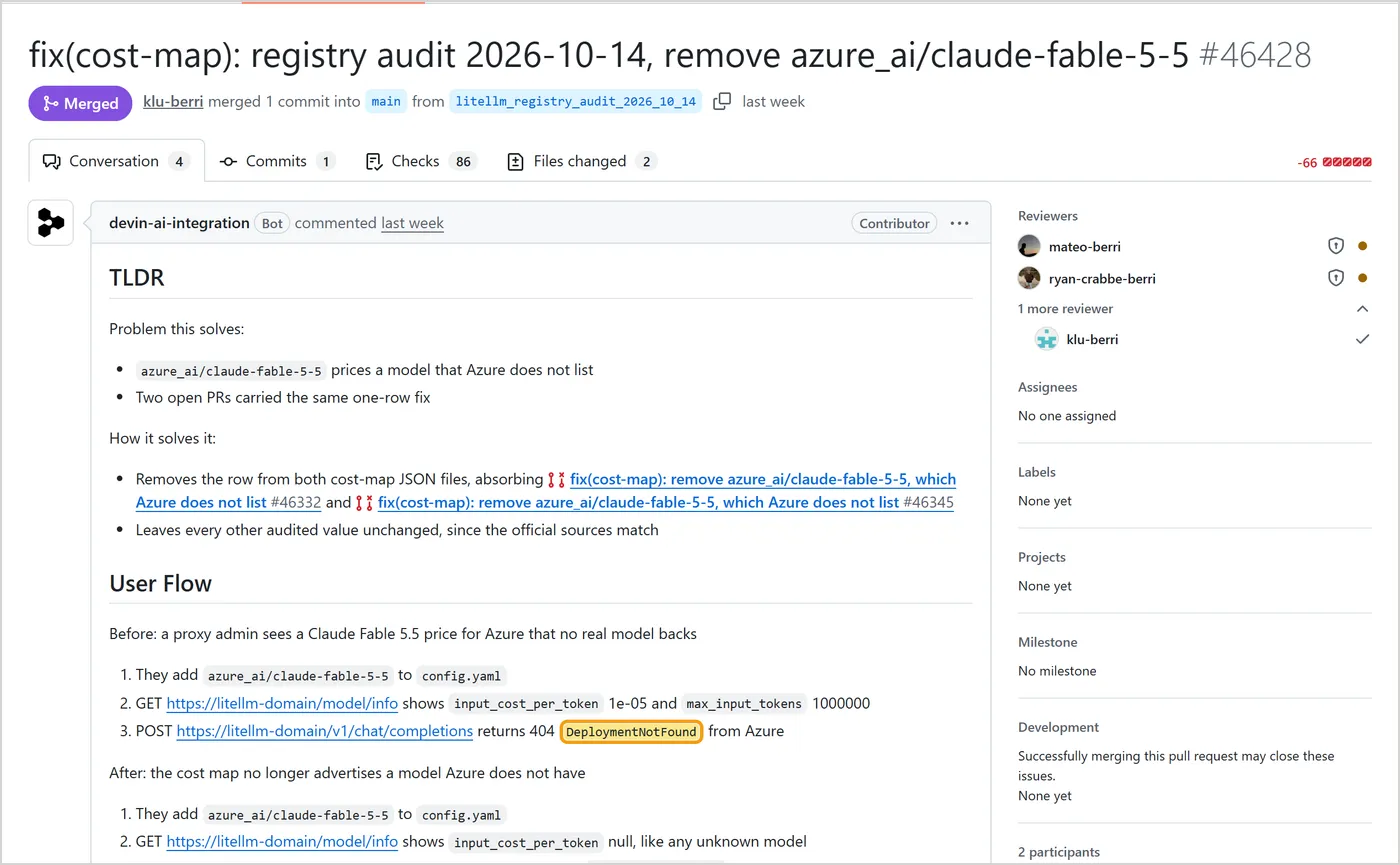
The follow-up pull request that took the row out the next day. Source: github.com/BerriAI/litellm/pull/46428
So the proof is narrow. When the bot checked, Microsoft's catalog carried a Claude Fable 5.5 entry marked generally available, and by the next day it didn't. That says nothing about speed or quality. Anyone quoting a Fable 5.5 price is quoting Fable 5.1's.
Codenames: Onigiri and the rest
On 15 October, LuminaBench reported five entries named claude-onigiri-eap-2 in a public JavaScript file loaded by Artificial Analysis's homepage. One is plain, and four carry effort levels from low to xhigh. Each names claude-opus-4-8 as its fallback model. LuminaBench's own conclusion is careful: the fallback resembles what Artificial Analysis described for Fable 5 before that model launched, but the code does not confirm that Onigiri is Fable 5.5.
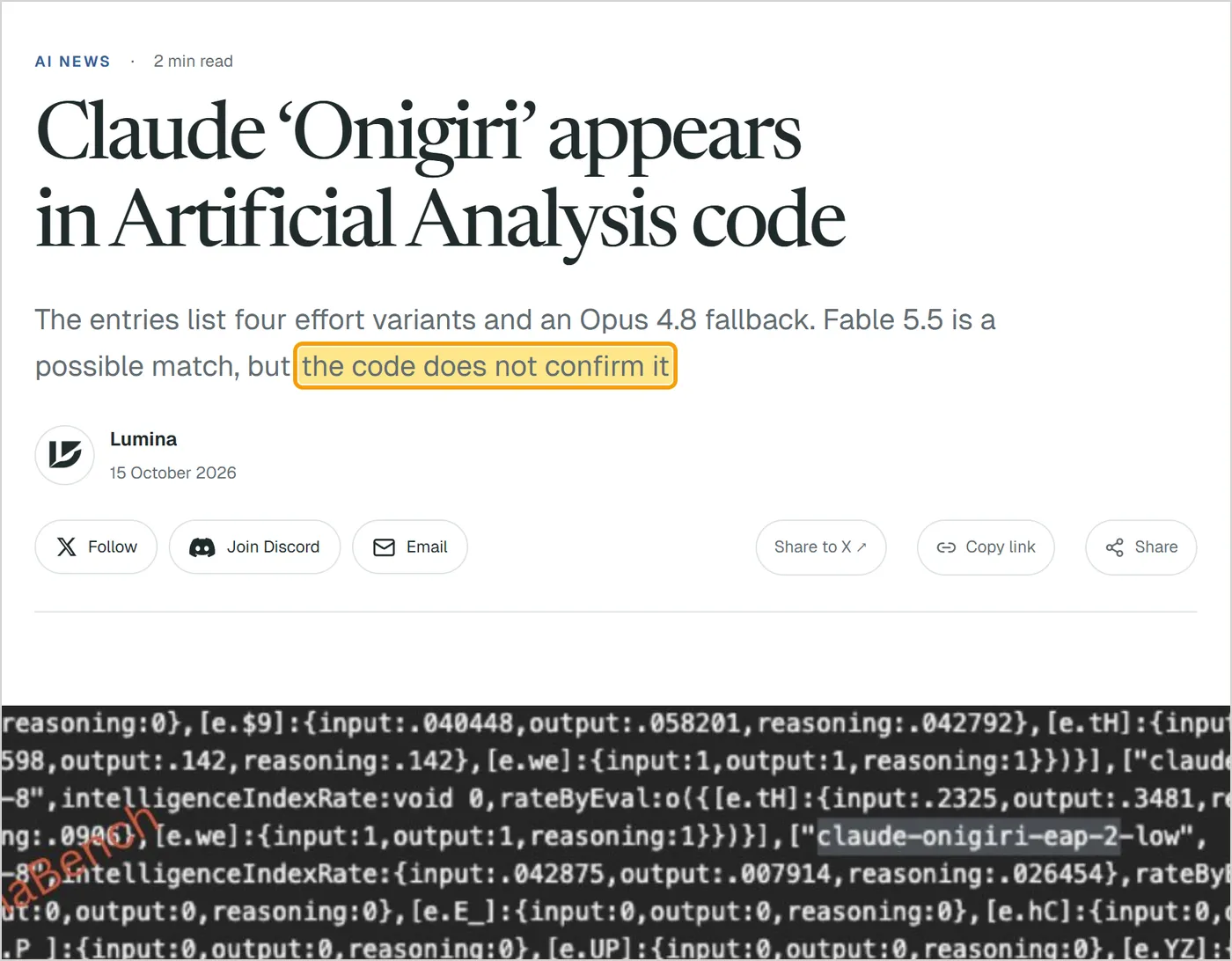
LuminaBench's headline, its caveat and the first claude-onigiri-eap-2 entry from the code it found. Source: luminabench.com/journal/claude-onigiri/
The other names are thinner. TestingCatalog, citing the leaker account AiBattle, lists six early-access codenames seen in builds of Cognition's Devin CLI. Orzata appeared on 21 September, Boba and Vanilla on 29 September, Odango on 2 October, and Verrine and Onigiri on 10 October. We could not see those builds. Count the list as reported, not confirmed.
What the model is said to do
The Information's post on 19 October is the only report about ability, and it names no model. Citing a person who has used it, the outlet says Anthropic is preparing a model that better infers what users want when instructions are vague. The same person describes stronger reasoning and more creative problem-solving.
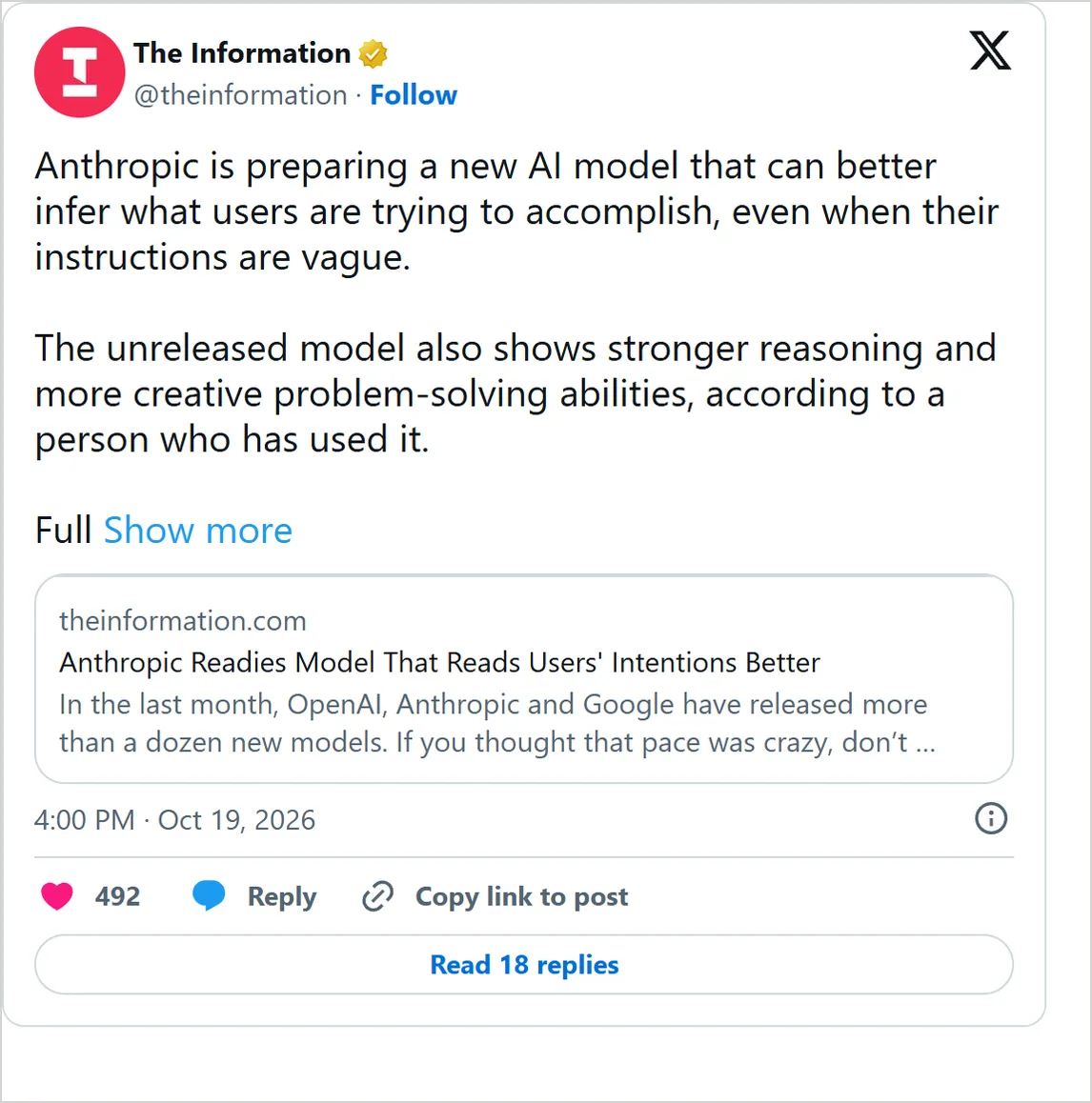
The post links a paywalled story and names no model. Time shown in UTC. Source: x.com/theinformation/status/2112212326795362560
TestingCatalog's 17 October report adds partner access. Leakers it cites say partners already have Fable 5.5 and expect a release the following week. That is the second "next week" in this story, since a 2 October 新智元 article said the same. Anthropic has said nothing since.
What the eight test videos show, and what they leave out
The clips that made Fable 5.5 a search term come from AI超元域, a Chinese-language AI channel. Its 21 October video walks through eight animations, and the channel's blog post two days later lists the inputs for each. The creator says the work came from Fable 5.5 "in internal testing" inside the official Claude desktop app.

The creator's own write-up, in Chinese. The highlighted line reads: tried Fable 5.5, in internal testing, in the official Claude desktop app. Source: www.aivi.fyi/llms/claude-fable-55-animation-review
| # | Clip | Input | What the clip shows |
|---|---|---|---|
| 1 | Promo animation | Two reference images, the OpenAI logo, an AI-made fluffy ball, a prompt | Motion graphics from the supplied images, with sound the creator credits to the model |
| 2 | History of art | Text prompt only | Painting styles era by era, including a Van Gogh look, and a cat scene with light and floor reflections |
| 3 | A day in a life | Text prompt only | A morning-to-night sequence with a watch coming apart, plus a building scene and a running photo nobody supplied |
| 4 | Bouncing ball | A short prompt asking for 15 seconds | A ball with impact sounds that ends as the decimal point in "5.5" |
| 5 | Highlighted text | Prompt not published | A highlighter sweep over text on a wood-grain desk |
| 6 | Butterflies | One butterfly image and a prompt | Butterflies fly in one by one and settle into the input image's layout, then a Claude Fable 5.5 title appears |
| 7 | Geological eras | Text prompt only | Ediacaran seafloor to the ice ages, with dinosaurs, a volcanic mass extinction and an asteroid strike |
| 8 | Journey of a token | A typed question | How a question becomes tokens and then an answer, drawn as an explainer |
The creator adds three caveats, and they matter. In clip 7 the same prompt also ran on Opus 5.5 and GPT-6 Astra. That was one run each, with no shared budget and no blind judging, so it ranks nothing. The geological clip needs fact-checking before anyone teaches from it. And the token clip is an illustration, not a record of what happens inside a model, which our token explainer covers in plain terms.
Our caveat is bigger. The creator never says how the files were made. The blog post names no code, no renderer and no tool, only that the desktop app produced the videos. Anthropic has not said which model served those sessions either. A GitHub collection of 69 "Fable 5.5" works gathered from X, from animations to small games, carries the same warning: each attribution rests on the creator's word.
Some users try to tell for themselves. One community check in that collection asks the model about someone it could only know from newer training data. A correct answer suggests a newer checkpoint. It cannot show the model's name, its price or its ship date.
How Claude makes an MP4 without a video model
Video generators such as Runway and Luma Dream Machine produce footage with a model trained on video. Such a model predicts pixels. Text, logos and layouts are pixels like any other, so keeping them exact from frame to frame is something the model has to learn, not something the method guarantees.
Code-built animation works the other way round. The model writes a program that says where every shape, word and image sits at each moment. A renderer draws frame one, then frame two, and an encoder packs the frames into an MP4. In Remotion, a React framework for this kind of video, each component reads the current frame number and the frame rate, then draws itself for that instant.
Sound can come from code as well. Rather than loading a sound file, a program can build a thud from a sine wave and a fading volume curve. It places the thud on the same timeline as the frames, so the bounce and the thud land on the same frame. Browsers include a tool for exactly this. Web Audio's OfflineAudioContext renders audio "as fast as it can" into a buffer instead of playing it.
Video model
Predicts pixels from a prompt
- Learns what footage looks like from training video
- Suited to photoreal light, texture and camera moves
- Text and logos are pixels, so exact copy is not guaranteed
- Changing one detail means generating the clip again
Code-built animation
Writes a program, then renders frames
- Every word, number and position is set in code
- Sound can be synthesized on the same timeline
- One edit changes one value and leaves the rest alone
- Photoreal scenes are hard to draw from code alone
This split tells you where to look in the eight clips. Exact text, a logo in the right spot and a last frame that matches an input image are what code does well. A photoreal cat, a building scene and a running photo are another matter. Anthropic says Claude Motion uses no video model and makes no realistic footage or people, and the creator does not explain where those shots came from.
Anthropic launched Claude Motion on 8 October, alongside Claude Dashboards. According to its help page, you choose Motion from the Output option in the message box or start from a Motion template in the Artifacts tab. The result exports as an MP4. Because the animation is code, you can change one word, number or timing without redoing the rest. Motion is on by default for Team plans, an Enterprise owner has to switch it on, and each animation counts toward the plan's usage limits.
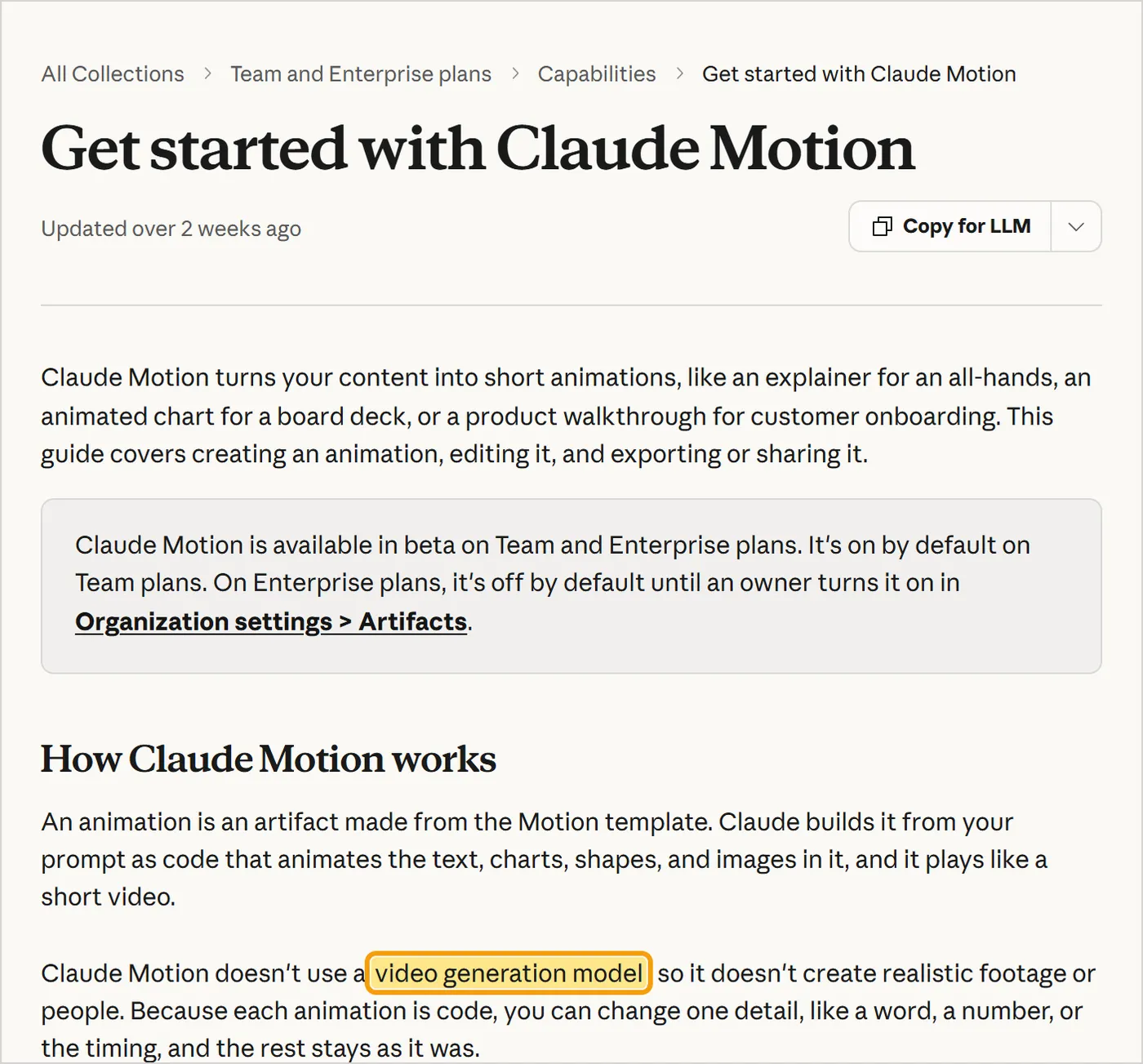
Anthropic's help page for Motion, including the line about video generation models. Source: support.claude.com/en/articles/17454997-get-started-with-claude-motion
Whether any of the eight clips came from Motion is unknown. Motion's documentation says nothing about sound, two of the clips have sound effects, and the creator doesn't name a tool.
Make a code-built video with today's models
You don't need Fable 5.5 to find out whether code-built video suits your work. Two routes run on current models.
Claude Motion is the short path if your company pays for Team or Enterprise. Tell it who will watch, the screen it will play on and the target length, and attach your source material, as the help page suggests. For a product explainer, a 30-second length and a scene list with the exact on-screen text leave the model less to guess.
Claude Code with Remotion suits developers who want the project files in their own repository. Remotion publishes official agent skills that teach Claude Code its conventions for animation, typography, audio, captions and rendering. Setup takes three commands.
remotion-setup.sh
# 1. scaffold a Remotion project
npx create-video@latest

# 2. inside the project, add Remotion's official agent skills
npx skills add remotion-dev/skills

# 3. after Claude Code writes the composition, render it to MP4
npx remotion render <composition-id> out/video.mp4
Remotion's license is free for individuals, non-profits and companies with up to three employees, and larger companies need a paid company license. Long pieces also cost tokens. Take a hypothetical animation script of 40,000 output tokens. At list prices it costs $2.00 on Fable 5.1, $0.80 on Opus 5.5 and $0.40 on Sonnet 5.5, before input tokens and revisions. Render a five-second test first and fix the storyboard there.
What is still unconfirmed
- The name and the price. "Fable 5.5" is the community's label. Anthropic has not used it, and the only price on record was copied from Fable 5.1.
- What Onigiri is. The code on Artificial Analysis's site is real. Its link to Fable 5.5 is an inference.
- Which model made the videos, and how. The creator names the desktop app, not the method.
- The date. Leak reports have promised "next week" twice this month. Anthropic has given no date.
More from Mindber
- Claude Fable 5 guide: what the first Fable cost at launch and how to reach it from the apps, the API and Claude Code.
- Fable 5's suspension in June: the export-control order that took it offline for three weeks, and the case for keeping a fallback model.
- Claude vs ChatGPT and Claude Pro vs ChatGPT Plus: where each Claude model sits and which plan reaches it.
- Opus cost calculator: turn your own token volumes into a monthly bill before you pick a model.
- Directory pages for Claude, plus Synthesia and HeyGen if you need presenter-style video from a video model, and the AI code assistant category for Claude Code's peers.
- Why AI models hallucinate, the reason the geological clip needs a fact-check before anyone teaches from it.
- Our rankings and the methodology behind them, which scores tools from public evidence like the sources on this page.
Frequently asked questions
Can I use Claude Fable 5.5 in Claude Code today?
Not by choice. Claude Code can only select models Anthropic lists, and no Fable 5.5 ID exists yet. Some users report that their Fable 5.1 sessions quietly moved to a newer checkpoint, which Anthropic has not confirmed.
Will Claude Fable 5.5 cost more than Fable 5.1?
Nobody outside Anthropic knows yet. The only Fable 5.5 price ever published was the placeholder LiteLLM's bot copied from Fable 5.1. The last step is the only precedent: Anthropic kept Fable 5's per-token price for 5.1 and cut its cache-read rate by 75%.
Is Claude Fable 5.5 related to Claude Mythos?
So far the two have shipped as a pair. Fable 5.1 and Mythos 5.1 are one model with different safeguards: Fable for general use, Mythos only for organizations in Anthropic's cyber and life-sciences verification programs. None of the leaks we read names a Mythos 5.5.
Is Fable 5.5 better than GPT-6 at making animations?
There is no evidence either way yet. The only comparison is AI超元域's single run of one prompt on Fable 5.5, Opus 5.5 and GPT-6 Astra, which the creator says was neither blind nor repeated. A fair test would run the same prompts several times per model, on the same budget, with judges who don't know which model made which clip.
Does Claude Motion work on Pro or Max plans?
No. While Motion is in beta, Anthropic limits it to Team and Enterprise. On Pro or Max, the closest route is Claude Code with Remotion's agent skills, set up as shown above.
Sources & methodology
Editorial analysis of Anthropic's own pages, two LiteLLM pull requests, named leak reports and the test videos' creator, read on 2026-10-24. Leaks are marked as reported, not confirmed. Mindber had no access to Fable 5.5 and ran no prompts.
- [1]Fable 5.1 released 1 September 2026; 1M context, 128K output, $10 / $50; four breaking changes from Fable 5Anthropic docs: Claude Fable 5.1 · 2026-10-24https://platform.claude.com/docs/en/models/fable-5-1/overview
- [2]Current lineup, prices and limits; Opus 5.5 as the default starting point; no Fable 5.5 listedAnthropic docs: Models overview · 2026-10-24https://platform.claude.com/docs/en/models/overview
- [3]No Fable 5.5 announcement; Opus 5.5 (22 Sep), Sonnet 5.5 (28 Sep) and Haiku 5.5 (7 Oct) postsAnthropic newsroom · 2026-10-24https://www.anthropic.com/news
- [4]Opus 5.5 ahead of Fable 5.1 on all nine listed benchmarks, gap narrower in Anthropic's own use; GDPval-AA v2.1 Elo 1846 vs 1735; GPT-6 Astra rowAnthropic: Introducing Claude Opus 5.5 · 2026-09-22https://www.anthropic.com/news/claude-opus-5-5
- [5]Haiku 5.5 rates for prompts over 100K tokensAnthropic: Introducing Claude Haiku 5.5 · 2026-10-07https://www.anthropic.com/news/claude-haiku-5-5
- [6]Fable 5.1 and Mythos 5.1 are one model with different safeguards; Fable 5 per-token price kept; cache reads cut 75%Anthropic: Introducing Claude Mythos and Fable 5.1 · 2026-10-24https://www.anthropic.com/claude-fable-and-mythos-5-1
- [7]azure_ai/claude-fable-5-5 added from Azure's Models API (East US 2, GenerallyAvailable); fields inherited from Fable 5.1; deprecation 2027-12-05LiteLLM pull request #46201 · 2026-10-13https://github.com/BerriAI/litellm/pull/46201
- [8]Row removed; model absent in four Azure regions; 404 DeploymentNotFoundLiteLLM pull request #46428 · 2026-10-14https://github.com/BerriAI/litellm/pull/46428
- [9]claude-onigiri-eap-2 and four effort variants in Artificial Analysis's site code, fallback claude-opus-4-8LuminaBench · 2026-10-15https://luminabench.com/journal/claude-onigiri/
- [10]Partner access and a next-week release per leakers; Devin CLI codenames by build date via AiBattleTestingCatalog · 2026-10-17https://www.testingcatalog.com/anthropic-several-models-coming-fable-5-5-reaches-partners/
- [11]Unreleased Anthropic model that better infers intent from vague instructionsThe Information on X · 2026-10-19https://x.com/theinformation/status/2112212326795362560
- [12]Quiet test rollout described under a surprise-launch headline新智元 via woshipm.com · 2026-10-02https://www.woshipm.com/ai/6473384.html
- [13]Eight test animations, their inputs, the creator's caveats and the Opus 5.5 / GPT-6 Astra runAI超元域 blog post and video · 2026-10-23https://www.aivi.fyi/llms/claude-fable-55-animation-review
- [14]69 community Fable 5.5 works with unverified attribution; community self-checkawesome-fable-5.5 on GitHub · 2026-10-24https://github.com/xianyu110/awesome-fable-5.5
- [15]Claude Motion launch and MP4 export, beta on Team and Enterprise plansClaude: Dashboards and Motion · 2026-10-08https://claude.com/resources/articles/dashboards-and-motion
- [16]Motion builds animations as code, uses no video model and makes no realistic footage or people; plan defaults; usage limitsClaude Help Center: Get started with Claude Motion · 2026-10-24https://support.claude.com/en/articles/17454997-get-started-with-claude-motion
- [17]Remotion agent skills and install commandRemotion docs: AI skills · 2026-10-24https://www.remotion.dev/docs/ai/skills
- [18]
- [19]Free use for individuals, non-profits and companies up to three employeesRemotion license · 2026-10-24https://github.com/remotion-dev/remotion/blob/main/LICENSE.md
- [20]OfflineAudioContext renders audio into a buffer as fast as it canMDN Web Docs · 2026-10-24https://developer.mozilla.org/en-US/docs/Web/API/OfflineAudioContext
Keep reading
Claude Fable 5: What It Is, How to Use It, and the Prompts That Exploit It
Pricing, safeguards, benchmarks and access for Anthropic's first public Mythos-class model.
Claude Fable 5 Suspended by US Government Order
How Fable 5 went dark three days after launch, how access came back, and what to use as a fallback.
Best AI Models, Ranked: June 2026 Leaderboard
The best models by job in June 2026, from text and coding to agents, image and video.
This article is an analysis of public information, not hands-on testing. We had no access to the model and ran none of the prompts behind the videos. All facts were checked against the sources above on the date at the top, and leak reports are labeled as such. Spot an error? Tell us. Corrections ship within 24 hours.
Learn the basics on Mindber
New to AI? These free Mindber pages explain the ideas behind articles like this one.
Share this article
Legal notice
This publication constitutes editorial commentary on publicly available information and does not constitute financial, legal, investment, or professional advice. Product names, trademarks, and registered trademarks referenced herein are the property of their respective owners; their appearance does not imply endorsement or affiliation. Mindber's analysis reflects editorial judgment based on public signals and is subject to change without notice. Scores are not buy, sell, or hold recommendations. No commercial relationship exists between Mindber and the vendors evaluated unless separately disclosed in writing. This publication is governed by the laws of Malaysia. Any dispute arising from or in connection with this publication shall be submitted to the exclusive jurisdiction of the courts of Malaysia.