
Gemini 4 Carbon: Google's New #1 Model, Compared With Opus 5.5 and GPT-6
newsUpdated 12 min read
Gemini 4 Carbon tops Artificial Analysis by one point over Claude Opus 5.5, but only cyber defenders can use it. Scores, cost per task and what X said.
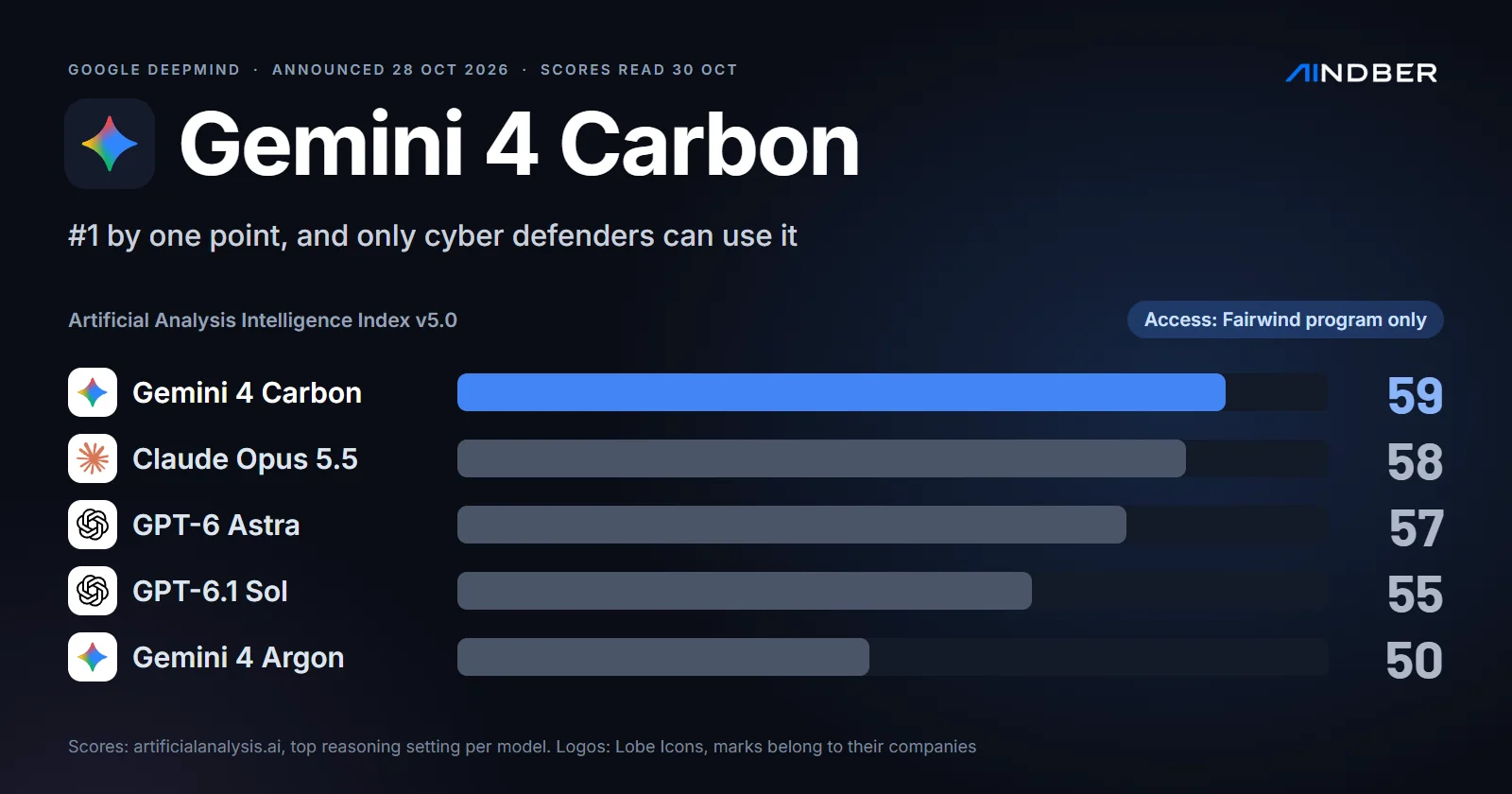
Developing story. Last verified: 30 October 2026, 18:20 UTC. Google announced Gemini 4 Carbon on 28 October and has not said when the public can use it. Scores and prices below are as Artificial Analysis and Arena listed them on 30 October. The 18:20 update adds how Carbon's launch reaction compares with the last five frontier launches.
By Frankie C. · Senior Market Researcher, Mindber. Tracks 500+ AI/SaaS tools across SEA markets via the Mindber Innovation Index methodology.
How we assessed this: On 30 October 2026 we read Google's announcement, its Fairwind program page and Artificial Analysis's launch note. At 17:13 UTC we read the live data behind Artificial Analysis's leaderboard. Arena's launch post and VentureBeat's transcription of Google's benchmark table filled in the rest. For the reaction, we read the posts of Google AI, Logan Kilpatrick, Arena and Cline on X and the Hacker News thread on the launch. The screenshots were captured the same day, and the yellow highlights are ours. Mindber has no access to Carbon and ran no prompts on it. This is analysis of public sources, not hands-on testing.
If you planned to move your coding agent or chatbot to Gemini 4 Carbon this week, you can't. Google announced it on 28 October as its strongest model, then gave it only to "a subset of trusted cyber defenders" in its Fairwind program. There is no public API, no app toggle and no date. The model you can call today is Gemini 4 Argon, which Google opened to developers on 13 October.
Our read: Carbon is the best model on the public scoreboards this week, by margins too thin to plan around. It leads Artificial Analysis's index by one point over Claude Opus 5.5 and Arena's text board by eight points over Argon, and it still trails Opus 5.5 on coding agents. For work you ship this month, the choice is between Argon, Opus 5.5 and OpenAI's cheaper GPT-6.1 Sol. Carbon earns a test slot the day its API opens, mainly for long agent runs and security work.
The same story in 73 seconds, with the scores, the cost per task and who can use it:
What to do while Carbon stays closed
Four steps, in the order most teams need them.
- Build on what you can call. Gemini 4 Argon is generally available in the Gemini API. Its introductory $2 and $10 per million tokens runs until 30 November, VentureBeat reports, and $4 and $20 apply from 1 December. Price your December bill at the higher rate now.
- Keep the model name in one config value. A single setting lets you try Carbon the day it opens, compare it and switch back without a code change.
- Check the model list instead of the news. The Gemini API's models endpoint lists every model your key can call. Carbon shows up there the moment it is live for you.
- Apply through Google Cloud if you defend infrastructure. Google's Fairwind page says governments, critical infrastructure operators, core technology platforms and defensive research labs get priority. Requests go through your Google Cloud account team.
check-carbon.sh
# list the Gemini 4 models your API key can call
curl -s "https://generativelanguage.googleapis.com/v1beta/models?key=$GEMINI_API_KEY" \
| jq -r '.models[].name' | grep gemini-4

# no line with "carbon" means it is not live for your key yet
On 30 October the Fairwind page still described the program as access to Argon, not Carbon. Expect it to change before the wider release.
How Carbon compares with Opus 5.5, GPT-6 and Argon
On Artificial Analysis's leaderboard, Carbon is first, but six models sit within nine points of it. The index blends nine evaluations, and version 5.0, new this week, puts 60% of its weight on private or withheld tests. Its scores can't be compared with the version 4 numbers in older articles.
Gemini 4 Carbon (high)
59/65
Claude Opus 5.5 (max)
58/65
GPT-6 Astra (max)
57/65
GPT-6.1 Sol (max)
55/65
Claude Sonnet 5.5 (max)
54/65
Gemini 4 Argon (high)
50/65
Muse Wonder Full (max)
50/65
016334965
Source: Artificial Analysis leaderboard, read 30 October 2026, 17:13 UTC, Oct 30, 2026
| Model | Maker | Index v5.0 | List price per 1M tokens (in / out) | Cost per index task | Output speed |
|---|---|---|---|---|---|
| Gemini 4 Carbon (high) | 59 | $4 / $20 | $7.76 | 83 tokens/s | |
| Claude Opus 5.5 (max) | Anthropic | 58 | $4 / $20 | $10.04 | 98 tokens/s |
| GPT-6 Astra (max) | OpenAI | 57 | $10 / $50 | $6.24 | 84 tokens/s |
| GPT-6.1 Sol (max) | OpenAI | 55 | $2 / $10 | $1.27 | 85 tokens/s |
| Gemini 4 Argon (high) | 50 | $4 / $20 | $7.68 | 83 tokens/s | |
| Muse Wonder Full (max) | Meta | 50 | $1 / $5 | $0.26 | 91 tokens/s |
Artificial Analysis lists standard prices, so Google's introductory discount is left out. Cost per task is what one run of the index cost at those prices.
The split by task type matters more than the headline. On Artificial Analysis's Coding Agent Index, Carbon scores 59 and Claude Code with Opus 5.5 scores 62. Carbon is second on Terminal-Bench 4.0 at 64% and on FrontierCode at 51%, behind Opus 5.5 both times. Carbon pulls ahead on knowledge. It scores 54 on AA-Omniscience, six points above Opus 5.5.
That knowledge score hides one regression. Carbon answers 58% of AA-Omniscience questions correctly, up from Argon's 48%, but its hallucination rate rose from 4% to 11%. Eleven percent is still the second lowest on the benchmark, behind only Argon. Opus 5.5 and GPT-6 Astra both sit at 50% when run at max reasoning.
Google's own table, as VentureBeat transcribed it, gives Carbon the top result in 15 of 17 rows. The two exceptions are telling for buyers. GPT-6 Astra leads FrontierSWE 2 at 65.5% to Carbon's 61.2%, and Opus 5.5 leads the OSWorld-2.1 computer-use test at 87.2% to 81.5%. Andon Labs' Vending-Bench 2 adds an outside view: Carbon finished the simulation with $16,484, against $15,515 for Astra.
Arena's community votes point the same way. Carbon debuted first in Text Arena, second in Agent Arena and fourth in WebDev.
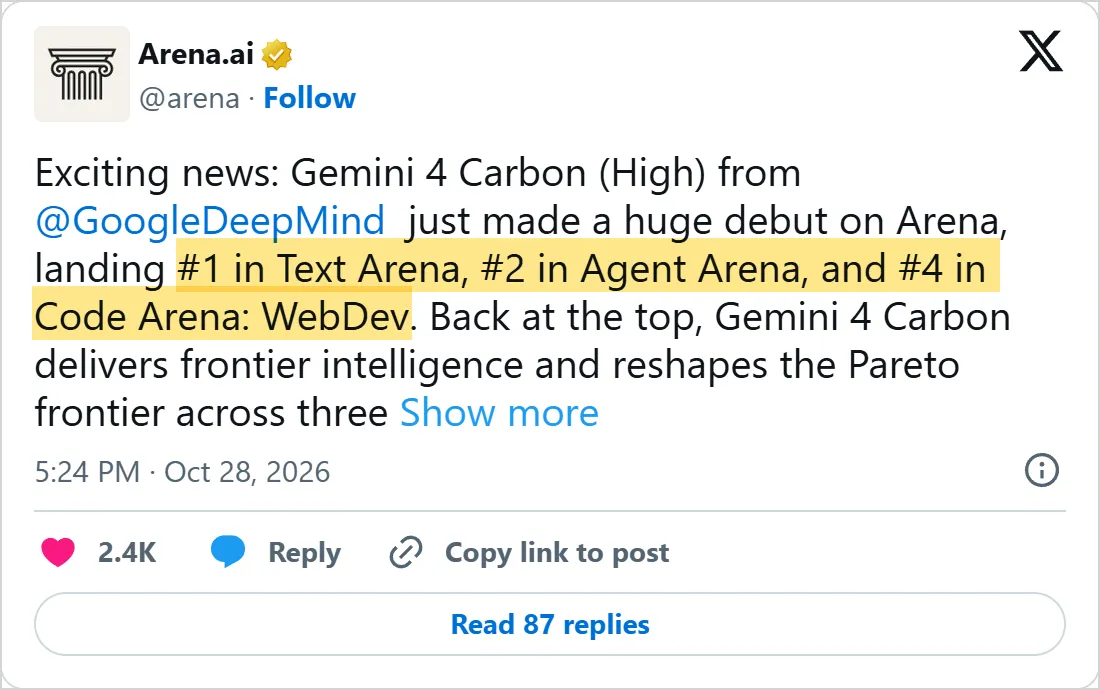
Posted 28 October 2026 at 17:24 UTC. The embed cuts the post at "Show more". The rest gives Text Arena 1528 for Carbon and 1520 for Argon, and WebDev 1768 against Claude Sonnet 5.5's 1770. Source: x.com/arena/status/2115495002998751262
The full post shows how close the races are. In Text Arena, Carbon leads Argon by eight points, 1528 to 1520. In WebDev it sits two points behind Claude Sonnet 5.5. In Agent Arena, Claude Opus 5.5 at max effort stays first.
The real price: same per token, different per task
Carbon and Opus 5.5 carry the same list price, so the bill depends on how many tokens each spends. In Artificial Analysis's run, Carbon used 123,000 output tokens per task against Opus 5.5's 173,000, which makes Carbon about 23% cheaper per task. GPT-6 Astra, at two and a half times the per-token price, still came out 20% cheaper than Carbon per task.
The value pick on this table is OpenAI's GPT-6.1 Sol. It scores 55, four points below Carbon, for $1.27 a task, about a sixth of Carbon's cost. Meta's Muse Wonder Full reaches 50 for 26 cents.
Two caveats apply to Carbon's numbers. It is slow to start: Artificial Analysis measured a first token after about 104 seconds on Google's API, because the model reasons before it answers. That suits overnight agent runs, not a chat window. Google's introductory price, $2 and $10 per million tokens, halves the per-token cost until a date Google has not named.
Cline, the open-source coding agent, read the launch more boldly than the data supports.
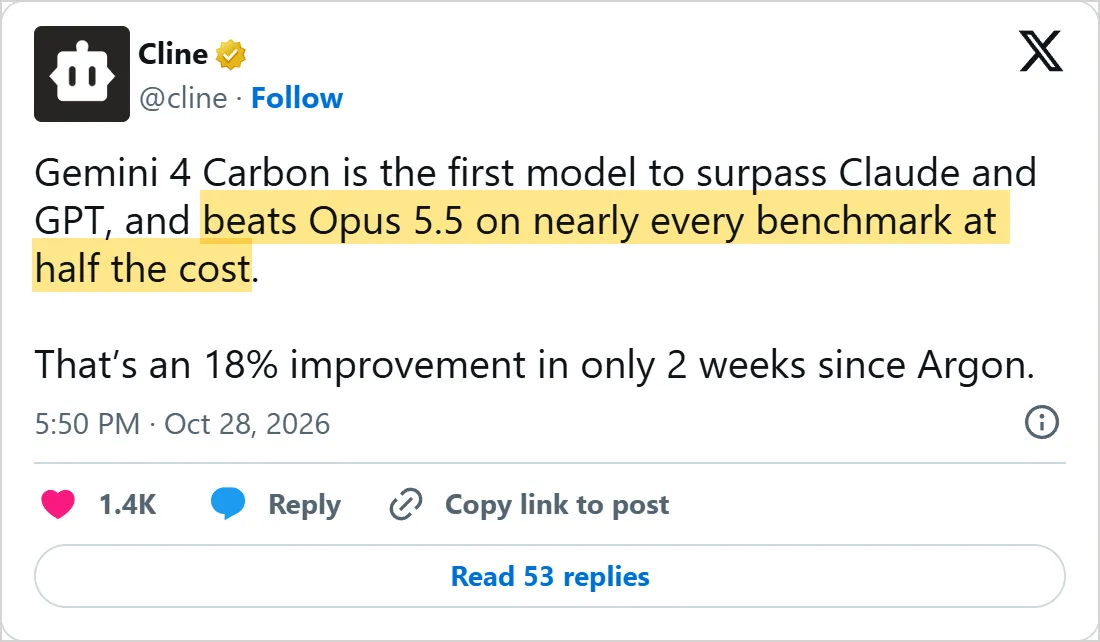
Posted 28 October 2026 at 17:50 UTC. Source: x.com/cline/status/2115501578916601925
"Half the cost" holds per token only at Google's introductory price against Opus 5.5's list price. Per finished task, at list prices, the gap is 23%. "Nearly every benchmark" leaves out the coding agent tests and the computer-use test, which Opus 5.5 still leads. Cline's 18% figure is its own. It matches the jump from Argon's 50 to Carbon's 59 on Artificial Analysis's index.
Why only cyber defenders get it first
Google built its launch around security work, and its numbers there are the largest gains in the table. Carbon scores 88.2% on SEC-bench Pro, which measures finding vulnerabilities, up from Argon's 83.4%. On ExploitGym it reaches 54.8%, up from 42.0%. On CWE-bench, a patching test, it reaches 71.0%. Google says all three ran without guardrails.
Gemini 4 ArgonGemini 4 Carbon
SEC-bench Pro (finding vulnerabilities)
Gemini 4 Argon
83.4
Gemini 4 Carbon
88.2
CWE-bench (patching)
Gemini 4 Argon
68
Gemini 4 Carbon
71
ExploitGym (exploitation)
Gemini 4 Argon
42
Gemini 4 Carbon
54.8
Source: Google's announcement and benchmark table, as reported by VentureBeat, 28 October 2026, Oct 28, 2026
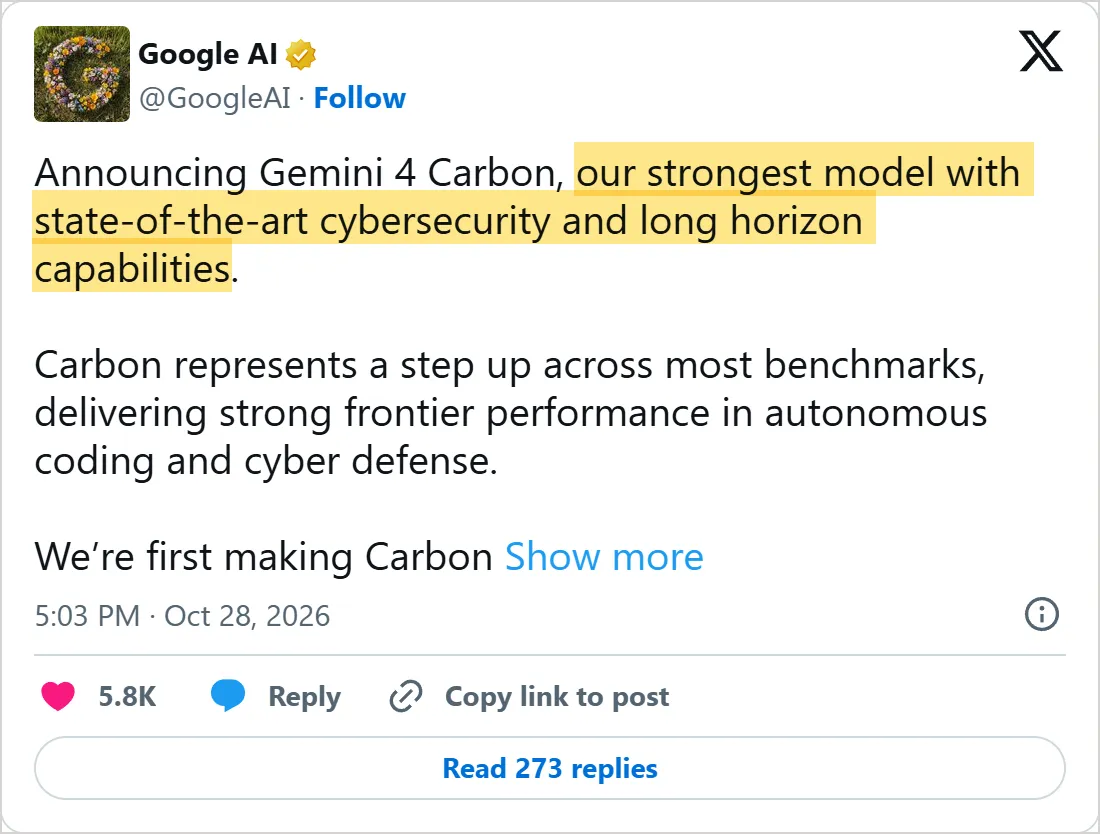
Posted 28 October 2026 at 17:03 UTC. The embed cuts the post. Its last lines say Carbon goes first to "a subset of trusted cyber defenders in our Fairwind program". Source: x.com/GoogleAI/status/2115489593818816591
Google's other security claims come from its partners and its own teams. The Chrome team found Carbon more than ten times better at high-quality patches than another lab's frontier model, which Google did not name. Wiz reports that Carbon leads its web penetration testing benchmarks. Our reading of the order: a model that finds and exploits bugs this well helps attackers too, so defenders get a head start. VentureBeat adds that Google is taking part in the US government's voluntary prerelease testing.
The safety figures are company-reported. Google says Carbon cheated successfully on 0.0% of Terminal-Bench 4.0 tasks and tried on 0.4%. In internal coding environments, high-severity misalignment alerts fell almost 80% from Argon. On Gray Swan's indirect prompt injection benchmark, the attack success rate fell from Argon's 0.7% to 0.0%.
What people said on X and Hacker News
Google's own people led with the scoreboard. Logan Kilpatrick, who works on the Gemini API and AI Studio, called Carbon "a big jump over Argon" and pointed to the Artificial Analysis rank. By 30 October his post had 1.2 million views and about 15,900 likes, 3.6 times the views on Google AI's own launch post. Arena's and Cline's posts above carried the same tone. Varun Mohan, who heads Google's Antigravity coding tool, told followers Fairwind access would widen before Antigravity users get it.
Developers on Hacker News were cooler. The launch thread reached 1,011 points and 800 comments, and its most-replied comments were about access and naming, not scores. One commenter wrote that "showing benchmarks without releasing the model is quite meaningless". Others said their Gemini app still showed older models, or asked whether Carbon replaces Argon. Google has not answered that last question.
Set against the last five frontier launches, Carbon drew the smallest launch thread on Hacker News. GPT-6 Astra's thread in September passed 2,000 points, and Argon's own launch drew 1,705. Carbon's thread was two days old when we read it. The others had a month or more, so the gap may narrow. Even so, the new #1 drew less discussion than OpenAI's cheaper GPT-6.1 Sol.
GPT-6 Astra (3 Sep)
2279 pts
Claude Opus 5.5 (22 Sep)
1806 pts
Gemini 4 Argon (30 Sep)
1705 pts
Claude Fable 5.1 (1 Sep)
1419 pts
GPT-6.1 Sol (29 Sep)
1067 pts
Gemini 4 Carbon (28 Oct)
1011 pts
0 pts625 pts1250 pts1875 pts2500 pts
Source: Hacker News launch stories via the Algolia HN API, read 30 October 2026, Oct 30, 2026
The gap between those two groups is the story for buyers. The scoreboards say Google is back at the top. The people who would pay for it still can't use it.
What is still unconfirmed
- The release date. Google says "as soon as possible". The previous model, Argon, went from Fairwind-only on 30 September to general availability on 13 October.
- The end of the introductory price. For Carbon, Google gives none. For Argon, VentureBeat reports 30 November.
- The API name and limits. Artificial Analysis lists a 1 million token context window. Google has published no model ID, output limit or technical report for Carbon.
- Whether Carbon replaces Argon. Both carry the same prices, and Google has not said whether Argon stays on sale.
- Independent security results. SEC-bench Pro, ExploitGym and CWE-bench scores come from Google. No outside lab has published its own numbers yet.
More from Mindber
- AI model rankings history: every model that held the #1 spot since GPT-3, the context for Google's return to the top.
- Best AI models, June 2026: the leaderboard before the Gemini 4 and GPT-6.1 releases.
- Claude Fable 5.5 leaks and Claude Fable 5's suspension: the Anthropic side of the race, including its own cyber-first release.
- Google's AI talent drain: who left Google DeepMind this year, and where they went.
- The most popular AI companies, month by month and our bar chart race maker for your own model charts.
- October 2026 security roundup: the patches security teams were already handling this month.
- Claude vs ChatGPT and Claude Pro vs ChatGPT Plus: which plan reaches which model.
- What an AI hallucination is and what a reasoning model is, the two ideas behind Carbon's Omniscience score and its slow first token.
- LLM cost calculator: turn your own token volumes into a monthly bill at each list price.
- Directory pages for Gemini, Claude, ChatGPT and Google Antigravity, plus the AI models and AI code assistant categories.
- Our rankings and the methodology behind them.
Frequently asked questions
Can I use Gemini 4 Carbon in the Gemini app or AI Studio?
Not yet. On 30 October Carbon was open only to a subset of cyber defenders in Google's Fairwind program. Google has given no date for the Gemini app, AI Studio or the API. Gemini 4 Argon is the newest Gemini model anyone can call.
Is Gemini 4 Carbon better than Claude Opus 5.5?
On general knowledge and reasoning, slightly: 59 to 58 on Artificial Analysis's index, with a much lower hallucination rate. On coding agents, no: Claude Code with Opus 5.5 scores 62 to Carbon's 59. Opus 5.5 also leads the OSWorld computer-use test in Google's own table.
How much will Gemini 4 Carbon cost?
Google lists $4 per million input tokens and $20 per million output tokens, the same as Argon and Claude Opus 5.5. Until an unstated date it charges an introductory $2 and $10. Cached input tokens cost 95% less than fresh ones.
What is the Fairwind program and how do I join?
Fairwind is Google's early-access program for cyber defenders. Governments, critical infrastructure operators, core technology platforms and academic labs working on defensive benchmarks get priority. Requests go through a Google Cloud account team, so non-customers must sign up for Google Cloud first.
What is the difference between Gemini 4 Argon and Carbon?
Argon came first, on 30 September, and is generally available. Carbon followed four weeks later as a stronger model at the same price. It gains most on security tests and long agent runs. Google has not said whether Carbon will replace Argon or sit beside it.
Which AI model gives the most for the money right now?
On Artificial Analysis's numbers, GPT-6.1 Sol: a score of 55 for $1.27 per index task. Carbon costs $7.76 for 59, and Opus 5.5 costs $10.04 for 58. Your own prompts may rank them differently, so test on your workload before you switch.
Sources & methodology
Editorial analysis of Google's announcement, Artificial Analysis's launch note and leaderboard data, Arena's launch post, VentureBeat's report and the reaction on X and Hacker News, read on 30 October 2026. Benchmark results are those publishers' own. Mindber had no access to Carbon and ran no prompts.
- [1]Announcement, 28 October; strongest model; SEC-bench Pro 88.2%, ExploitGym 54.8%, CWE-bench 71.0% without guardrails; Chrome team 10x patches; Wiz; safety and alignment figures; $2 / $10 introductory, $4 / $20 later, 95% cached-input discount; Fairwind firstGoogle: Gemini 4 Carbon, our next frontier model · 2026-10-28https://blog.google/innovation-and-ai/models-and-research/gemini-models/introducing-gemini-4-carbon/
- [2]Intelligence Index v5.0 #1 at 59; #1 in 4 of 9 evaluations; Coding Agent Index 59 vs 62; Terminal-Bench 64%; FrontierCode 51% vs 56%; AA-Omniscience 54, accuracy 58%, hallucination 11% vs 4%; $7.76 vs $10.04 per task; 123k vs 173k tokens; not publicly availableArtificial Analysis: Gemini 4 Carbon is the new #1 · 2026-10-28https://artificialanalysis.ai/articles/gemini-4-carbon-new-number-1
- [3]Index scores, list prices, cost per task and output speed for all models in the table, read at 17:13 UTCArtificial Analysis leaderboard · 2026-10-30https://artificialanalysis.ai/leaderboards/models
- [4]Time to first token about 104 seconds on Google's API; 1M context; one API providerArtificial Analysis: Gemini 4 Carbon model page · 2026-10-30https://artificialanalysis.ai/models/gemini-4-carbon
- [5]GPT-6.1 Sol released 29 September 2026; $2 / $10Artificial Analysis: GPT-6.1 Sol model page · 2026-10-30https://artificialanalysis.ai/models/gpt-6-1-sol
- [6]Google's 17-row table including FrontierSWE 2 and OSWorld-2.1; Argon security scores; Vending-Bench 2; Argon timeline and 30 November price change; US prerelease testing; Varun Mohan on Fairwind before AntigravityVentureBeat · 2026-10-28https://venturebeat.com/technology/google-unveils-gemini-4-carbon-retaking-the-worlds-no-1-spot-on-updated-harder-benchmarks-but-access-is-limited
- [7]Fairwind program: who gets priority, how to apply, Argon named as the modelGoogle DeepMind: Fairwind program · 2026-10-30https://deepmind.google/fairwind-program
- [8]Launch post: subset of trusted cyber defenders in the Fairwind program; posted 17:03 UTCGoogle AI (@GoogleAI) on X · 2026-10-28https://x.com/GoogleAI/status/2115489593818816591
- [9]Text Arena #1 at 1528 vs Argon 1520; Agent Arena #2; WebDev #4 at 1768 vs Sonnet 5.5 at 1770; posted 17:24 UTCArena (@arena) on X · 2026-10-28https://x.com/arena/status/2115495002998751262
- [10]A big jump over Argon; #1 on Artificial Analysis V5; posted 17:02 UTCLogan Kilpatrick (@OfficialLoganK) on X · 2026-10-28https://x.com/OfficialLoganK/status/2115489284404940898
- [11]Beats Opus 5.5 on nearly every benchmark at half the cost; 18% improvement; posted 17:50 UTCCline (@cline) on X · 2026-10-28https://x.com/cline/status/2115501578916601925
- [12]1,011 points and 800 comments; comments on access, naming and benchmarks without a releaseHacker News: Gemini 4 Carbon · 2026-10-30https://news.ycombinator.com/item?id=50276792
- [13]Launch thread sizes: GPT-6 Astra 2,279 points (49554643), Claude Opus 5.5 1,806 (49803892), Gemini 4 Argon 1,705 (49913571), Claude Fable 5.1 1,419 (49525378), GPT-6.1 Sol 1,067 (49896586)Hacker News search (Algolia API) · 2026-10-30https://hn.algolia.com/api/v1/search?query=Gemini%204%20Carbon&tags=story
- [14]Logan Kilpatrick's post at 1.2 million views and about 15,900 likes; Google AI's at about 336,000 viewsPost counts via api.fxtwitter.com · 2026-10-30https://api.fxtwitter.com/OfficialLoganK/status/2115489284404940898
Keep reading
AI Model Rankings History: Every #1, GPT-3 to Gemini 4
Who held the top spot, month by month, and for how long.
Claude Fable 5.5 Before Launch: What the Leaks and Test Videos Show
The Anthropic model everyone is waiting for, and what is confirmed.
Google AI Talent Drain: Shazeer and Jumper Join Rivals
The people who left Google DeepMind this year and where they went.
Learn the basics on Mindber
Background for this article, from the free Mindber learning hub.
Topic guides
AI Basics lessons
Share this article
Legal notice
This publication constitutes editorial commentary on publicly available information and does not constitute financial, legal, investment, or professional advice. Product names, trademarks, and registered trademarks referenced herein are the property of their respective owners; their appearance does not imply endorsement or affiliation. Mindber's analysis reflects editorial judgment based on public signals and is subject to change without notice. Scores are not buy, sell, or hold recommendations. No commercial relationship exists between Mindber and the vendors evaluated unless separately disclosed in writing. This publication is governed by the laws of Malaysia. Any dispute arising from or in connection with this publication shall be submitted to the exclusive jurisdiction of the courts of Malaysia.