
Mindber
HomeDiscoverRankingsModel ArenaWhat's NewComparePricingBlog
Mindber

Independent directory for discovering, comparing, and monitoring AI apps, agents, and automation software by category, pricing, traffic, regional demand, alternatives, and verified activity signals.

All systems operational
ENEnglishCN中文ESEspañolIDIndonesiaVITiếng ViệtTHไทย

Product

  • AI software directory
  • AI software rankings
  • Compare AI apps
  • AI software pricing
  • Submit an AI product

Resources

  • AI scoring methodology
  • AI activity signals
  • AI rankings methodology
  • Verification tiers
  • Methodology changelog
  • AI data sources
  • AI product blog
  • AI market reports

Company

  • About Mindber
  • Claim a profile
  • Report correction
  • Contact Mindber

Legal

  • Terms
  • Privacy
  • Disclaimer
  • DMCA
  • Takedown

Mindber publishes human-reviewed AI product profiles, rankings, comparisons, and reports from publicly accessible product, pricing, traffic, regional, and source data, with clear context for buyers, search engines, and AI answer engines. Not investment, legal, or purchasing advice.

Mindber Score™, Mindber Innovation Index™, Mindber Functionality Score™, and Mindber Activity Score™ are trademarks of Mindber.

© 2026 Mindber. All rights reserved.v2.5
  • Home
  • Discover
  • Rankings
  • Model Arena
  • Compare
  • Sign in
Skip to main content
BlogThe SpaceX IPO Is Quietly the First Big AI IPO

The SpaceX IPO Is Quietly the First Big AI IPO

newsUpdated June 13, 202613 min read

SpaceX (Nasdaq: SPCX) went public June 12, 2026 — putting Grok, xAI, and a $60B Cursor deal on the market. What the first AI IPO means for buyers.
#ai-ipo#spacex#spcx#xai#grok#cursor#ai-tools-market
The SpaceX IPO Is Quietly the First Big AI IPO — SpaceX (Nasdaq: SPCX) went public June 12, 2026 — putting Grok, xAI, and a $60B Cursor deal on the market. What the first AI IPO means for buyers.

Reported as of June 12, 2026. Mindber editorial analysis of public reporting and SpaceX's S-1 filing, verified against primary sources — not original research, not financial advice, and not a recommendation to buy or sell any security. Every figure below is attributed to a named third-party source and reflects what was published as of this date. Filings and prices change; verify against the primary source before you act.

By Mindber Research · AI tools and SaaS market analysis. We track the companies behind the tools, not the ticker — see our methodology and liveness scoring.

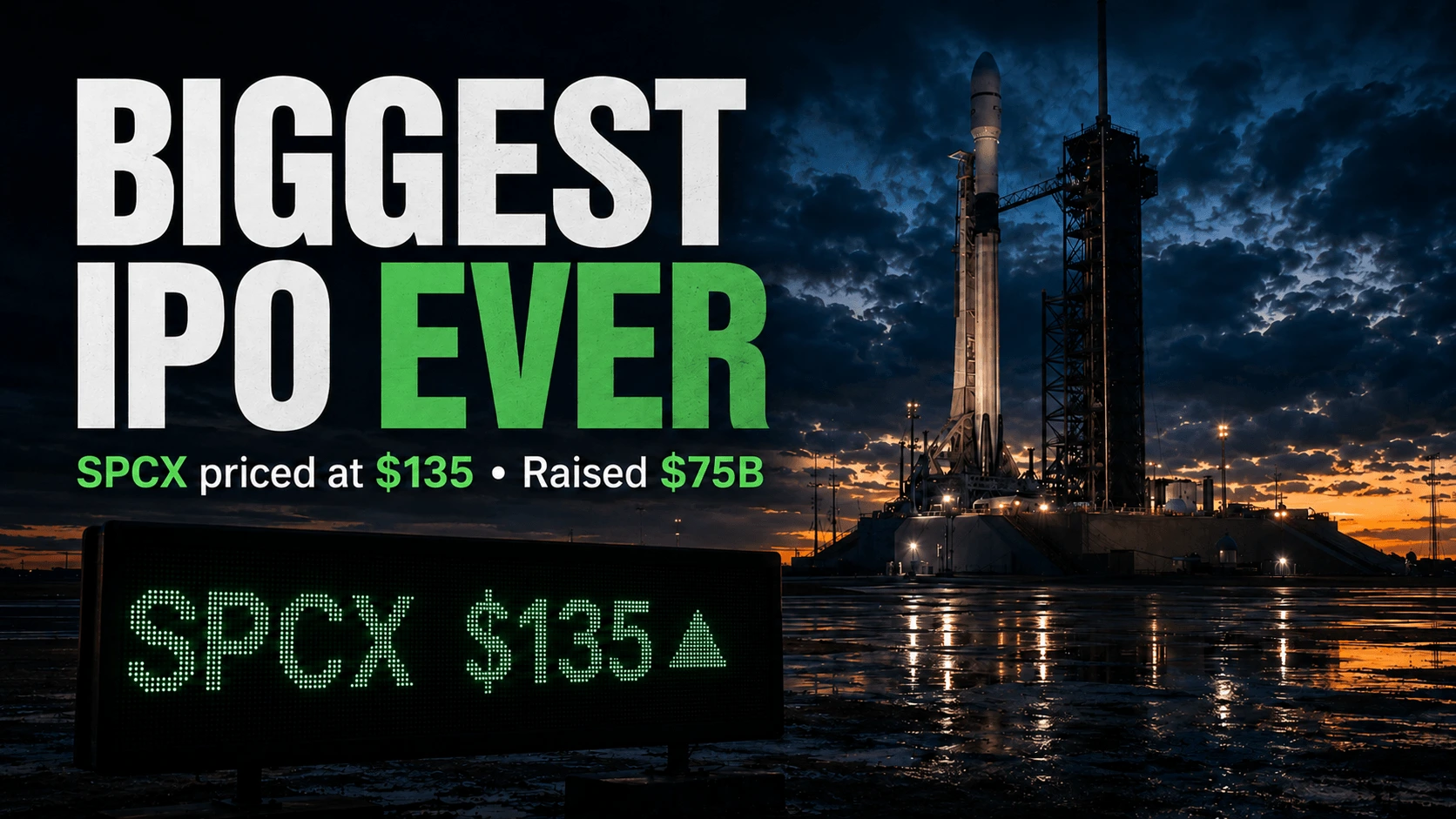
Every front page today says the same thing: biggest IPO ever. SpaceX listed on the Nasdaq under the ticker SPCX at $135 a share — roughly a $1.75 trillion valuation, about $75 billion raised, and a bell rung from a launch site in South Texas instead of Wall Street (CNBC). That headline is correct, commodity by tonight, and not the story we came to tell.

Mindber doesn't track rockets. We track AI tools — what they cost, whether they're still alive, and whether the company behind them will exist when your annual contract renews. By that lens, June 12, 2026 marks something more specific than a record: it is the first time a frontier AI lab landed on public markets, wearing a rocket company as a trench coat.

Summary

  • SpaceX (Nasdaq: SPCX) listed June 12, 2026 at $135/share — roughly a $1.75 trillion valuation and the largest IPO in history.
  • The under-covered part: since February 2026, xAI — Grok, X, and the Colossus supercomputer — is a wholly owned SpaceX subsidiary. SPCX is the first frontier AI lab ordinary investors can own outside Big Tech.
  • SpaceX agreed in May 2026 to buy Cursor for a reported $60 billion (closing status pending).
  • OpenAI and Anthropic are reported to be preparing listings, possibly this year — neither has a confirmed date.
  • For AI-tool buyers this changes three things: vendor durability becomes auditable through quarterly filings, public-market margin pressure flows downhill into pricing, and model-vendor comparison finally gets real numbers.

The headline everyone got — and the one that matters here

Until today, if you wanted equity exposure to a frontier model lab, your options were slivers inside Microsoft, Alphabet, Meta, or Amazon — businesses where AI is one line among many and impossible to isolate on a balance sheet. SPCX changes the shape of that. Reuters-tracked coverage and the S-1 itself describe SpaceX as a "vertically integrated space technology, connectivity, and artificial intelligence company." The AI part is not a footnote. It is a reporting segment with its own revenue lines.

The scale of the listing tells you how the market read it. SpaceX reserved roughly 30% of the allocation for retail investors — against a typical 5–10% — and retail orders were reported north of $100 billion (Yahoo Finance, Kiplinger). That is not how a launch business prices itself. It is how a once-in-a-cycle technology platform prices itself.

$1.75T
Implied valuation at the $135 IPO price — the largest debut in market history
CNBC IPO coverage, 2026-06-12
~30%
Share of the allocation reserved for retail, vs a typical 5–10%
Yahoo Finance / Kiplinger, 2026-06-12
$60B
Reported price of the pending SpaceX–Cursor acquisition (May 2026)
CNBC, 2026-05-20

So when retail bought SPCX this morning, they did not buy a launch business with a chatbot stapled on. They bought launch, satellite broadband, a social network, a frontier model lab, one of the world's largest AI training clusters, and — pending close — one of the most widely adopted AI code editors on the market. The directory exists for exactly this question: what is actually inside the thing you're paying for. You can read how we break a vendor down on the Mindber methodology page and check live adoption on the AI Models board.

How a rocket company became an AI lab

The structure took four years of Russian-doll mergers to assemble, and most of the IPO commentary skips it entirely. Musk bought Twitter in 2022 and renamed it X. In 2025, xAI absorbed X, which handed Grok a live feed of public posts for training and retrieval. Then on February 2, 2026, SpaceX acquired xAI in an all-stock deal — SpaceX valued at $1 trillion, xAI at $250 billion, a combined $1.25 trillion — folding the lab in as a wholly owned subsidiary, later organized under a division reported as SpaceXAI.

Two more moves filled out the AI segment this year. Tesla put $2 billion into xAI in January. And in May 2026, SpaceX struck a deal to acquire Cursor — the AI coding editor a meaningful share of engineering teams run daily — for a reported $60 billion.

How SpaceX became a frontier AI lab (2022 → 2026)

  1. 1

    2022 — Musk buys Twitter, renames it X

    The social platform that will later supply Grok its real-time public-post feed for training and retrieval enters the orbit.
  2. 2

    2025 — xAI absorbs X

    Grok's maker and the social network merge. The data pipe and the model lab are now one entity.
  3. 3

    Jan 2026 — Tesla invests $2B in xAI

    A second Musk company anchors the lab's capital base ahead of the larger combination.
  4. 4

    Feb 2, 2026 — SpaceX acquires xAI (all-stock)

    SpaceX at $1T, xAI at $250B — a combined $1.25T. xAI becomes a wholly owned SpaceX subsidiary; Grok, X, and Colossus move under the rocket company.
  5. 5

    May 2026 — SpaceX strikes a deal for Cursor (~$60B)

    The AI code editor is folded into the AI segment build-out. Closing status remains pending against current filings.
  6. 6

    Jun 12, 2026 — SpaceX IPOs on the Nasdaq as SPCX

    The first frontier AI lab reaches public markets — inside a vertically integrated space, connectivity, and AI company.

That chain is why the "first AI IPO" framing holds. The model lab did not list under its own name. It listed as the third segment of a company most people still file under "rockets."

What the filing actually discloses

The prospectus is unusually legible for a company this complex. It reports three segments, and the AI one is not cosmetic.

SegmentWhat's insideDisclosed signals (per S-1 coverage)
SpaceFalcon, Dragon, Starship, government launchFalcon 9 booster reuse at a record 35 flights; roughly 200 droneship landing attempts on a single vessel
ConnectivityStarlinkSubscribers roughly doubled 2024 to 2025 from a 4.4M base; majority share of company revenue
AIGrok, X, Colossus computeX plus Grok subscription revenue up $365M in 2025 and another $177M in Q1 2026; xAI holds a US DoD contract with a $200M ceiling

Two honest caveats sit right in the document. First, Connectivity (Starlink), not AI, is still the revenue engine — the AI segment is the fastest-growing and the most strategically loud, but it is not yet the largest line. Second, the prospectus is candid about the cost of assembling all this: it acknowledges that integrating xAI brought delays, disruptions, added costs, and diverted management attention. A buyer reading this as an "AI stock" should hold both facts at once. You can pull the actual filing yourself from SEC EDGAR rather than trusting any single outlet's summary — which is exactly the source-first habit our data-sources policy is built around.

The valuation fight nobody can settle

Wall Street cannot agree on what the whole thing is worth, and the disagreement is the tell. Independent analyst targets published this week run from $63 a share (Morningstar) to $190 (Oppenheimer) — against the $135 IPO price. One analysis pegs the listing at roughly 94 times 2025 revenue. That is a three-times spread between the bear and the bull on the same filing, the same segments, the same numbers.

We are not here to referee it, and nothing here is investment advice. The spread itself is the point: when a company is one part launch cadence, one part subscriber-growth broadband, and one part frontier-model lab, every analyst is really making three bets at once and weighting them differently. The AI segment is the variable they disagree on most, because it has the least history and the steepest implied curve. How much of that $1.75 trillion the AI segment carries is precisely the open question — and it is the part a tools buyer, not a stock buyer, can actually reason about, because adoption and durability are observable. That is what the Mindber rankings and the liveness methodology measure.

Why this matters if you buy AI tools, not AI shares

Three things change for anyone running AI tooling budgets — the readers we wrote The True Cost of AI Tools in 2026 for.

Vendor durability becomes auditable. Our liveness scoring exists because AI tools die quietly and take your workflows with them — the pattern we documented across the discover directory. A public parent flips the information asymmetry: Grok, X subscriptions, and — post-close — Cursor will now surface in quarterly filings. Audited revenue is the strongest durability signal there is, far stronger than a changelog cadence or a Discord pulse. When the company behind your code editor has to report that segment to the SEC every 90 days, "is this tool going to be abandoned?" stops being a guess.

Pricing pressure flows downhill. Public companies answer to margin expectations every quarter. The enterprise pricing resets we documented in the AI Shelfware Epidemic were driven by private burn math; public-market scrutiny tends to accelerate both price increases on sticky products and discounting on lagging ones. If Cursor closes under SPCX, its pricing tiers become a quarterly-earnings variable rather than a founder's judgment call. For anyone modeling spend, that is a structural change — budget for it the way you'd model any other line in a true-cost teardown.

Comparison gets real numbers. Today, comparing model vendors on stability means reading tea leaves. Once OpenAI and Anthropic follow, the AI model landscape gains something it has never had: three frontier labs publishing audited revenue, churn-adjacent metrics, and named risk factors, side by side. That is the real story of June 12. SPCX didn't just break Saudi Aramco's record — it opened the era in which the AI tools market gets a public ledger.

What a public SPCX changes for AI buyers

Filings replace guesswork

Durability you can audit

  • Grok, X subs, and (post-close) Cursor now report in quarterly numbers
  • Audited revenue beats changelog cadence as a liveness signal
  • Cross-check vendor health on the Mindber liveness score before you renew
Margins answer to the market every 90 days

Pricing becomes an earnings variable

  • Expect sharper increases on sticky tiers and discounts on laggards
  • Model Cursor's price as a quarterly variable if the deal closes
  • Re-run your TCO each quarter, not each contract
Once OpenAI and Anthropic follow

Real numbers for comparison

  • Three frontier labs with audited revenue, side by side
  • Risk factors stated in plain prospectus language
  • Compare adoption and cost on the AI Models board, not the sales deck

What the OpenAI and Anthropic listings will change

Reporting from NBC, Gizmodo, and others says both OpenAI and Anthropic are preparing public offerings, potentially this year. Neither has a confirmed listing date, so treat the timing as reported, not scheduled. But the direction matters more than the date.

A single public AI lab is a data point. Three is a market. The moment a second and third frontier lab file their own S-1s, the entire category becomes legible in a way it has never been: comparable revenue recognition, comparable disclosure of compute spend, comparable risk language about model litigation and data sourcing. Buyers stop comparing marketing pages and start comparing 10-Qs. For a brand like Mindber — built on the premise that you should trust the numbers, not the vendor — that is the tailwind the whole thesis was waiting for. We track each lab's tools today in the AI Models registry and across the LLM category and AI agents category; audited financials would make those pages sharper.

One thing we deliberately skipped: the Grok content and litigation history. It is real, it is contested, and it is not what a tools-buyer needs from this filing. If and when it becomes a material risk factor in an actual prospectus, we'll cover it against the document — not the discourse. That restraint is the same reason our disclaimer and source-transparency rules exist.

The watchlist from here

We'll track three dates, and each lands in the What's New radar within 24 hours, sourced and versioned, per usual:

  1. The Cursor deal's closing status — until it closes, treat the $60B figure as a struck deal, not a completed acquisition. Check current filings.
  2. SPCX's first quarterly report as a public company — the first audited look inside a frontier lab's AI segment. This is the number the entire "is it an AI stock" debate is waiting on.
  3. Any S-1 from OpenAI or Anthropic — the moment the category gets its second and third public comparables.

If you build or buy on top of these labs, the practical move is unglamorous: re-baseline your vendor assumptions each quarter once the filings start, the same discipline we recommend for procurement in the PDPA/PDPC AI procurement guide and for cost in the Opus 4.8 cost calculator.

How Mindber reads this

A finance desk asks "is $135 cheap?" We ask a narrower, more answerable question: does going public make these tools more or less likely to be alive, supported, and honestly priced a year from now? On the evidence in the filing, the answer leans toward more — public disclosure is a durability signal, even when the valuation is contested. That is the only claim we'll make, and we'll revise it when the first quarterly report lands. You can follow our running read on the blog and the live rankings.

Frequently asked questions

Is xAI publicly traded?

Indirectly, yes. xAI became a wholly owned SpaceX subsidiary in February 2026, and SpaceX began trading on the Nasdaq under the ticker SPCX on June 12, 2026. Buying SPCX gives exposure to xAI, Grok, and X. There is no standalone xAI ticker.

What stock ticker is Grok under?

SPCX. Grok is developed by xAI, which sits inside SpaceX. The relevant Nasdaq listing is SPCX, which began trading June 12, 2026. There is no separate Grok or xAI ticker.

Does SpaceX own Cursor?

Not yet completed. SpaceX struck a deal in May 2026 to acquire Cursor for a reported $60 billion as part of its AI segment build-out. The closing status should be checked against current filings before treating it as final.

When will OpenAI and Anthropic IPO?

Multiple reports as of June 2026 say both OpenAI and Anthropic are preparing public offerings, potentially this year. Neither company has a confirmed listing date, so treat the timing as reported, not scheduled.

Is SPCX an AI stock?

Partly. SpaceX's S-1 reports three segments: Space (launch), Connectivity (Starlink), and AI (Grok, X, and Colossus compute). The filing describes the company as a vertically integrated space technology, connectivity, and artificial intelligence company. Connectivity is still the larger revenue line; AI is the fastest-growing and most strategically prominent. How much of the $1.75 trillion valuation the AI segment carries is exactly what analysts disagree on.

What was the SpaceX IPO price and valuation?

SpaceX priced its IPO at $135 a share on June 12, 2026, implying a valuation of roughly $1.75 trillion and raising about $75 billion — reported as the largest IPO in history, surpassing Saudi Aramco's prior record. Analyst price targets published the same week ranged from $63 (Morningstar) to $190 (Oppenheimer).

What is Colossus?

Colossus is the supercomputer / AI training cluster operated by xAI, now part of SpaceX's AI segment. In the S-1 it sits alongside Grok and X as the compute backbone of the AI business. It is one of the reasons the filing can describe SpaceX as an artificial-intelligence company rather than only a space company.

How much of SpaceX's revenue comes from AI?

The S-1 does not present AI as the majority line. Connectivity (Starlink) holds the majority share of company revenue; the AI segment is the fastest-growing, with X plus Grok subscription revenue reported up $365M in 2025 and another $177M in Q1 2026, plus a US DoD contract with a $200M ceiling. Treat AI as a rising segment, not the revenue base — and watch the first public quarterly report for the audited split.

Why does a public SpaceX matter if I buy AI software, not shares?

Because public disclosure changes what you can know about your vendor. Once Grok, X, and (post-close) Cursor report inside quarterly filings, vendor durability becomes auditable rather than inferred from changelogs — the strongest input to a liveness assessment. Public-market margin pressure also tends to move pricing on both sticky and lagging products, so buyers should model AI tool spend as a quarterly variable. See the Mindber liveness methodology and the true-cost teardown for how we factor that in.

Sources

Every figure in this article is attributed to a named third-party source or the primary S-1 filing. Mindber conducted no original research here and makes no investment recommendation. Re-verify against the primary source before acting.

  1. [1]
    SpaceX listed on the Nasdaq as SPCX on June 12, 2026 at $135/share; roughly $1.75T valuation, ~$75B raised; reported as the largest IPO in history; retail allocation ~30% with retail orders reported north of $100B
    CNBC — SpaceX IPO live coverage (May 20 & June 12, 2026) — 2026-06-12
  2. [2]
    S-1 describes SpaceX as a vertically integrated space technology, connectivity, and artificial intelligence company across three segments; prospectus acknowledges xAI integration brought delays, disruptions, added costs, and diverted management attention
    SpaceX S-1 via SEC EDGAR — 2026-06-12
  3. [3]
    xAI became a wholly owned SpaceX subsidiary on February 2, 2026 (all-stock; SpaceX $1T, xAI $250B, combined $1.25T); xAI absorbed X in 2025; Tesla invested $2B in xAI in January 2026
    Reuters via Capital.com — SpaceX/xAI coverage — 2026-06
  4. [4]
    SpaceX struck a deal in May 2026 to acquire Cursor for a reported $60 billion; closing status pending
    CNBC — May 20, 2026 — 2026-05-20
  5. [5]
    Analyst price targets range from $63 (Morningstar) to $190 (Oppenheimer) vs the $135 IPO price; one analysis pegs the listing at roughly 94x 2025 revenue
    Kiplinger / BitMEX-cited analysis — 2026-06-12
  6. [6]
    Disclosed signals: Falcon 9 booster reuse at a record 35 flights; ~200 droneship landing attempts on a single vessel; Starlink subscribers roughly doubled 2024 to 2025 from a 4.4M base; X plus Grok subscription revenue up $365M in 2025 and $177M in Q1 2026; xAI holds a US DoD contract with a $200M ceiling
    Kalkine / IndMoney / Sentisight S-1 analyses; Spaceflight Now — 2026-06
  7. [7]
    OpenAI and Anthropic reported to be preparing public offerings, potentially this year, with no confirmed dates
    Gizmodo (June 12, 2026) / NBC News (June 12, 2026) — 2026-06-12
  8. [8]
    IPO-day market data and quote reference for SPCX on the Nasdaq
    Yahoo Finance / Nasdaq market activity — 2026-06-12

Not investment advice. Mindber aggregates and cites publicly available information about AI tools and the companies behind them. Nothing on this page is investment, legal, or financial advice, and nothing here is a recommendation to buy or sell any security. Figures reflect reporting available as of publication and are versioned — this page is updated as filings change. Vendors may submit corrections through our right of reply.

Keep reading

The True Cost of AI Tools in 2026: Sticker vs Reality

Why the rate card is ~12% of what an AI tool actually costs — a fully sourced TCO model for buyers.

The AI Shelfware Epidemic: 53% of Spend Goes Unused

Why most enterprise AI spend destroys value — and the 30-minute audit that stops it before the renewal.

Track the AI IPO wave

One email when the Cursor deal closes, SPCX reports its first quarter, or OpenAI/Anthropic file — sourced and versioned.

Share this article

Legal notice

This publication constitutes editorial commentary on publicly available information and does not constitute financial, legal, investment, or professional advice. Product names, trademarks, and registered trademarks referenced herein are the property of their respective owners; their appearance does not imply endorsement or affiliation. Mindber's analysis reflects editorial judgment based on public signals and is subject to change without notice. Scores are not buy, sell, or hold recommendations. No commercial relationship exists between Mindber and the vendors evaluated unless separately disclosed in writing. This publication is governed by the laws of Malaysia. Any dispute arising from or in connection with this publication shall be submitted to the exclusive jurisdiction of the courts of Malaysia.

AI-generated · This report was generated using AI language models trained on publicly available data. It reflects editorial analysis at the time of generation and is not the result of hands-on product testing, independent verification by a human analyst, or a commercial endorsement. All scores, assessments, and claims are derived from signals indexed by Mindber at generation time and are subject to change without notice. Mindber and its operators make no warranty of accuracy, completeness, or fitness for any commercial decision-making purpose. This report is for informational purposes only.

MI

Mindber Research

Mindber Research Desk. AI tools and SaaS market analysis.

Tracks 500+ AI and SaaS tools through the Mindber Innovation Index and liveness methodology. Covers the companies behind the tools, not the stock.

On this page
  • The headline everyone got — and the one that matters here
  • How a rocket company became an AI lab
  • What the filing actually discloses
  • The valuation fight nobody can settle
  • Why this matters if you buy AI tools, not AI shares
  • What the OpenAI and Anthropic listings will change
  • The watchlist from here
  • How Mindber reads this
  • Frequently asked questions

Related articles

Claude Fable 5 Suspended by US Government Order

Jun 1312 min

Best AI Models, Ranked — June 2026 Leaderboard for Text, Coding, Agents, Image & Video (With Sources)

Jun 1516 min

Claude Fable 5: What It Is, How to Use It, and the Prompts That Exploit It

Jun 913 min
Sign In
Skip to main content
BlogThe SpaceX IPO Is Quietly the First Big AI IPO

The SpaceX IPO Is Quietly the First Big AI IPO

newsUpdated June 13, 202613 min read

SpaceX (Nasdaq: SPCX) went public June 12, 2026 — putting Grok, xAI, and a $60B Cursor deal on the market. What the first AI IPO means for buyers.

#ai-ipo#spacex#spcx#xai#grok#cursor#ai-tools-market
The SpaceX IPO Is Quietly the First Big AI IPO — SpaceX (Nasdaq: SPCX) went public June 12, 2026 — putting Grok, xAI, and a $60B Cursor deal on the market. What the first AI IPO means for buyers.

Reported as of June 12, 2026. Mindber editorial analysis of public reporting and SpaceX's S-1 filing, verified against primary sources — not original research, not financial advice, and not a recommendation to buy or sell any security. Every figure below is attributed to a named third-party source and reflects what was published as of this date. Filings and prices change; verify against the primary source before you act.

By Mindber Research · AI tools and SaaS market analysis. We track the companies behind the tools, not the ticker — see our methodology and liveness scoring.

Every front page today says the same thing: biggest IPO ever. SpaceX listed on the Nasdaq under the ticker SPCX at $135 a share — roughly a $1.75 trillion valuation, about $75 billion raised, and a bell rung from a launch site in South Texas instead of Wall Street (CNBC). That headline is correct, commodity by tonight, and not the story we came to tell.

Mindber doesn't track rockets. We track AI tools — what they cost, whether they're still alive, and whether the company behind them will exist when your annual contract renews. By that lens, June 12, 2026 marks something more specific than a record: it is the first time a frontier AI lab landed on public markets, wearing a rocket company as a trench coat.

Summary

  • SpaceX (Nasdaq: SPCX) listed June 12, 2026 at $135/share — roughly a $1.75 trillion valuation and the largest IPO in history.
  • The under-covered part: since February 2026, xAI — Grok, X, and the Colossus supercomputer — is a wholly owned SpaceX subsidiary. SPCX is the first frontier AI lab ordinary investors can own outside Big Tech.
  • SpaceX agreed in May 2026 to buy Cursor for a reported $60 billion (closing status pending).
  • OpenAI and Anthropic are reported to be preparing listings, possibly this year — neither has a confirmed date.
  • For AI-tool buyers this changes three things: vendor durability becomes auditable through quarterly filings, public-market margin pressure flows downhill into pricing, and model-vendor comparison finally gets real numbers.

The headline everyone got — and the one that matters here

Until today, if you wanted equity exposure to a frontier model lab, your options were slivers inside Microsoft, Alphabet, Meta, or Amazon — businesses where AI is one line among many and impossible to isolate on a balance sheet. SPCX changes the shape of that. Reuters-tracked coverage and the S-1 itself describe SpaceX as a "vertically integrated space technology, connectivity, and artificial intelligence company." The AI part is not a footnote. It is a reporting segment with its own revenue lines.

The scale of the listing tells you how the market read it. SpaceX reserved roughly 30% of the allocation for retail investors — against a typical 5–10% — and retail orders were reported north of $100 billion (Yahoo Finance, Kiplinger). That is not how a launch business prices itself. It is how a once-in-a-cycle technology platform prices itself.

$1.75T
Implied valuation at the $135 IPO price — the largest debut in market history
CNBC IPO coverage, 2026-06-12
~30%
Share of the allocation reserved for retail, vs a typical 5–10%
Yahoo Finance / Kiplinger, 2026-06-12
$60B
Reported price of the pending SpaceX–Cursor acquisition (May 2026)
CNBC, 2026-05-20

So when retail bought SPCX this morning, they did not buy a launch business with a chatbot stapled on. They bought launch, satellite broadband, a social network, a frontier model lab, one of the world's largest AI training clusters, and — pending close — one of the most widely adopted AI code editors on the market. The directory exists for exactly this question: what is actually inside the thing you're paying for. You can read how we break a vendor down on the Mindber methodology page and check live adoption on the AI Models board.

How a rocket company became an AI lab

The structure took four years of Russian-doll mergers to assemble, and most of the IPO commentary skips it entirely. Musk bought Twitter in 2022 and renamed it X. In 2025, xAI absorbed X, which handed Grok a live feed of public posts for training and retrieval. Then on February 2, 2026, SpaceX acquired xAI in an all-stock deal — SpaceX valued at $1 trillion, xAI at $250 billion, a combined $1.25 trillion — folding the lab in as a wholly owned subsidiary, later organized under a division reported as SpaceXAI.

Two more moves filled out the AI segment this year. Tesla put $2 billion into xAI in January. And in May 2026, SpaceX struck a deal to acquire Cursor — the AI coding editor a meaningful share of engineering teams run daily — for a reported $60 billion.

How SpaceX became a frontier AI lab (2022 → 2026)

  1. 1

    2022 — Musk buys Twitter, renames it X

    The social platform that will later supply Grok its real-time public-post feed for training and retrieval enters the orbit.
  2. 2

    2025 — xAI absorbs X

    Grok's maker and the social network merge. The data pipe and the model lab are now one entity.
  3. 3

    Jan 2026 — Tesla invests $2B in xAI

    A second Musk company anchors the lab's capital base ahead of the larger combination.
  4. 4

    Feb 2, 2026 — SpaceX acquires xAI (all-stock)

    SpaceX at $1T, xAI at $250B — a combined $1.25T. xAI becomes a wholly owned SpaceX subsidiary; Grok, X, and Colossus move under the rocket company.
  5. 5

    May 2026 — SpaceX strikes a deal for Cursor (~$60B)

    The AI code editor is folded into the AI segment build-out. Closing status remains pending against current filings.
  6. 6

    Jun 12, 2026 — SpaceX IPOs on the Nasdaq as SPCX

    The first frontier AI lab reaches public markets — inside a vertically integrated space, connectivity, and AI company.

That chain is why the "first AI IPO" framing holds. The model lab did not list under its own name. It listed as the third segment of a company most people still file under "rockets."

What the filing actually discloses

The prospectus is unusually legible for a company this complex. It reports three segments, and the AI one is not cosmetic.

SegmentWhat's insideDisclosed signals (per S-1 coverage)
SpaceFalcon, Dragon, Starship, government launchFalcon 9 booster reuse at a record 35 flights; roughly 200 droneship landing attempts on a single vessel
ConnectivityStarlinkSubscribers roughly doubled 2024 to 2025 from a 4.4M base; majority share of company revenue
AIGrok, X, Colossus computeX plus Grok subscription revenue up $365M in 2025 and another $177M in Q1 2026; xAI holds a US DoD contract with a $200M ceiling

Two honest caveats sit right in the document. First, Connectivity (Starlink), not AI, is still the revenue engine — the AI segment is the fastest-growing and the most strategically loud, but it is not yet the largest line. Second, the prospectus is candid about the cost of assembling all this: it acknowledges that integrating xAI brought delays, disruptions, added costs, and diverted management attention. A buyer reading this as an "AI stock" should hold both facts at once. You can pull the actual filing yourself from SEC EDGAR rather than trusting any single outlet's summary — which is exactly the source-first habit our data-sources policy is built around.

The valuation fight nobody can settle

Wall Street cannot agree on what the whole thing is worth, and the disagreement is the tell. Independent analyst targets published this week run from $63 a share (Morningstar) to $190 (Oppenheimer) — against the $135 IPO price. One analysis pegs the listing at roughly 94 times 2025 revenue. That is a three-times spread between the bear and the bull on the same filing, the same segments, the same numbers.

We are not here to referee it, and nothing here is investment advice. The spread itself is the point: when a company is one part launch cadence, one part subscriber-growth broadband, and one part frontier-model lab, every analyst is really making three bets at once and weighting them differently. The AI segment is the variable they disagree on most, because it has the least history and the steepest implied curve. How much of that $1.75 trillion the AI segment carries is precisely the open question — and it is the part a tools buyer, not a stock buyer, can actually reason about, because adoption and durability are observable. That is what the Mindber rankings and the liveness methodology measure.

Why this matters if you buy AI tools, not AI shares

Three things change for anyone running AI tooling budgets — the readers we wrote The True Cost of AI Tools in 2026 for.

Vendor durability becomes auditable. Our liveness scoring exists because AI tools die quietly and take your workflows with them — the pattern we documented across the discover directory. A public parent flips the information asymmetry: Grok, X subscriptions, and — post-close — Cursor will now surface in quarterly filings. Audited revenue is the strongest durability signal there is, far stronger than a changelog cadence or a Discord pulse. When the company behind your code editor has to report that segment to the SEC every 90 days, "is this tool going to be abandoned?" stops being a guess.

Pricing pressure flows downhill. Public companies answer to margin expectations every quarter. The enterprise pricing resets we documented in the AI Shelfware Epidemic were driven by private burn math; public-market scrutiny tends to accelerate both price increases on sticky products and discounting on lagging ones. If Cursor closes under SPCX, its pricing tiers become a quarterly-earnings variable rather than a founder's judgment call. For anyone modeling spend, that is a structural change — budget for it the way you'd model any other line in a true-cost teardown.

Comparison gets real numbers. Today, comparing model vendors on stability means reading tea leaves. Once OpenAI and Anthropic follow, the AI model landscape gains something it has never had: three frontier labs publishing audited revenue, churn-adjacent metrics, and named risk factors, side by side. That is the real story of June 12. SPCX didn't just break Saudi Aramco's record — it opened the era in which the AI tools market gets a public ledger.

What a public SPCX changes for AI buyers

Filings replace guesswork

Durability you can audit

  • Grok, X subs, and (post-close) Cursor now report in quarterly numbers
  • Audited revenue beats changelog cadence as a liveness signal
  • Cross-check vendor health on the Mindber liveness score before you renew
Margins answer to the market every 90 days

Pricing becomes an earnings variable

  • Expect sharper increases on sticky tiers and discounts on laggards
  • Model Cursor's price as a quarterly variable if the deal closes
  • Re-run your TCO each quarter, not each contract
Once OpenAI and Anthropic follow

Real numbers for comparison

  • Three frontier labs with audited revenue, side by side
  • Risk factors stated in plain prospectus language
  • Compare adoption and cost on the AI Models board, not the sales deck

What the OpenAI and Anthropic listings will change

Reporting from NBC, Gizmodo, and others says both OpenAI and Anthropic are preparing public offerings, potentially this year. Neither has a confirmed listing date, so treat the timing as reported, not scheduled. But the direction matters more than the date.

A single public AI lab is a data point. Three is a market. The moment a second and third frontier lab file their own S-1s, the entire category becomes legible in a way it has never been: comparable revenue recognition, comparable disclosure of compute spend, comparable risk language about model litigation and data sourcing. Buyers stop comparing marketing pages and start comparing 10-Qs. For a brand like Mindber — built on the premise that you should trust the numbers, not the vendor — that is the tailwind the whole thesis was waiting for. We track each lab's tools today in the AI Models registry and across the LLM category and AI agents category; audited financials would make those pages sharper.

One thing we deliberately skipped: the Grok content and litigation history. It is real, it is contested, and it is not what a tools-buyer needs from this filing. If and when it becomes a material risk factor in an actual prospectus, we'll cover it against the document — not the discourse. That restraint is the same reason our disclaimer and source-transparency rules exist.

The watchlist from here

We'll track three dates, and each lands in the What's New radar within 24 hours, sourced and versioned, per usual:

  1. The Cursor deal's closing status — until it closes, treat the $60B figure as a struck deal, not a completed acquisition. Check current filings.
  2. SPCX's first quarterly report as a public company — the first audited look inside a frontier lab's AI segment. This is the number the entire "is it an AI stock" debate is waiting on.
  3. Any S-1 from OpenAI or Anthropic — the moment the category gets its second and third public comparables.

If you build or buy on top of these labs, the practical move is unglamorous: re-baseline your vendor assumptions each quarter once the filings start, the same discipline we recommend for procurement in the PDPA/PDPC AI procurement guide and for cost in the Opus 4.8 cost calculator.

How Mindber reads this

A finance desk asks "is $135 cheap?" We ask a narrower, more answerable question: does going public make these tools more or less likely to be alive, supported, and honestly priced a year from now? On the evidence in the filing, the answer leans toward more — public disclosure is a durability signal, even when the valuation is contested. That is the only claim we'll make, and we'll revise it when the first quarterly report lands. You can follow our running read on the blog and the live rankings.

Frequently asked questions

Is xAI publicly traded?

Indirectly, yes. xAI became a wholly owned SpaceX subsidiary in February 2026, and SpaceX began trading on the Nasdaq under the ticker SPCX on June 12, 2026. Buying SPCX gives exposure to xAI, Grok, and X. There is no standalone xAI ticker.

What stock ticker is Grok under?

SPCX. Grok is developed by xAI, which sits inside SpaceX. The relevant Nasdaq listing is SPCX, which began trading June 12, 2026. There is no separate Grok or xAI ticker.

Does SpaceX own Cursor?

Not yet completed. SpaceX struck a deal in May 2026 to acquire Cursor for a reported $60 billion as part of its AI segment build-out. The closing status should be checked against current filings before treating it as final.

When will OpenAI and Anthropic IPO?

Multiple reports as of June 2026 say both OpenAI and Anthropic are preparing public offerings, potentially this year. Neither company has a confirmed listing date, so treat the timing as reported, not scheduled.

Is SPCX an AI stock?

Partly. SpaceX's S-1 reports three segments: Space (launch), Connectivity (Starlink), and AI (Grok, X, and Colossus compute). The filing describes the company as a vertically integrated space technology, connectivity, and artificial intelligence company. Connectivity is still the larger revenue line; AI is the fastest-growing and most strategically prominent. How much of the $1.75 trillion valuation the AI segment carries is exactly what analysts disagree on.

What was the SpaceX IPO price and valuation?

SpaceX priced its IPO at $135 a share on June 12, 2026, implying a valuation of roughly $1.75 trillion and raising about $75 billion — reported as the largest IPO in history, surpassing Saudi Aramco's prior record. Analyst price targets published the same week ranged from $63 (Morningstar) to $190 (Oppenheimer).

What is Colossus?

Colossus is the supercomputer / AI training cluster operated by xAI, now part of SpaceX's AI segment. In the S-1 it sits alongside Grok and X as the compute backbone of the AI business. It is one of the reasons the filing can describe SpaceX as an artificial-intelligence company rather than only a space company.

How much of SpaceX's revenue comes from AI?

The S-1 does not present AI as the majority line. Connectivity (Starlink) holds the majority share of company revenue; the AI segment is the fastest-growing, with X plus Grok subscription revenue reported up $365M in 2025 and another $177M in Q1 2026, plus a US DoD contract with a $200M ceiling. Treat AI as a rising segment, not the revenue base — and watch the first public quarterly report for the audited split.

Why does a public SpaceX matter if I buy AI software, not shares?

Because public disclosure changes what you can know about your vendor. Once Grok, X, and (post-close) Cursor report inside quarterly filings, vendor durability becomes auditable rather than inferred from changelogs — the strongest input to a liveness assessment. Public-market margin pressure also tends to move pricing on both sticky and lagging products, so buyers should model AI tool spend as a quarterly variable. See the Mindber liveness methodology and the true-cost teardown for how we factor that in.

Sources

Every figure in this article is attributed to a named third-party source or the primary S-1 filing. Mindber conducted no original research here and makes no investment recommendation. Re-verify against the primary source before acting.

  1. [1]
    SpaceX listed on the Nasdaq as SPCX on June 12, 2026 at $135/share; roughly $1.75T valuation, ~$75B raised; reported as the largest IPO in history; retail allocation ~30% with retail orders reported north of $100B
    CNBC — SpaceX IPO live coverage (May 20 & June 12, 2026) — 2026-06-12
  2. [2]
    S-1 describes SpaceX as a vertically integrated space technology, connectivity, and artificial intelligence company across three segments; prospectus acknowledges xAI integration brought delays, disruptions, added costs, and diverted management attention
    SpaceX S-1 via SEC EDGAR — 2026-06-12
  3. [3]
    xAI became a wholly owned SpaceX subsidiary on February 2, 2026 (all-stock; SpaceX $1T, xAI $250B, combined $1.25T); xAI absorbed X in 2025; Tesla invested $2B in xAI in January 2026
    Reuters via Capital.com — SpaceX/xAI coverage — 2026-06
  4. [4]
    SpaceX struck a deal in May 2026 to acquire Cursor for a reported $60 billion; closing status pending
    CNBC — May 20, 2026 — 2026-05-20
  5. [5]
    Analyst price targets range from $63 (Morningstar) to $190 (Oppenheimer) vs the $135 IPO price; one analysis pegs the listing at roughly 94x 2025 revenue
    Kiplinger / BitMEX-cited analysis — 2026-06-12
  6. [6]
    Disclosed signals: Falcon 9 booster reuse at a record 35 flights; ~200 droneship landing attempts on a single vessel; Starlink subscribers roughly doubled 2024 to 2025 from a 4.4M base; X plus Grok subscription revenue up $365M in 2025 and $177M in Q1 2026; xAI holds a US DoD contract with a $200M ceiling
    Kalkine / IndMoney / Sentisight S-1 analyses; Spaceflight Now — 2026-06
  7. [7]
    OpenAI and Anthropic reported to be preparing public offerings, potentially this year, with no confirmed dates
    Gizmodo (June 12, 2026) / NBC News (June 12, 2026) — 2026-06-12
  8. [8]
    IPO-day market data and quote reference for SPCX on the Nasdaq
    Yahoo Finance / Nasdaq market activity — 2026-06-12

Not investment advice. Mindber aggregates and cites publicly available information about AI tools and the companies behind them. Nothing on this page is investment, legal, or financial advice, and nothing here is a recommendation to buy or sell any security. Figures reflect reporting available as of publication and are versioned — this page is updated as filings change. Vendors may submit corrections through our right of reply.

Keep reading

The True Cost of AI Tools in 2026: Sticker vs Reality

Why the rate card is ~12% of what an AI tool actually costs — a fully sourced TCO model for buyers.

The AI Shelfware Epidemic: 53% of Spend Goes Unused

Why most enterprise AI spend destroys value — and the 30-minute audit that stops it before the renewal.

Track the AI IPO wave

One email when the Cursor deal closes, SPCX reports its first quarter, or OpenAI/Anthropic file — sourced and versioned.

Share this article

Legal notice

This publication constitutes editorial commentary on publicly available information and does not constitute financial, legal, investment, or professional advice. Product names, trademarks, and registered trademarks referenced herein are the property of their respective owners; their appearance does not imply endorsement or affiliation. Mindber's analysis reflects editorial judgment based on public signals and is subject to change without notice. Scores are not buy, sell, or hold recommendations. No commercial relationship exists between Mindber and the vendors evaluated unless separately disclosed in writing. This publication is governed by the laws of Malaysia. Any dispute arising from or in connection with this publication shall be submitted to the exclusive jurisdiction of the courts of Malaysia.

AI-generated · This report was generated using AI language models trained on publicly available data. It reflects editorial analysis at the time of generation and is not the result of hands-on product testing, independent verification by a human analyst, or a commercial endorsement. All scores, assessments, and claims are derived from signals indexed by Mindber at generation time and are subject to change without notice. Mindber and its operators make no warranty of accuracy, completeness, or fitness for any commercial decision-making purpose. This report is for informational purposes only.

MI

Mindber Research

Mindber Research Desk. AI tools and SaaS market analysis.

Tracks 500+ AI and SaaS tools through the Mindber Innovation Index and liveness methodology. Covers the companies behind the tools, not the stock.

On this page
  • The headline everyone got — and the one that matters here
  • How a rocket company became an AI lab
  • What the filing actually discloses
  • The valuation fight nobody can settle
  • Why this matters if you buy AI tools, not AI shares
  • What the OpenAI and Anthropic listings will change
  • The watchlist from here
  • How Mindber reads this
  • Frequently asked questions

Related articles

Claude Fable 5 Suspended by US Government Order

Jun 1312 min

Best AI Models, Ranked — June 2026 Leaderboard for Text, Coding, Agents, Image & Video (With Sources)

Jun 1516 min

Claude Fable 5: What It Is, How to Use It, and the Prompts That Exploit It

Jun 913 min