
Best AI Models, Ranked: June 2026 Leaderboard for Text, Coding, Agents, Image & Video (With Sources)
guideUpdated 16 min read
The best AI model in June 2026, ranked by job: Claude Fable 5 leads capability, GPT-5.5 coding agents, Gemini 3.1 Pro value. With sources.
Last verified: 2026-06-15 (SGT/MYT) · Mindber Data Drop v2026.06. Benchmark scores and prices on this page date from that check and name their sources. Anthropic and OpenAI have both released newer models since June, so read this as the June record and use the live Model Arena for today's order.
By Mindber Research · AI model tracking. Figures checked against the cited leaderboards on 2026-06-15.
How we assessed this: Editorial analysis of published results from independent leaderboards (Artificial Analysis, vals.ai, Scale AI SEAL, tbench.ai, τ²-bench, LMArena) and vendor pricing pages, as of June 2026. Mindber ran no private benchmarks, and this is not hands-on product testing. Any figure we could not confirm against a live source was dropped, not guessed.
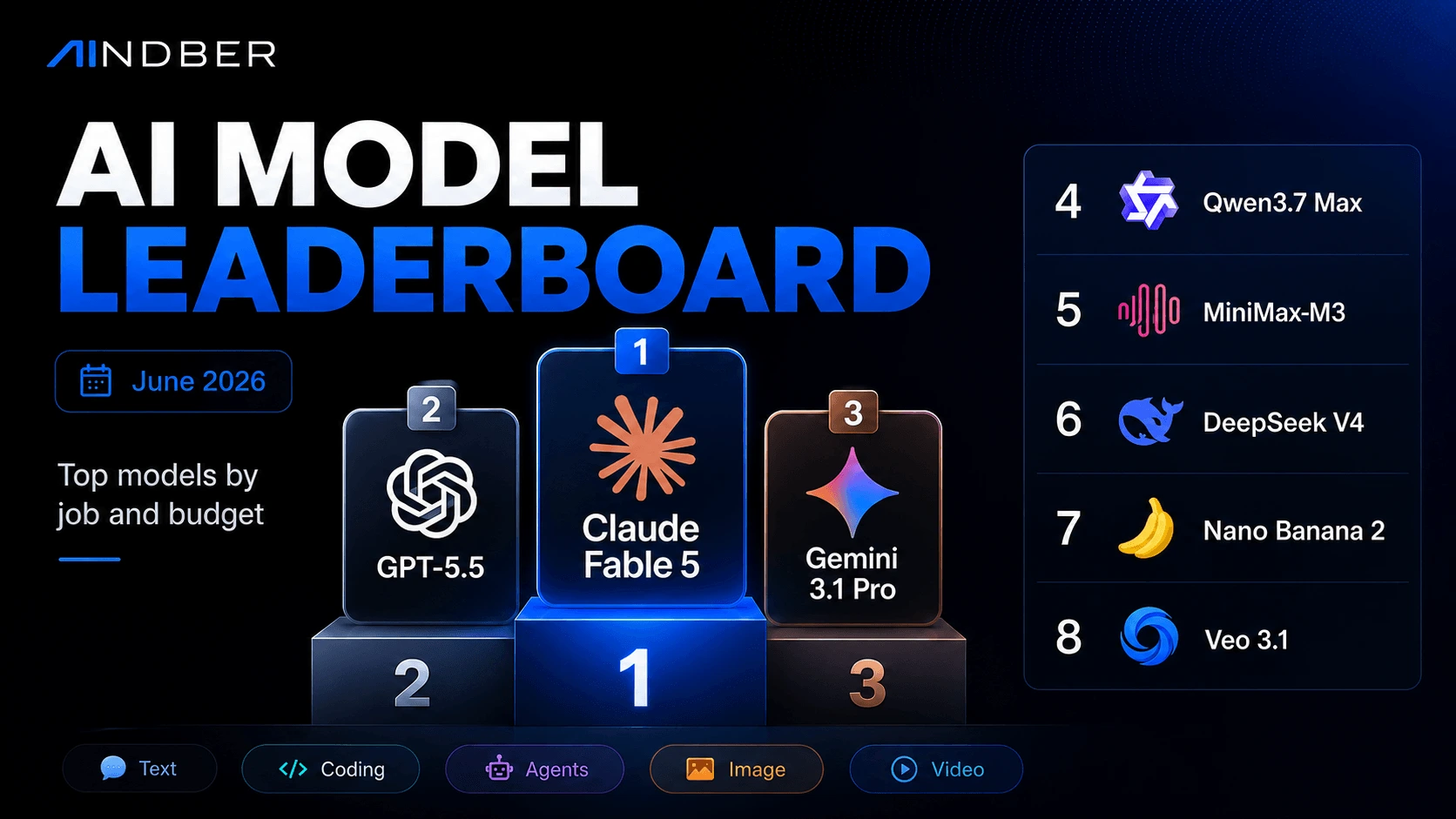
If you're choosing a model to sit behind a product or a coding agent, the top row of a leaderboard is rarely the one to buy. On raw capability, the best AI model in June 2026 is Claude Fable 5, first on the Artificial Analysis Intelligence Index at 65. The next four models sit within about 8 points of it. Their prices are far apart.
Our pick for most production traffic is Gemini 3.1 Pro or Qwen3.7 Max. Both score 57 on the same index for less than a quarter of Fable 5's blended price. We would pay frontier rates only for the hardest 5 to 10% of requests. The rest can go to that value tier, or to an open-weight model such as MiniMax-M3 or DeepSeek V4. Coding agents, images and video each have their own leaders, listed in the table below.
Availability is the second reason not to default to the top row. A US government order switched Fable 5 off everywhere three days after its 9 June launch, as our suspension story reported at the time. Anthropic restored access on 1 July. So on the day we checked these boards, nobody could use the model at the top of the index. An earlier version of this page ranked Fable 5 without saying so. Our June reporting shows it was offline that day, so we added it.
June 2026 leaders by job
| Job | Shortlist first | Cheaper option | Watch out for |
|---|---|---|---|
| Text & reasoning | Claude Fable 5 | Gemini 3.1 Pro / Qwen3.7 Max | Prices differ far more than scores |
| Coding (model) | Claude Fable 5 / Opus 4.8 | DeepSeek V4 / MiniMax-M3 | SWE-bench Verified is saturated |
| Coding agent (tool) | GPT-5.5 (Codex CLI) | Claude Opus 4.8 (Claude Code) | Boards rank agent and model as a pair |
| General agent / tool use | GPT-5.5 | GLM-5 family (customer-service tasks) | No universal winner across benchmarks |
| Image | Nano Banana 2 | Seedream 5.0 (volume) | Lane leaders, no single #1 |
| Video | Veo 3.1 (cinematic + audio) | Kling 3.0 | Sora 2 is retired, so migrate off it |
| Lowest cost or self-hosting | DeepSeek V4 Pro | MiniMax-M3 | Blended prices move often |
| Fastest output | Mercury 2 | Gemini 3.1 Flash-Lite | Speed counts most in long chains |
Picks are Mindber's reading of the June 2026 boards. The evidence for each row is in the sections below.
What moved between April and June
Seven weeks that reset the board
- 1
23 April 2026: GPT-5.5
OpenAI's new default everyday model. It goes on to lead agentic coding through Codex. - 2
26 April: Sora closes on the web and in its app
OpenAI sets 24 September 2026 as the date the Sora 2 API shuts down. - 3
28 May: Claude Opus 4.8
Anthropic's new Opus arrives at the same per-token price as the one before it. - 4
9 June: Claude Fable 5 goes GA
It debuts first on the Artificial Analysis Intelligence Index and first on SWE-bench Verified, with a 1M-token context. - 5
12 June: Fable 5 switched off
A US government order disables Fable 5 and Mythos 5 on every platform. Access returns on 1 July.
GPT-5.5 came with a reported drop in hallucinations of about 60% against GPT-5.4, and its current rates sit on the OpenAI pricing page. Anthropic shipped two models twelve days apart. The new Opus kept its predecessor's price and moved ahead of it on both the index and SWE-bench Verified. Fable 5 is the bigger step. Our Fable 5 guide walks through access and the safeguards Anthropic attached to it, and Anthropic's own framing is in its announcement.
The larger shift happened lower down. Open-weight models nearly caught up. MiniMax-M3 and DeepSeek V4, along with Alibaba's Qwen3.7 Max, now sit within about 0.2 points of Gemini's Pro model on SWE-bench Verified. The two open-weight models get there at roughly one-tenth of Gemini's token price. The top of the table has become a plateau, and in 2026 the decisions worth your time are about cost, speed and fit.
Text and reasoning: a narrow top, wide prices
The cleanest single capability number is the Artificial Analysis Intelligence Index. It folds GPQA Diamond, MMLU-Pro, AIME, LiveCodeBench and several other benchmarks into one normalised score.
| # | Model | Creator | Intelligence Index | Blended price /1M | Context |
|---|---|---|---|---|---|
| 1 | Claude Fable 5 (max effort) | Anthropic | 65 | $7.70 | 1M |
| 2 | Claude Opus 4.8 (max) | Anthropic | 61 | $3.85 | 1M |
| 3 | GPT-5.5 (xhigh) | OpenAI | 60 | $4.35 | 922k |
| 4 | GPT-5.5 (high) | OpenAI | 59 | $4.35 | 922k |
| 5 | Gemini 3.1 Pro Preview | 57 | $1.74 | 1M | |
| 5 | Qwen3.7 Max | Alibaba | 57 | $1.43 | 1M |
| 5 | Claude Opus 4.7 (max) | Anthropic | 57 | $3.85 | 1M |
| 8 | Gemini 3.5 Flash | 55 | $1.31 | 1M | |
| 8 | MiniMax-M3 (open) | MiniMax | 55 | $0.22 | 1M |
| 10 | Kimi K2.6 (open) | Moonshot | 54 | $0.70 | 256k |
Source: Artificial Analysis Intelligence Index, June 2026.
Across a broad reasoning suite, the gap from first to fifth is small enough that most production workloads won't notice it. The bill will. Google's Pro model charges $1.74 per million tokens, blended, and Fable 5 costs more than four times that for 8 extra points. Qwen3.7 Max matches Gemini's score for a little less and brings strong multilingual output.
Further down, MiniMax-M3 comes within two points of Gemini at about an eighth of its price. If most of your spend goes on a high volume of medium-difficulty calls, those few points rarely justify the gap in price. The weekly LLM rankings let you recheck the trade as new models land.
Human preference is a separate question. LMArena records which answers people like in blind A/B votes, while the index measures what models can do. The Claude and Gemini families trade places at the top of LMArena's text board, and that order shifts week to week. When the two boards disagree, a model is usually over- or under-tuned for chat style. Neither source is wrong. Mindber's scoring methodology keeps capability and preference on separate axes for that reason, instead of folding them into one number.
Coding scores: which numbers hold up
Coding has the most misleading numbers on the internet.
| # | Model | SWE-bench Verified | Price /1M (in/out) |
|---|---|---|---|
| 1 | Claude Fable 5 | 95.0% | $10 / $50 |
| 2 | Claude Opus 4.8 | 88.6% | $5 / $25 |
| 3 | GPT-5.5 | 82.6% | $5 / $30 |
| 4 | Claude Opus 4.7 | ~82% | $5 / $25 |
| 5 | MiniMax-M3 (open) | 80.5% | $0.30 / $1.20 |
| 5 | Gemini 3.5 Flash | 78.8% | $1.31 blended |
Source: vals.ai SWE-bench Verified, June 2026. Reported scores for the older Opus range from 82% to 88% depending on the test scaffold.
SWE-bench Verified is partly saturated and partly memorised. Its 500 Python issues leaked into training data before the benchmark was widely published. OpenAI's own audit found that frontier models can reproduce verbatim "gold" patches for some tasks, and OpenAI stopped reporting Verified scores. It now points to SWE-bench Pro instead.
Scale AI's SEAL leaderboard runs every model on identical scaffolding. There the scores fall hard. The best public standardised result is about 59.1%, from GPT-5.4 at xHigh, and no model passes about 47.1% on the private commercial set. Moving from Verified to Pro typically costs a model 15 to 35 points.
Top result on each board, June 2026. Higher is better.
Verified: Fable 5
95/100
SEAL public: GPT-5.4
59.1/100
SEAL private set
47.1/100
0255075100
Source: vals.ai SWE-bench Verified and Scale AI SEAL (standardised scaffolding), Jun 1, 2026
Mindber's verification methodology treats any headline benchmark number as a hypothesis to check, and SWE-bench shows why. A "95% on SWE-bench" claim tells you the benchmark is saturated more than it tells you about the model. Use Pro or standardised numbers for procurement and keep Verified for a rough relative order. On harder code that a model hasn't seen, expect roughly half the Verified success rate.
Coding agents and tool use: the pair gets ranked
An agent leaderboard doesn't rank models. It ranks an agent tool and a model together, and the tool matters as much as the model. Terminal-Bench 2.1 has the agent operate a real computer through the terminal: compiling code, setting up servers, running data workflows.
GPT-5.5Opus 4.8
SWE-bench Verified, model alone
GPT-5.5
82.6 %
Opus 4.8
88.6 %
Terminal-Bench 2.1, inside Codex CLI and Claude Code
GPT-5.5
83.4 %
Opus 4.8
78.9 %
Source: vals.ai SWE-bench Verified and tbench.ai Terminal-Bench 2.1, Jun 1, 2026
Opus wins the model test by six points. Put each model inside its maker's agent and the result reverses: Codex CLI on GPT-5.5 scores 83.4% on Terminal-Bench, ahead of Claude Code at 78.9%. Gemini CLI running Google's Pro model is third, at 70.7% (±2.9), per tbench.ai.
The effect shows up inside one model too. Anthropic's new Opus is listed at 74.6% on the same benchmark, more than four points below its Claude Code result. Our sources don't say which test setup produced that figure. Read the gap as a hint about scaffolding, not a measurement.
Customer-service tool use reorders the board again. On τ²-bench's retail and airline tool-calling tasks, GLM-family models lead, and GLM-4.7-Flash scores 98.8%. A model that wins at terminal automation can lose at multi-turn customer-service work, so choose the agent by the task you run, not by a single board.
Image and video: pick the lane
No image model leads every kind of work. Find the lane your images sit in:
- All-round work and consistent characters: Nano Banana 2 (Gemini 3.1 Flash Image) outputs native 4K and keeps faces and styles stable across edits. That suits mascots, storyboards and campaigns. It sits at the premium end, about $0.13 to $0.24 an image.
- Text and typography: GPT Image (1.5 / 2) reasons through spatial instructions in a "thinking" latent space. It's the one model you can trust to spell a headline correctly, and it rates consistently near the top on Arena.ai for prompt adherence.
- High volume on a budget: Seedream 5.0 (ByteDance) gives production-grade 4K at about $0.026 to $0.032 an image, built for e-commerce catalogues and content calendars.
- Logos and posters: Ideogram v3.
- Locking a brand style, with open weights: Flux 2 Pro, in dev, pro and max tiers.
- Non-English prompts: Qwen Image, strong on Chinese, Arabic and Spanish.
- Speed: Z-Image Turbo, at about one second per image.
Video lost its best-known name this spring. OpenAI closed Sora on the web and in its app on 26 April 2026 and set 24 September 2026 for the API shutdown. No new pipeline should start on it.
For cinematic work, Google's Veo 3.1 is our pick. It is the only model here that generates 48kHz synchronised dialogue, where the others stop at sound effects. It also renders people and natural light with the best photorealism in the field. A 5-second clip costs about $0.15 to $1.20, depending on the tier.
Kling 3.0 from Kuaishou is the workhorse for iteration: native 4K at 60fps with multilingual lip-sync, for about $0.10 a second. The rest of the field fills narrower jobs.
- Seedance 2.0 (ByteDance) handles image-to-video, stylised motion and short vertical clips.
- HappyHorse-1.0 (Alibaba) generates audio and video together and lip-syncs in 7 languages. It is climbing the Artificial Analysis video board and runs on fal.ai.
- Runway Gen-4.5 lost the leaderboard lead but still wins directed, multi-shot work, thanks to motion brushes, scene consistency and a real timeline editor.
- Luma Ray3.14 outputs native 16-bit HDR.
Video arenas score on different scales, LMArena text-to-video on one and Artificial Analysis on another, so their numbers don't compare. Treat these as lane leaders, not one ranked ladder.
The value tier, and how to route traffic
If you ship a product and watch margins, the open-weight rows matter most. They sit close to the frontier at a fraction of the cost:
| Model | Index | Price /1M | Why pick it |
|---|---|---|---|
| MiniMax-M3 (open) | 55 | $0.22 | Near-frontier, open weights, 1M context |
| Kimi K2.6 (open) | 54 | $0.70 | Strong open reasoning |
| DeepSeek V4 Pro (open) | 52 | $0.18 | Cheapest credible workhorse, and cache hits cut input cost further |
| GLM-5.1 (open) | 51 | $0.90 | Strong tool use and agent work |
Source: Artificial Analysis, June 2026.
The cheapest good setup puts a router in front of several models. About 80% of traffic goes to a cheap workhorse such as DeepSeek V4, MiniMax-M3 or a small Gemini Flash. A frontier model, Opus or Fable 5, takes the hard 20%. Done right, that beats any single-model subscription on cost and on quality.
Work it through at the blended rates in our tables. Four-fifths of your tokens at DeepSeek V4 Pro's rate plus one-fifth at the Opus rate comes to under a quarter of sending everything to Opus. That assumes every request uses the same number of tokens. If the hard fifth runs longer, the saving shrinks.
The rate card is also only part of the bill. The True Cost of AI Tools 2026 puts the real cost of an AI tool at about 8x its sticker price once retries, output asymmetry and idle seats are counted.
Set the quality bar before you set the split. Collect a few dozen real requests with answers you would accept, then run them through two value-tier models. Only the requests both of them fail need the frontier tier.
Speed for real-time work and long agent chains
When latency compounds across many sequential steps, throughput decides. Median output speed in June 2026:
- Mercury 2 (Inception, a diffusion LLM): about 889 tokens per second
- Granite 4.0 H Small (IBM): about 524
- Step 3.7 Flash: about 385
- gpt-oss-120b (high): about 338
- Gemini 3.1 Flash-Lite: about 326
Source: Artificial Analysis median output speed, June 2026.
For chat, anything over about 150 tokens per second already feels instant. Speed pays off in agent loops and batch jobs. There, each extra second is multiplied by the number of steps in the chain.
More from Mindber
- Compare puts two models side by side on price and capability.
- The AI tools directory lists image, video and coding tools with Mindber scores and live pricing, and you can filter it by use case.
- The Opus 4.8 cost calculator works out break-even workloads against Sonnet and GPT-5.5.
- All our guides, including the Fable 5 and cost explainers this page draws on.
Frequently asked questions
Is Claude better than GPT-5.5?
On broad reasoning, yes: Claude Fable 5 and Opus 4.8 both rank above GPT-5.5 on the Intelligence Index. As a coding agent, no, since Codex CLI on GPT-5.5 beats Claude Code on Terminal-Bench. On price they are close. Opus and GPT-5.5 both charge $5 per million input tokens, and Opus costs less per output token.
What is the best free or open-source AI model?
MiniMax-M3 is the strongest open-weight model on the June index, ahead of Kimi K2.6 and DeepSeek V4 Pro. Open weights let you download the model and run it yourself, so you pay for hardware instead of a per-token fee. If you'd rather not run GPUs, the same models sell through APIs, and DeepSeek V4 Pro costs about $0.18 per million tokens, blended.
Why does Fable 5 show two different prices on this page?
They measure different things. The $10 / $50 figure is the list price per million input and output tokens, and $7.70 is the single blended figure Artificial Analysis publishes. The blended figure comes out below both list rates, and we haven't reconstructed how it is calculated. Price a real workload from the list rates and use blended numbers for ranking.
Is Claude Mythos 5 on this leaderboard?
No. Research-preview models such as the Mythos tier appear on some leaderboards but are not generally available, so we rank only models the public can use. Mythos 5 was also disabled by the same June order that took Fable 5 offline. Fable 5 stays in the ranking because it was on general release before the order and returned on 1 July.
Which image model handles Chinese or mixed-language prompts best?
Qwen Image and Seedream handle Chinese and mixed-script prompts more reliably than Western-tuned models. Seedream's low per-image price also makes batch product shots realistic on a small budget, which matters to sellers and creators in Southeast Asia who work across several languages.
How often is this leaderboard updated?
Editions were planned monthly, with the next one due in mid-July 2026. The figures in this June edition have not been revised since the 15 June check. For newer models, the Model Arena board and the What's New feed track launches as they happen.
Method & sources
- Capability, price and speed: Artificial Analysis Intelligence Index (381 models), June 2026.
- Coding: vals.ai (SWE-bench Verified) and Scale AI SEAL (SWE-bench Pro, standardised scaffolding), June 2026.
- Agents: tbench.ai (Terminal-Bench 2.1) and τ²-bench, June 2026.
- Human preference: LMArena (blind A/B voting), June 2026.
- Vendor pricing & specs: Anthropic, OpenAI and Google Gemini pricing pages, June 2026.
- Fable 5 availability: Mindber's June reporting and Anthropic's redeployment notice.
Prices are blended or illustrative and change often, so confirm each provider's live pricing before you commit spend.
Spot an error or a release we missed? Use the correction form and include a link to the source.
Related on Mindber
The True Cost of AI Tools in 2026: Sticker vs Reality
Why the real cost of an AI tool runs ~8x the rate card, with a fully sourced TCO model and the seven hidden costs.
Opus 4.8 Cost Calculator: When It Beats Sonnet & GPT-5.5
Break-even workloads, smart-routing savings, and per-model cache rates for the current frontier models.
Claude Fable 5: What It Is, How to Use It, and the Prompts That Exploit It
Anthropic's first public Mythos-class model: pricing, safeguards, benchmarks, access and copy-paste prompts.
Learn the basics on Mindber
Background for this article, from the free Mindber learning hub.
Topic guides
AI Basics lessons
Share this article
Legal notice
This publication constitutes editorial commentary on publicly available information and does not constitute financial, legal, investment, or professional advice. Product names, trademarks, and registered trademarks referenced herein are the property of their respective owners; their appearance does not imply endorsement or affiliation. Mindber's analysis reflects editorial judgment based on public signals and is subject to change without notice. Scores are not buy, sell, or hold recommendations. No commercial relationship exists between Mindber and the vendors evaluated unless separately disclosed in writing. This publication is governed by the laws of Malaysia. Any dispute arising from or in connection with this publication shall be submitted to the exclusive jurisdiction of the courts of Malaysia.