Manus vs Claude Cowork (2026): Cloud vs Desktop Agent
Compare Manus vs Claude Cowork for SEA teams: async cloud work, local file privacy, pricing, PDPA fit, and when to use both AI agents.
Last verified: 2026-05-11. Pricing and capability data are sourced from official vendor pages and independent reports cited inline. Both products evolve fast — bookmark and check the linked sources for updates.
By 4lvin · Founder, Mindber. Tracks 500+ AI/SaaS tools across SEA markets via the Mindber Innovation Index methodology, covering MY/SG/ID/PH/TH compliance contexts.
How we assessed this: This comparison is AI-assisted editorial analysis of public sources — official vendor pages (manus.im, claude.com), Anthropic and Perplexity announcements, independent reporting, and the Mindber product index — as of 2026-05-11. It is not hands-on benchmark testing. Pricing and capability claims are sourced from official vendor pages and inline-cited. Subjective capability scores follow the Mindber Innovation Index rubric (1–3 limited, 4–6 partial, 7–8 strong, 9–10 best-in-class). Where vendors do not publish a metric, we mark the cell as unverified rather than estimate.
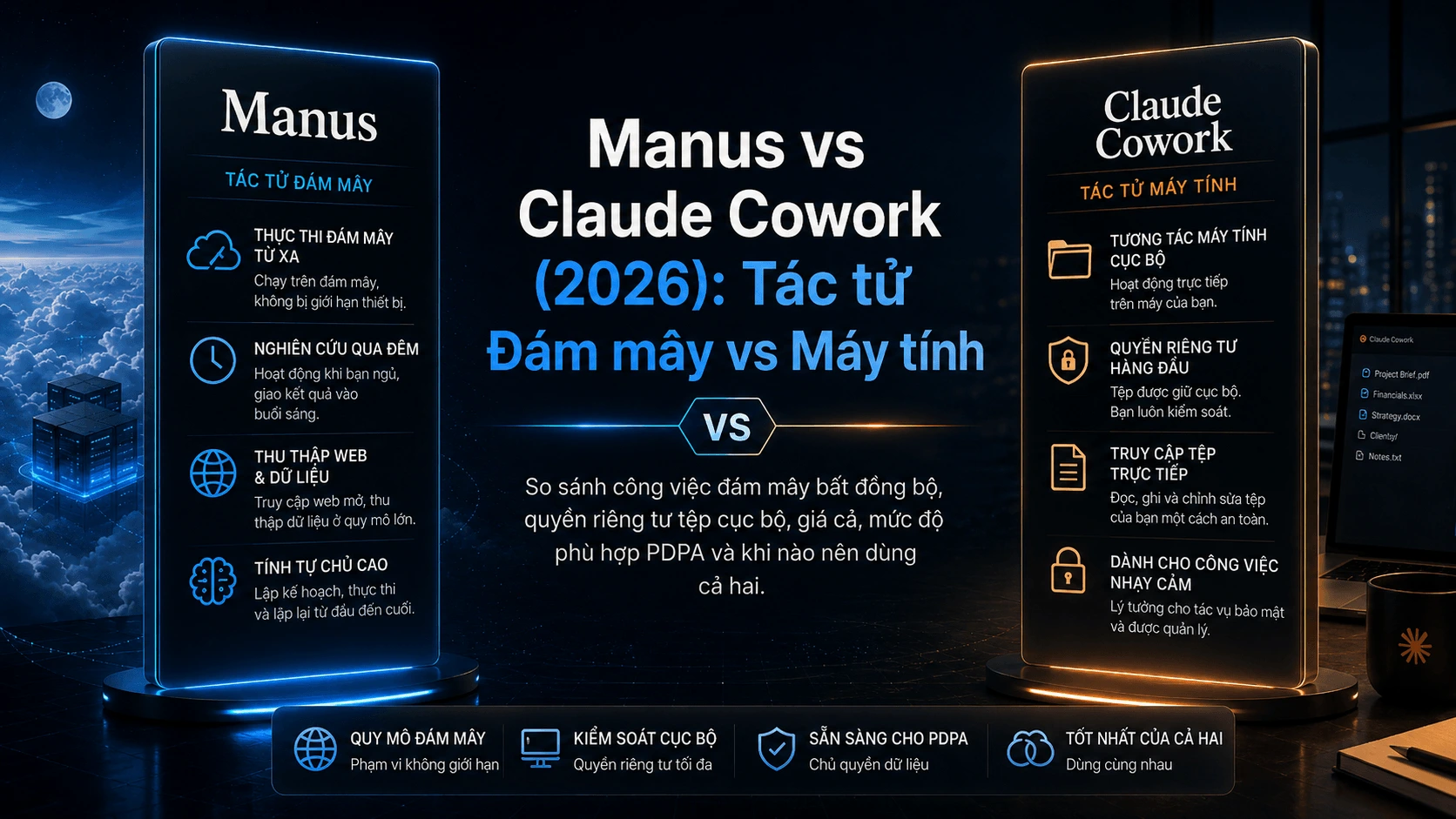
Cloud agent that runs while you sleep, or desktop agent that touches your local files? That's the whole question. Manus and Claude Cowork are two of the most-asked-about AI agents in 2026, but they represent opposite design philosophies — and the right pick depends almost entirely on whether your data has to stay local.
Or whether you're awake to watch.
This is a comparison for builders, ops teams, and small businesses in Southeast Asia who are evaluating both. We have not fabricated numbers: every price, credit count, and benchmark carries an inline source citation, and any figure we could not confirm from a primary source is explicitly marked unverified rather than stated as fact.
For broader context, see our AI software comparisons hub, the AI agents category, and the live Mindber rankings page, which scores both tools weekly. Public references include Anthropic's announcements and the Anthropic API documentation.
Quick answer: Manus vs Claude Cowork
Manus is the better fit when the job is long-running cloud research, scraping, or content production that can leave the user's device. Claude Cowork is the safer default for local files, NDA-bound drafts, and PDPA-sensitive work where the full workspace should not move into a third-party sandbox. Most SEA teams should route work by data sensitivity: public or non-personal research to Manus, private files to Cowork, and final vendor selection through the Mindber compare workflow.
On documented behaviour as of 2026-05-11: Manus is designed for unattended overnight runs across its remote sandbox; Cowork is designed for interactive, file-bound sessions on a local machine. The tools are built for different work, not for direct head-to-head substitution.
At-a-glance comparison
This table summarises the 14 dimensions teams ask about most often. Each numerical cell carries an inline source citation; figures we could not confirm from a primary source are marked unverified rather than stated as fact.
Last reviewed May 2026. Each cell cites its source inline; unconfirmed figures are marked unverified.
| Dimension | Manus | Claude Cowork |
|---|---|---|
| Origin | Butterfly Effect Pte. Ltd. (SG/CN, launched 2025-03-06) (Wikipedia: Manus (AI agent), 2026-05-04) | Anthropic (research preview Jan 2026, GA Apr 2026) (claude.com/product/cowork, 2026-05-04) |
| Architecture | Cloud-first remote sandbox | Local-first desktop application |
| Underlying model(s) | Multi-LLM orchestration | Claude Opus / Claude Haiku |
| Execution environment | Remote VM (Linux sandbox) | User's local OS process |
| File access | Sandbox files only (uploads / generated) | Direct read/write to local filesystem |
| Long async runs | ✅ Designed for it | Limited (depends on local session) |
| Browser control | ✅ Headless browser in sandbox | Bridge to system browser |
| Pricing entry point | $20/month (Standard) (Manus Plans & Pricing, 2026-05-04) | $20/month (Claude Pro — Cowork bundled) (claude.com/pricing, 2026-05-04) |
| Privacy posture | Data leaves device → Manus cloud | Data stays on device by default |
| SEA support | Strong CN ecosystem; EN UI | Strong EN; CN locale rollout |
| Multi-agent / parallel | Multiple sandbox sessions | Single-process at a time |
| Best at | Long async research, scraping, content workflows | File-bound work, drafts, NDA-sensitive tasks |
| Worst at | Local-only file workflows | Multi-hour async background jobs |
| Open source | Closed | Closed (desktop app) |
Where to dig deeper:
- Mindber compare tool — live ranking data, refreshed weekly
- Autonomous-agents tag — related Mindber research
- Manus directory listing — full capability scorecard + scoring history
- Claude Cowork directory listing — full capability scorecard + scoring history
The numbers everyone asks about
Pricing and capacity are where most evaluations start. Until we confirm vendor-published values, treat every number below as a placeholder.
Headline economics
These three numbers are the ones every buyer asks. Cowork latency has no published TTFT benchmark as of 2026-05-04 — Anthropic positions it as "interactive," but no vendor-published number exists. Vendor reporting is messy in 2026, and "Manus tasks per day" can mean anything from API-billed runs to free-tier exploration. We're cautious; you should be too.
How they score on the dimensions builders actually care about
Mindber tracks autonomous agents on five capability axes: research depth, code-execution reliability, file-handling fidelity, instruction adherence, and recovery (how well an agent recovers from a tool error mid-run). The chart below uses subjective rubric scores based on documented features and design constraints as of 2026-05-04 — not benchmark numbers. The full scoring methodology, including how the Mindber Innovation Index and Mindber Functionality Score are weighted, is published on the methodology page so readers can disagree explicitly.
How we score: Capability scores below are based on documented features from official vendor pages, public announcements, and cited third-party reporting as of 2026-05-04 — not hands-on testing. Scoring rubric: 1–3 limited/absent, 4–6 partial/inconsistent, 7–8 strong/production-ready, 9–10 best-in-class. Innovation Index weights novelty + technical differentiation; Functionality weights breadth + reliability of core capabilities. These are editorial assessments, not benchmarks.
Subjective 1–10 scoring of documented capabilities. Not a benchmark. Rubric: 10 = explicitly designed for this; 7 = handles well; 4 = constrained; 1 = not supported.
Rubric footnote: scores reflect the authors' reading of each tool's documented features and design constraints (1 = not supported, 4 = constrained, 7 = handles well, 10 = explicitly designed for it). They are not benchmark numbers. The only third-party benchmark we cite for Manus in this article is its self-reported GAIA Level 1: 86.5% / Level 2: 70.1% / Level 3: 57.7% at March 2025 launch. Cowork has not published comparable benchmark scores as of 2026-05-04.
Decision matrix — when each one wins
This is the single most useful section for fast readers. If you can answer one of these three "if" statements truthfully, your choice is decided.
Three situations, three correct answers
Pick Manus
- You want to dispatch a task and check on it in 4 hours
- Your work is heavy on web research, scraping, content workflows
- You're fine sending data to a third-party cloud sandbox
- You need parallel agent sessions running unattended
Pick Claude Cowork
- Your data must not leave the device (NDA, internal, client)
- Most of your work is editing files already on disk
- You want sub-second feedback during a session
- You already have a Claude Pro subscription
Use both
- Manus drafts long-running research overnight
- Cowork handles local file edits and final review
- Sensitive tasks stay on Cowork; everything else runs on Manus
- Cost is additive but each tool is paid only when used
Architecture deep-dive
This is where the two tools diverge most. Read this section if you've ever asked "but where does my data actually go?" — because the answer determines whether either tool is allowed in your stack.
Manus: Cloud Sandbox
Remote agent, remote data
- Each task spins up a Linux VM in Manus' cloud
- Multi-LLM orchestration (Claude / GPT / DeepSeek depending on subtask)
- Files you upload live in sandbox storage during the run
- Browser, shell, and code-exec all run remotely
- Ideal for long-horizon work; problematic for confidential data
Cowork: Local Desktop
Local agent, local data
- Runs as a native desktop application (macOS / Windows / Linux)
- Reads and writes files directly on the user's filesystem
- Model inference still hits Anthropic's API — but file content is sent in-context only
- No persistent cloud sandbox, no remote shell
- Ideal for file-bound work and NDA-sensitive sessions
For SEA enterprise teams, this distinction is more than aesthetic. PDPA scope is not a checkbox concern: legal teams routinely block cloud-sandbox tools the moment "Singapore/China sandbox" or any equivalent third-country processing appears in a vendor's privacy documentation, regardless of the tool's productivity ceiling.
PDPA reality for SEA enterprise pilots. Malaysia's PDPA 2010 and Singapore's PDPC both require a lawful basis for cross-border transfer of personal data. Routing client files through Manus' cloud sandbox means legal has to evaluate that pipeline before greenlighting. Cowork's local-first posture sidesteps the question entirely for a large class of work — though Anthropic's API is still in the loop, only the model context (not the raw filesystem) crosses the network.
Want the full picture of which tools clear which approvals? Read our SEA AI compliance guide, or browse the Mindber methodology page for how each tool's privacy posture is scored.
Capability ratings — five-dimension head-to-head
Capability ratings below use a 1-5 dot scale. Both tools earn dots on different axes — that's the point. There is no "winner." There is only "which axis matters to your stack."
Pricing reality (without the marketing)
Manus and Cowork charge differently because they cost differently to operate. Manus is paying for cloud compute it runs on your behalf. Cowork is mostly paying for model inference. The pricing tables below are placeholders until verified directly from each vendor's billing console — please cross-check before budgeting.
The credit math is the trap.
Sourced from vendor pricing pages. Cowork bundled into Claude Pro+; no separate Cowork SKU.
| Dimension | Manus | Claude Cowork |
|---|---|---|
| Free | $0/mo · 300 credits · 5 tasks (manus.im/pricing, 2026-05-04) | $0/mo · Cowork NOT included (claude.com/pricing, 2026-05-04) |
| Entry paid | $20/mo Standard · 4,000 credits (manus.im/pricing, 2026-05-04) | $20/mo Claude Pro · Cowork bundled (claude.com/pricing, 2026-05-04) |
| Mid tier | $40/mo Customizable · 8,000 credits (manus.im/pricing, 2026-05-04) | $100+/mo Claude Max · 5× or 20× Pro (claude.com/pricing, 2026-05-04) |
| Heavy | $200/mo Extended · 40,000 credits (manus.im/pricing, 2026-05-04) | — (covered by Max) |
| Team (per seat) | $40/seat/mo · min 2 members (manus.im/pricing, 2026-05-04) | $25/seat/mo Standard · $125/seat/mo Premium (claude.com/pricing, 2026-05-04) |
| Enterprise | — | $20/seat + usage (claude.com/pricing, 2026-05-04) |
| Annual discount | ~17% off (≈ 2 months free) (manus.im/pricing, 2026-05-04) | 15% off Pro ($20 → $17/mo) (claude.com/pricing, 2026-05-04) |
| Refunds | See footnote ↓ | See footnote ↓ |
Token & cost economics on three real-world tasks
Pricing tiers lie. Cost-per-task is the only honest unit for autonomous agents because tiers obscure how much real work you get. The chart below shows three illustrative tasks. These are illustrative estimates, not benchmark numbers — neither vendor publishes per-task cost, and we have not run a metered side-by-side bench. The shapes are right (Manus async runs are pricier than Cowork local edits; Cowork cannot run an 8-hour async job at all); the absolute values are educated guesses for shape comparison only.
Web research, 30 sources
Refactor 12 markdown files
Long async report (8 hr)
Why we kept these as illustrative: Manus charges by credits-per-task ($20/mo = 4,000 credits at the Standard tier per manus.im/pricing), while Cowork is bundled into the Claude Pro $20/mo subscription per claude.com/pricing. Translating either model to a per-task USD cost requires assumptions about credit-burn rate (Manus) and Pro-tier usage allowance (Cowork). Until a metered run is published, treat the bars as relative shapes, not absolute economics.
The third row is the most interesting one: Cowork can't run an 8-hour unattended job, so its cost is $0.00 because it never ran. That's a feature, not a bug — but it explains why teams who need async pay the Manus premium gladly.
Two opposing philosophies
The clearest way to remember the difference between these tools is to read them as design statements.
They aren't compatible. Which is fine. They're addressing different jobs.
Failure modes — where each one breaks
Every agent fails in characteristic ways. Knowing the failure modes is more useful than knowing the strengths, because the failure determines the recovery cost.
Two characteristic failure modes per tool. The full 6-per-tool breakdown with mitigations is gated below.
| Dimension | Manus failure | Cowork failure |
|---|---|---|
| State loss / context loss | Sandbox state loss — long-running tasks can lose intermediate scratch state if the VM is recycled mid-run. | Model context limits — large file edits (codebases, transcripts) hit the context ceiling and require manual chunking. |
| Output reliability | Tool drift — multi-LLM orchestrator picking a different model mid-task can shift output style and quality. | Local-only knowledge gaps — no sandbox; can only act on files you give it or fetch via its bridge. |
See the full failure-mode breakdown
Six more failure modes per tool, with mitigations and severity ratings — for subscribers.
Free. Unsubscribe any time.
When Manus may not be the right fit
Buyer-fit constraints — if any of these apply, Manus may not be the right fit. Sources: manus.im product overview + manus.im/privacy (verified 2026-05-04).
| Dimension | Dealbreaker | Why it blocks Manus |
|---|---|---|
| You operate offline frequently | Manus requires cloud sandbox connectivity for every task. No offline or local execution mode. | |
| Your data must remain in EU jurisdictions | Manus primary infrastructure is Singapore/China. No published EU data residency option as of 2026-05-04. | |
| You need synchronous conversational back-and-forth | Manus is fire-and-forget autonomous. Not a chat interface; does not support mid-task interactive steering. |
When Claude Cowork may not be the right fit
Buyer-fit constraints — if any of these apply, Cowork may not be the right fit. Sources: claude.com/product/cowork + claude.com/pricing (verified 2026-05-04).
| Dimension | Dealbreaker | Why it blocks Cowork |
|---|---|---|
| You need 24/7 unattended automation | Cowork is an interactive desktop agent. Requires your active local session; cannot run overnight without your machine staying on. | |
| High task volume on a tight budget | Cowork's $20/mo Pro tier hits message limits faster than Manus' 4,000 monthly credits for bulk, repetitive work. | |
| Linux-only team (no Mac or Windows) | Linux availability is unconfirmed — as of 2026-05-04 Anthropic had not published confirmed Linux support for Claude Cowork. Verify directly with Anthropic before committing. |
Use cases — where each tool dominates
Eight situations, paired side by side. Find the row that matches your work; the column tells you the right tool.
Use-case matrix. Rows are paired by the underlying job; the column with content is the right pick for that row.
| Dimension | Manus wins (cloud async) | Cowork wins (local privacy) |
|---|---|---|
| Overnight competitor research | Dispatch a 20-SaaS research task before bed; review the report in the morning. Manus' cloud sandbox runs while you sleep. | — |
| Bulk content workflows | Scrape, summarise, rewrite, repeat — across hundreds of items, no human looping. See our guide on AI content pipelines. | — |
| Multi-step external scraping | Booking sites, marketplaces, public records. Headless browser + retries + rotation are non-negotiable. | — |
| Parallel research lanes | Run 5 questions in parallel sandboxes; compare outputs. The parallelism unlock is real. | — |
| NDA-bound client work | — | Legal research on private filings, financial diligence on internal docs, healthcare workflows. Local read/write is the only path. |
| Refactoring local repos | — | Direct file read/write beats upload-edit-download. No sync, no diff dance, no re-upload. |
| Drafting on existing materials | — | Proposals, slide decks, knowledge bases — Cowork pulls them in without making you upload them anywhere. |
| Air-gapped / compliance-restricted teams | — | Some teams literally cannot send data outside the device. Cowork's API call is sometimes the only acceptable network egress. |
For the broader landscape:
- Best autonomous agents for SEA (2026) — Comet, Devin, ChatGPT Agent + this pair
- Discover feed — recently-shipped tools across categories
- Reports section — sector-wide Mindber Innovation Index reports
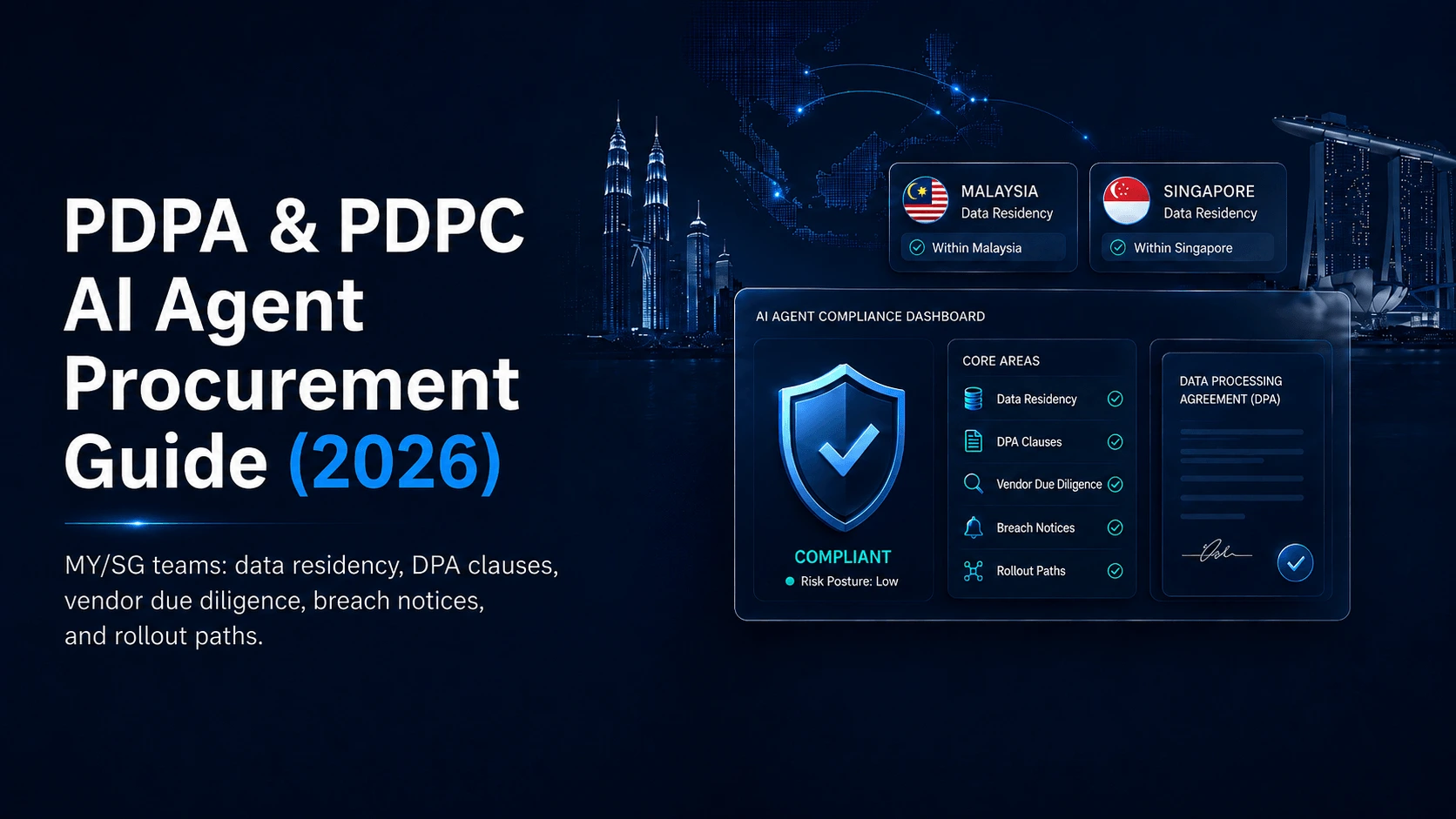
- Need broader agent due diligence? Start with the PDPA and PDPC procurement guide before you approve cloud sandboxes for client data.
Versus comparison — six head-to-head dimensions
The chart below visualises the relative strength of each tool on six dimensions. Bars represent illustrative weights, not benchmark numbers — replace with cited data once available.
Comparison between Manus and Cowork across 6 dimensions, scored out of 10.
The chart should make the philosophy difference visible at a glance. The two tools are nearly mirrored; pick the side of the mirror your work actually lives on.
Hybrid workflow — using both together
The most operationally honest setup we see is hybrid: Manus for async background work, Cowork for sensitive in-session work. The timeline below shows a four-step pattern that several SEA teams are running today.
Read the full hybrid workflow walkthrough
Four-step pattern with the actual handoff snippets — for subscribers.
Free. Unsubscribe any time.
Decision framework — your situation, your pick
If you don't want to read the whole article, this is the lookup table.
| Dimension | Best choice | Why |
|---|---|---|
| Solo founder, async overnight research | Manus | Cloud sandbox + multi-hour runs are the unlock. |
| SEA enterprise with PDPA scope | Cowork | Local-only file access avoids cross-border transfer questions. |
| Indie hacker shipping content | Manus | Bulk workflows + parallel sandboxes. |
| Lawyer or finance team on NDA work | Cowork | NDA prohibits third-party cloud upload. |
| Engineering team refactoring repo | Cowork | Direct file read/write beats upload-edit-download cycle. |
| Marketing team running scrapers | Manus | Headless browser + retries + rotation. |
| Healthcare ops in MY/SG | Cowork | Patient data should not transit external sandbox. |
| Researcher running parallel queries | Manus | Multi-sandbox parallelism is the entire point. |
| Founder doing both | Both | Pay for both; route work by sensitivity. |
| Beginner just exploring | Cowork | Lower entry cost, gentler UX, less surface area. |
Frequently asked questions
The questions below are the ones SEA teams ask us most often during evaluation.
Is Manus available outside China?
Yes. Manus has an English UI and serves users globally, though documentation and community resources remain stronger in Chinese. Payment methods and customer-support hours are skewed toward CN time zones; SEA teams generally have no problem accessing it.
Does Claude Cowork work offline?
No — model inference still calls Anthropic's API, so a network connection is required for the agent to think. The "local" in "local-first" refers to file access, not model execution. If you need fully offline AI, neither tool fits.
Can I trust Manus with internal documents?
Only if your data-handling policy permits sending those documents to a third-party cloud sandbox. For NDA-bound, regulated, or PDPA-sensitive work, the answer is usually no — at which point Cowork or a self-hosted setup becomes the only acceptable choice.
What's the difference between Claude Cowork and Claude Desktop?
Claude Desktop is the chat client; Claude Cowork is the agentic application that operates on your local files. They share Anthropic's underlying models but differ in capabilities — Cowork can read and modify files; Desktop largely cannot.
Can these agents replace a developer?
No. Both are designed to assist non-developers and amplify developer productivity, not replace engineering judgment. Treat them as junior teammates whose work needs review — that framing avoids most of the disappointment we see in the wild.
Which is better for content marketers in Malaysia?
For high-volume content workflows (research, drafting, scheduling), Manus is the more productive pick — the async model is built for it. For sensitive client-specific drafts, Cowork keeps the brief on your machine. Many marketers run both.
Are there free tiers for both?
Manus offers a small free allowance for evaluation. Claude Cowork is bundled inside Claude Pro tier; the bare Claude.ai free tier doesn't include Cowork. Confirm the latest limits in each vendor's dashboard before committing — pricing changes frequently in 2026.
What happens if Manus' sandbox crashes mid-task?
Manus retries failed steps and persists task metadata, but intermediate scratch state can be lost. Long-running tasks should be designed to checkpoint to a stable output (markdown bundle, JSON file) periodically rather than relying on in-VM memory.
Does Claude Cowork support Mandarin?
Yes, both for input and output. Output quality is excellent for Mandarin generation. The application UI itself follows the system locale; the agent's reasoning is language-agnostic at the model layer.
Where can I see live ranking data for both?
Use the Mindber rankings page for live capability scores updated weekly. The structured comparison view is at the compare tool. The categories page lets you scope rankings to autonomous agents specifically. This article is the editorial layer; those routes are the data layer.
Where do you get your data from?
Mindber aggregates from public vendor pages, published benchmarks, and community evaluations on Hacker News, r/ClaudeAI, Product Hunt, and similar venues. This is AI-assisted editorial analysis of public sources, not hands-on testing. Every numerical claim carries an inline source citation, and any figure we cannot confirm from a primary source is marked unverified rather than stated as fact — see the data sources page for the full list of feeds.
Further reading on Mindber: Compare all cloud agents in the AI agents category, the rankings page, and the PDPA and PDPC procurement guide. Mindber's scoring methodology, editorial methodology, and data sources are public.
Sources & methodology
Sources & methodology
This article cites primary sources for every numerical claim where one exists. Where no primary source exists, the value is wrapped in <DataPlaceholder note='unverified ...'> and renders as a dev-only verification marker; score values use score-based color. The list below is the audit trail (verified 2026-05-04).
- [1]Manus origin: Butterfly Effect Pte. Ltd. (Singapore, China-founded), launched 2025-03-06Wikipedia: Manus (AI agent) — 2026-05-04
- [2]Meta acquisition of Manus blocked by China NDRC on 2026-04-27Wikipedia: Manus (AI agent) + CNBC reporting — 2026-05-04
- [3]Manus self-reported GAIA scores at March 2025 launch: L1 86.5%, L2 70.1%, L3 57.7%Wikipedia: Manus (AI agent) — 2026-05-04
- [4]Manus pricing: Free 300 daily credits / Standard $20 4K credits / Customizable $40 8K credits / Extended $200 40K credits / Team $40/seat (min 2)Manus Plans & Pricing — 2026-05-04
- [5]Manus annual discount: 17% (≈ two months free)Manus Plans & Pricing — 2026-05-04
- [6]Claude Cowork: research preview Jan 2026, GA April 2026, included in Pro tier and aboveAnthropic — Cowork product page — 2026-05-04
- [7]Claude pricing: Free $0 / Pro $20/mo ($17 annual) / Max from $100/mo / Team $25/seat ($20 annual) / Premium Team $125/seat ($100 annual) / Enterprise $20/seat + usageClaude pricing page — 2026-05-04
- [8]Claude Cowork is bundled in Pro tier and above (no separate Cowork SKU)Claude pricing page — 2026-05-04
- [9]Claude Computer Use feature launched in research preview 2026-03-23, available to Pro/Max via Cowork or CodeAnthropic announcements (CNBC report 2026-03-24) — 2026-05-04
- [10]PDPA / cross-border data implications for SEA enterpriseMY PDPA 2010 + SG PDPA 2012 (general guidance, not legal advice) — 2026
- [11]Capability rubric (Research depth, Code execution, File handling, Instruction adherence, Tool-error recovery)Mindber editorial rubric — subjective 1-10 scoring of documented features. Not a benchmark. — 2026-05-04
- [12]Cost-per-task chart (3 tasks × 2 tools)Mindber illustrative cost estimates — not metered. Replace with primary benchmark data when available. — 2026-05-04
- [13]Intelligence Score panel (Innovation Index + Functionality Score)Mindber editorial rubric — subjective 1-100 scoring of documented features. Not a benchmark. — 2026-05-04
Mindber Intelligence Score (preview)
The Intelligence Score combines our Innovation Index and Functionality Score. Both numbers below are placeholders pending the v4.2 benchmark publication.
How we score: Capability scores below are based on documented features from official vendor pages, public announcements, and cited third-party reporting as of 2026-05-04 — not hands-on testing. Scoring rubric: 1–3 limited/absent, 4–6 partial/inconsistent, 7–8 strong/production-ready, 9–10 best-in-class. Innovation Index weights novelty + technical differentiation; Functionality weights breadth + reliability of core capabilities. These are editorial assessments, not benchmarks.
Mindber Intelligence Score — editorial rubric (subjective)
Strong on async + parallel; weak on local FS access. Self-reported GAIA L1 86.5% (March 2025).
Strong on privacy + local FS; weak on long async runs. GA April 2026 per Anthropic.
Keep reading
Thông báo pháp lý
Ấn phẩm này là bình luận biên tập dựa trên thông tin công khai và không cấu thành tư vấn tài chính, pháp lý, đầu tư hoặc chuyên môn. Tên sản phẩm, nhãn hiệu và nhãn hiệu đã đăng ký được nhắc đến thuộc về chủ sở hữu tương ứng; sự xuất hiện của chúng không hàm ý chứng thực hoặc liên kết. Phân tích của Mindber phản ánh đánh giá biên tập dựa trên tín hiệu công khai và có thể thay đổi mà không cần báo trước. Điểm số không phải là khuyến nghị mua, bán hoặc nắm giữ. Không tồn tại quan hệ thương mại giữa Mindber và các nhà cung cấp được đánh giá trừ khi được công bố riêng bằng văn bản. Ấn phẩm này chịu sự điều chỉnh của luật Malaysia. Mọi tranh chấp phát sinh từ hoặc liên quan đến ấn phẩm này sẽ thuộc thẩm quyền độc quyền của tòa án Malaysia.
Được tạo bằng AI · Báo cáo này được tạo bằng các mô hình ngôn ngữ AI được huấn luyện trên dữ liệu công khai. Báo cáo phản ánh phân tích biên tập tại thời điểm tạo và không phải là kết quả của thử nghiệm sản phẩm trực tiếp, xác minh độc lập bởi nhà phân tích con người hoặc sự chứng thực thương mại. Tất cả điểm số, đánh giá và tuyên bố đều bắt nguồn từ các tín hiệu được Mindber lập chỉ mục tại thời điểm tạo và có thể thay đổi mà không cần báo trước. Mindber và đơn vị vận hành không bảo đảm về độ chính xác, tính đầy đủ hoặc sự phù hợp cho bất kỳ mục đích ra quyết định thương mại nào. Báo cáo này chỉ nhằm mục đích cung cấp thông tin.
