
The Tesla Roadster Left the Ground. Is It a Flying Car?
newsUpdated 12 min read
The Tesla Roadster flying car demo, explained: how cold-gas thrusters and suction fans work, what the car may cost, and whether 2028 production is realistic.
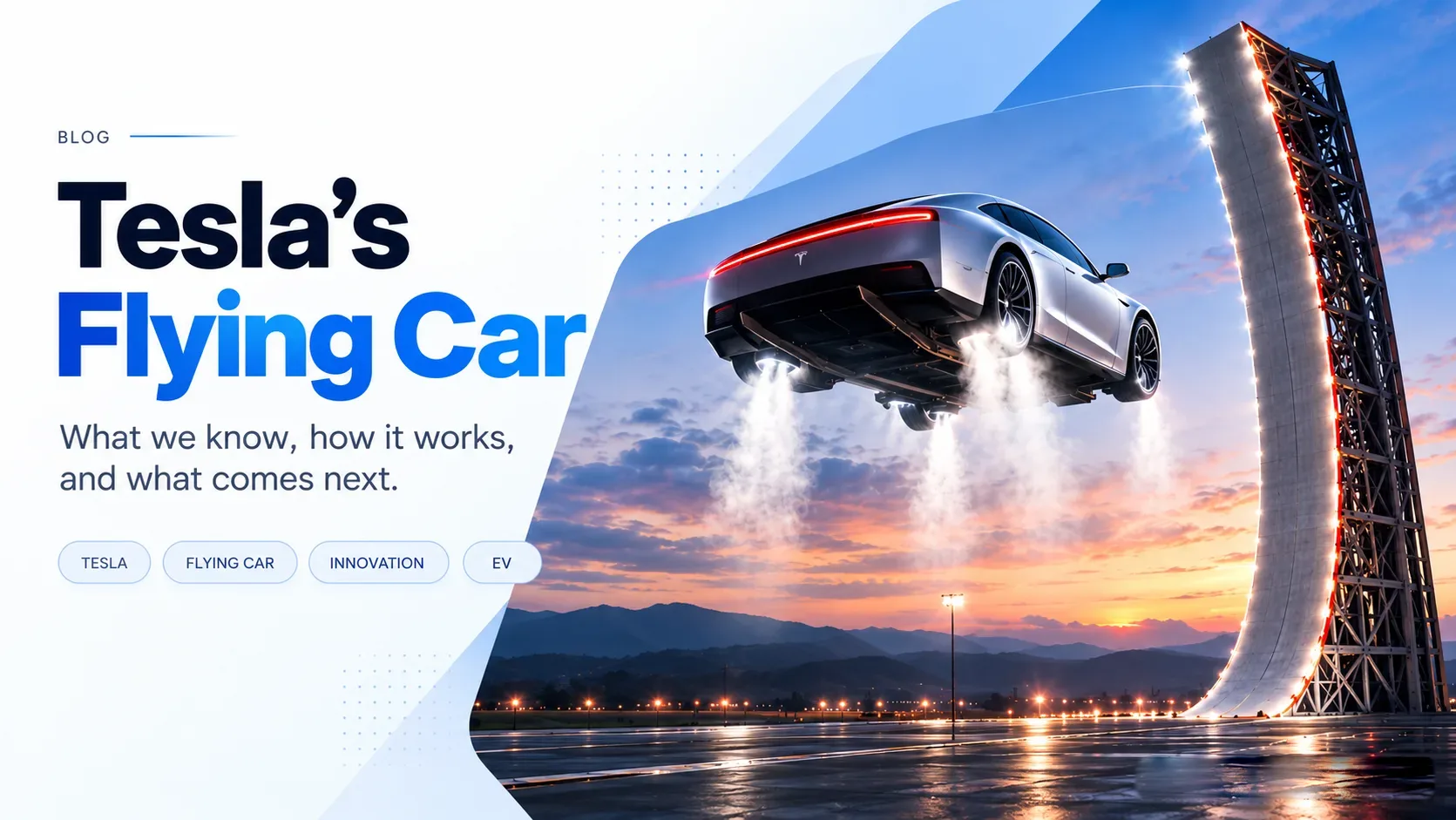
Developing story. Event details as of October 16, 2026. This is Mindber's reading of what Tesla showed at its Roadster demonstration, set against what Tesla and Elon Musk have said before and the rules that would apply. We haven't driven or tested the car, and nothing here is investment advice. The banner is an AI-generated illustration, not a photo from the event. More details may come out, so some figures below may change. Our methodology and verification standards explain how we handle a story like this, and the corrections form is open if you find an error.
By Frankie C. · Senior Market Researcher, Mindber. Tracks 500+ AI/SaaS tools across SEA markets via the Mindber Innovation Index methodology.
If you put down a deposit on a Tesla Roadster in 2017, you finally have new footage to look at. On October 16, 2026, Tesla showed the second-generation car at a demonstration and in a video posted the same day. It lifted itself off the ground on cold-gas thrusters and ran through a handful of short aerial moves.
We don't think that makes it a flying car in any useful sense. It's an extremely quick road car that can hop. Compressed gas runs out within seconds, so physics keeps each flight short, and nothing Tesla has shown carries people anywhere through the air under control and within the law.
Musk has been dropping hints about a flying Roadster since 2018, and now there's footage. For anyone weighing a purchase, the money, the hardware and the calendar matter more than the label.
Tesla Roadster price, deposits and specs
Tesla's 2017 price list put the base car at $200,000 and the Founders Series at $250,000. A base reservation took $50,000, and Founders Series buyers paid the whole price up front. Some of that money has now sat with Tesla for almost nine years without earning interest.
Inflation alone moves the number. US consumer prices are up by roughly a third since late 2017, so the base price in current dollars is well over a quarter of a million.
If you hold a reservation, read Tesla's current terms before the order window opens, and get the final price and delivery terms in writing before adding money. Treat the production date as a target until cars reach customers. Outside the US, ask whether your market's car will ship with the flight hardware switched on at all. The legal section below explains why it might not.
Tesla's own figures, with the year each one was stated:
| Detail | What Tesla has said |
|---|---|
| First shown | November 16, 2017, in Hawthorne, California |
| Original production target | 2020 |
| Current production target | 2028 |
| Flight hardware | Cold-gas thrusters and suction fans (October 2026 demo) |
| 0–60 mph | 1.9 seconds (2017 claim), under 1 second (2024 goal) |
| Top speed | Over 250 mph (2017 claim) |
| Range | 620 miles (2017 claim) |
| Base price | $200,000 (2017) |
| Reservation | $50,000 for the base car, $250,000 paid in full for the Founders Series (2017) |
How does the Tesla Roadster fly?
It works more like a lunar lander than an airplane. There are no wings and nothing spinning overhead. The car vents compressed gas through small thrusters, pushes against gravity, and settles back down when the gas runs low.
A cold-gas thruster is the balloon trick with better hardware. Let go of a balloon you haven't tied and it shoots off, because the air rushing out pushes it the other way. Swap the rubber for a tank of highly compressed gas, add a valve and a nozzle, and you have a thruster. Nothing burns, so there's no flame. Satellites use them for small nudges.
Point several thrusters in different directions and they can shove the car sideways or turn it, which is how spacecraft change attitude. That's most likely where the aerial moves in the video come from.
Musk's June 2018 sketch called for about ten of them spread around the car. They would be fed by ultra-high-pressure air in a composite overwrapped pressure vessel (COPV), a light tank wrapped in carbon fiber. The pressure is the point. The harder the gas is squeezed, the more of it fits in a tank small enough to hide in a car. SpaceX, which listed on Nasdaq in June, knows those tanks about as well as anyone. Some of that knowledge came the hard way: a COPV failure caused the 2016 launch-pad explosion in Florida that destroyed the Amos-6 satellite.
Why each flight lasts seconds
Cold gas is wildly inefficient. Rocket engineers measure efficiency as specific impulse, and compressed nitrogen manages roughly 70 seconds at best, against around 300 for a kerosene rocket engine. We ran the numbers for a car of about two tonnes at that best case.
What hovering a two-tonne car takes
≈20 kN
Thrust just to hold the car in the air, which is its own weight
Mindber estimate, 2,000 kg assumed
≈30 kg/s
Compressed gas burned every second at 70 seconds of specific impulse
Mindber estimate
85–90 kg
Gas for a three-second hover, before counting the tank that holds it
Mindber estimate
To hover, the thrusters have to push up with a force equal to the car's weight. With so little push per kilogram of gas, the car throws gas overboard at a furious rate just to stay level. The tank that holds the gas adds weight of its own.
Near sea level the real figures are worse, since that best case assumes no air pressing back on the nozzle.
What the suction fans do
The fans pull the other way. They suck air out from under the car, the pressure under the floor drops, and the atmosphere pushes the whole car onto the road. A wing only manages that at speed. A fan does it standing still.
Racing figured this out decades ago, and it rarely lasted. The Chaparral 2J ran two rear fans off a separate two-stroke engine in the 1970 Can-Am season and was banned after it. Brabham's BT46B won the 1978 Swedish Grand Prix with Niki Lauda driving and was pulled after that one race. The idea came back in 2022, when the electric McMurtry Spéirling used fan downforce to set the Goodwood Festival of Speed hill-climb record.
How fast is the Tesla Roadster?
Musk's current goal is 0 to 60 mph in under a second, nearly a full second quicker than the 1.9 seconds Tesla promised at the 2017 launch. Nobody independent has timed one, because there are no customer cars to time.
He moved the target in February 2024 and called the sub-second sprint the least interesting part of the car. The October demo put acceleration back at the front of the pitch. Tesla's 2017 figures also promised an 8.8-second quarter mile.
Under a second is a strange number for anything with license plates, and grip is why. Sixty miles an hour is about 27 meters per second, so getting there in one second means averaging better than 2.7 g. Street tires give up a little above 1 g. It isn't close.
Tesla rates the Model S Plaid at 1.99 seconds over the same sprint, with the first foot of rollout left out. Even that car runs out of tire long before it runs out of motor. A tire's grip grows with how hard it's pressed into the road, and on a normal car only the car's weight does the pressing. Going quicker takes help from outside the tires: something shoving the car into the road, or something pushing it forward without touching the road at all. Fans handle the first job, thrusters the second.
So the hardware is less of a gimmick than the flying clips make it look. In our reading, it may be the only realistic route to Tesla's own number.
Is a flying Tesla Roadster legal?
Driving it should be, once Tesla certifies it. Flying it is another matter. Our guess is that any flight mode in customer cars gets limited to private property or closed courses, at least at first. That's our reading of the rules below, not something Tesla has said.
US carmakers certify their own vehicles against the Federal Motor Vehicle Safety Standards. Those standards spell out brakes, airbags and crash protection in close detail, and thrusters never came up. A car that could crash would now carry a tank of air at extreme pressure. Its nozzles would fire fast-moving gas and grit at whatever happens to be nearby, and the racket of venting gas would hit people on the pavement a few feet away. Road regulators have rarely, if ever, had to answer questions like these.
The air side is messier. Under US federal aviation rules, any device "used or intended to be used for flight in the air" counts as an aircraft. A car built to leave the ground fits that uncomfortably well. The lightly regulated ultralight category is no escape hatch either. It covers single-seat craft under 254 pounds empty, and the Roadster blows past that by well over a tonne.
Southeast Asia, where many of our readers are, has its own version of the problem. Each country's vehicle regulator would have to sign off on a car with thrusters, and there's no obvious box to put it in. Road-legal cars could reach some markets with the flight hardware switched off or missing.
Next to the companies chasing sustained flight, the Roadster's thrusters look like a performance feature with a party trick bolted on. Nothing wrong with that. Their certified route is slow. Alef Aeronautics, building a car meant to take off vertically, got a special airworthiness certificate from the FAA in 2023, limited to uses such as research and exhibition. Klein Vision's AirCar, which unfolds into a fixed-wing plane and needs a runway, earned a certificate of airworthiness from Slovakia's transport authority in 2022. Neither has made flying cars ordinary. Air-taxi makers such as Joby and Archer skipped the car part entirely, and they've still spent years grinding through FAA certification.
Tesla Roadster release date and track record
Tesla is aiming at 2028, eight years after the car's first target date.
Nine years of Roadster promises
- 1
November 2017: the launch
Tesla shows the Roadster with its headline specs and price, and plans production for 2020. - 2
June 2018: the thruster idea
Musk describes a "SpaceX option package" of about ten cold-gas thrusters and suggests it might let the car fly. - 3
February 2024: new goals
Musk sets a target of under one second to 60 mph, promises a demo by the end of 2024 and hopes to ship in 2025. Neither happens on that schedule. - 4
October 16, 2026: the demo
Tesla shows the Roadster in short airborne maneuvers and targets 2028 for production.
Tesla does ship late products eventually. The Semi, shown on the same night in November 2017 as the Roadster, reached its first customer in late 2022. The Cybertruck arrived about four years after its 2019 debut. This car has slipped further than either, though, and every new piece of hardware (thrusters, fans, a high-pressure tank) is one more thing that can slip.
What the demo is for, in our view
Tesla's first Roadster sold about 2,450 cars, and its job was to prove that electric cars could be desirable. This one's job looks similar: show that Tesla can still do things that look impossible. At a supercar price and in low volume, it won't get anyone through rush hour faster, even if it ships on time.
That job matters more now than it used to. A big chunk of Tesla's valuation rides on robotaxis and the Optimus humanoid robot, bets that mostly pay off later, if they pay off at all. A car that jumps off the ground on command is an effective way to keep people believing in later. Call it marketing if you like. The engineering is real too, and Tesla badly needs the two to arrive together.
The fans are the part we'd follow. Because they grip at a standstill, the same idea could mean shorter emergency stops and more grip at the exact moment a driver needs it. If fan-assisted braking ever trickles down to a mass-market Tesla, it will do more for road safety than all the air time in the world.
A demo shows the best five seconds. A product is everything around them: how often it works, what it costs, what the rules allow and who fixes it when it breaks.
That gap is what Mindber measures in software. Our liveness scoring checks whether the AI tools in Discover and our rankings keep working after launch, and the archive of inactive tools holds the ones that stopped. Our news coverage runs from Google's AI talent drain to Claude Fable 5's three-day run before a government shutoff. Everything else is on the Mindber blog.
You can ask the Mindber community any Roadster question this post leaves open.
Frequently asked questions
Is the Tesla Roadster deposit the final price?
No. A deposit holds a place in line rather than a price. Tesla's only published prices date from 2017, before the car had thrusters, fans or a high-pressure tank to pay for, so the final figure could look quite different.
Is the Tesla Roadster faster than a Model S Plaid?
On paper, yes. Tesla's 2017 claim already edged the Plaid's rated time, and the sub-second goal would roughly halve it. The Plaid is on sale, so its number can be checked. Every Roadster figure is still a claim.
Could a bigger gas tank keep the Roadster in the air longer?
Only a little. By our estimate, each second of hover burns about 30 kilograms of gas. A bigger tank adds weight the thrusters must also lift, so each extra second you add costs more gas than the last one you added.
Is the SpaceX package standard on every Roadster?
Probably not, going by its name: Musk called it an option package when he described it in 2018, which points to an extra-cost choice. He said its thrusters would sharpen acceleration, braking and cornering, and might let the car fly. The sources this post draws on give no price or trim list for it.
What happened to the first Tesla Roadster?
Tesla built it on a Lotus chassis from 2008 to 2012. Musk's own car went much further than the new one has. In February 2018, SpaceX sent it into orbit around the sun on the first Falcon Heavy, with a mannequin in a spacesuit at the wheel.
Is SpaceX involved in the Tesla Roadster?
By name, at least. Musk named the thruster kit after SpaceX, which steers returning Falcon 9 boosters with nitrogen cold-gas thrusters on the same principle. None of the statements this post draws on names SpaceX, now a public company, as a supplier to Tesla.
Sources and methodology
What this is based on: public statements by Tesla and Elon Musk, Tesla's published specifications, US federal regulations, and well-documented motorsport and aviation history, as of October 16, 2026. The gas-use and acceleration figures are Mindber's own rough estimates from the assumptions stated in the text, not Tesla data. We haven't driven or tested the car.
- [1]Roadster demonstration and video: short airborne maneuvers on cold-gas thrusters with suction fans; 2028 production targetTesla Roadster demonstration and video · 2026-10-16
- [2]2017 unveiling: 0-60 mph in 1.9 s, 8.8 s quarter mile, over 250 mph, 620 miles; $200,000 base and $250,000 Founders Series; $50,000 reservationTesla Roadster page and November 16, 2017 unveiling · 2017-11-16
- [3]SpaceX option package: about ten small thrusters fed by ultra-high-pressure air in a COPV, which might let the car flyElon Musk on Twitter (now X) · 2018-06
- [4]New goal of 0-60 mph in under one second, a demo by the end of 2024 and shipping hoped for in 2025Elon Musk on X · 2024-02-28
- [5]Model S Plaid 0-60 mph in 1.99 s with one-foot rollout subtracted
- [6]Aircraft definition: a device used or intended to be used for flight in the air
- [7]Ultralight vehicles: single occupant, under 254 lb empty weight if powered
- [8]Federal Motor Vehicle Safety Standards and manufacturer self-certification
- [9]US consumer prices up roughly one third since late 2017
- [10]Amos-6 launch-pad explosion traced to a COPV failureSpaceX investigation update · 2017-01
- [11]Fan cars: Chaparral 2J (1970), Brabham BT46B (1978 Swedish Grand Prix), McMurtry Speirling (Goodwood hill-climb record, 2022)Motorsport race and event records
- [12]Alef Model A FAA special airworthiness certificate (2023); Klein Vision AirCar certificate of airworthiness (2022)Alef Aeronautics and Klein Vision announcements
- [13]Original Lotus-based Roadster production of about 2,450 cars (2008-2012); Falcon Heavy carried Musk's Roadster to space (February 2018); Semi first delivery (December 2022); Cybertruck first deliveries (November 2023)Tesla and SpaceX public announcements
- [14]Hover estimate: about 20 kN of thrust, roughly 29 kg of gas per second and 85-90 kg for three seconds, for an assumed 2,000 kg car at 70 s specific impulseMindber calculation · 2026-10-16
More from Mindber news
The SpaceX IPO Is Quietly the First Big AI IPO
SpaceX (Nasdaq: SPCX) went public June 12, 2026, putting Grok, xAI and a $60B Cursor deal on the market. What the first AI IPO means for buyers.
Google's AI Brain Drain: Shazeer and Jumper Leave
Noam Shazeer left Google for OpenAI and John Jumper left DeepMind for Anthropic in one week. Why the AI talent drain hit Alphabet stock and the race.
Learn the basics on Mindber
New to AI? These free Mindber pages explain the ideas behind articles like this one.
Share this article
Legal notice
This publication constitutes editorial commentary on publicly available information and does not constitute financial, legal, investment, or professional advice. Product names, trademarks, and registered trademarks referenced herein are the property of their respective owners; their appearance does not imply endorsement or affiliation. Mindber's analysis reflects editorial judgment based on public signals and is subject to change without notice. Scores are not buy, sell, or hold recommendations. No commercial relationship exists between Mindber and the vendors evaluated unless separately disclosed in writing. This publication is governed by the laws of Malaysia. Any dispute arising from or in connection with this publication shall be submitted to the exclusive jurisdiction of the courts of Malaysia.