
Google's AI Brain Drain: Shazeer and Jumper Leave
newsUpdated 12 min read
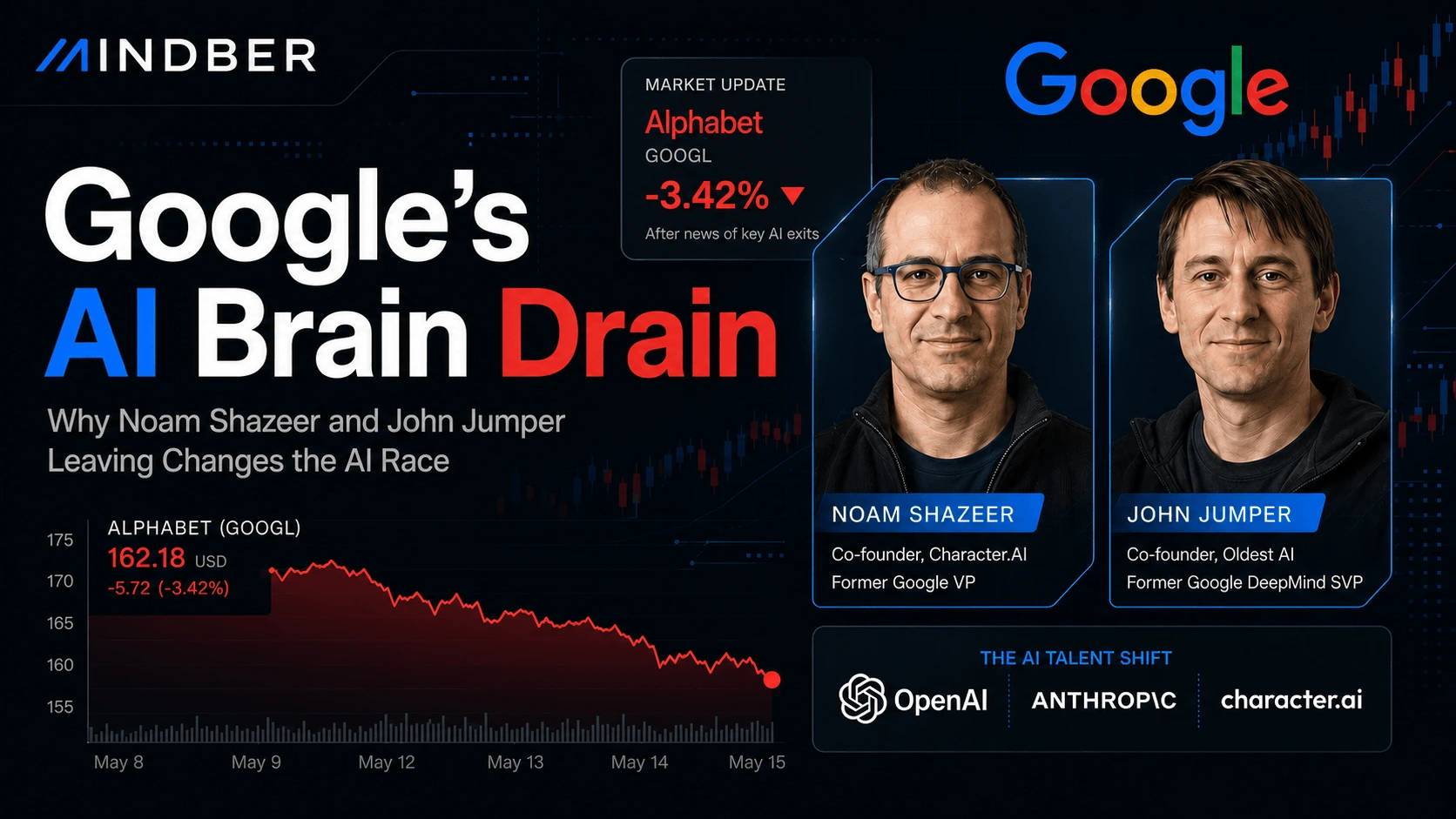
Noam Shazeer left Google for OpenAI and John Jumper left DeepMind for Anthropic in one week — why the AI talent drain hit Alphabet stock and the race.
Reported as of June 24, 2026. Mindber editorial analysis of public reporting from named third-party sources — not original research, not financial advice, and not a recommendation to buy or sell any security. Every figure below is attributed to a named source and reflects what was published as of this date. Markets move and details change; verify against the primary source before you act.
By Frankie C. · Senior Market Researcher, Mindber. Tracks 500+ AI/SaaS tools across SEA markets via the Mindber Innovation Index methodology.
Google didn't just lose two AI employees. It lost two symbols of its AI moat.
In one week, Noam Shazeer left Google for OpenAI and John Jumper left Google DeepMind for Anthropic. Shazeer co-led Gemini and co-wrote the paper that built the modern language-model era. Jumper won a Nobel Prize for AlphaFold. Then Alphabet had its worst trading day in a year. This is what changed, and why it matters for the AI race — not the leaderboard, the talent race.
What happened: two landmark exits in five days
Two of the most recognizable names in AI left Google's orbit in the same week — one for OpenAI, one for Anthropic. On June 18, 2026, Noam Shazeer, a Google vice president of engineering and a co-lead of the Gemini models, announced he is joining OpenAI. One day later, John Jumper, the Google DeepMind researcher who shared the 2024 Nobel Prize in Chemistry for AlphaFold, said he is leaving for Anthropic after nearly nine years.
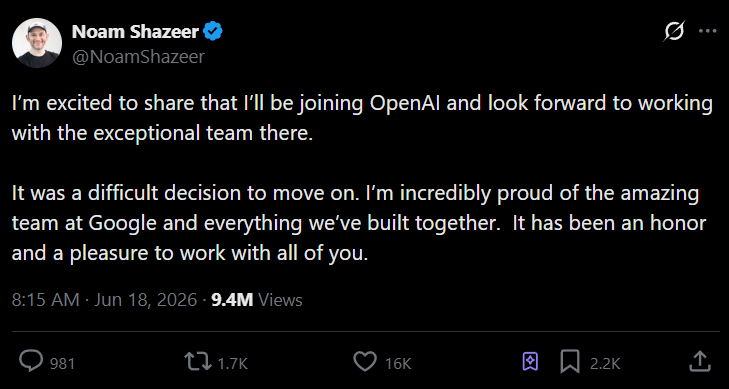
Shazeer's own announcement of the move. Source: Noam Shazeer on X, June 18, 2026.
The timing is the story. Google has spent two years arguing that Gemini can compete head-on with OpenAI and Anthropic — and on paper it should be one of the hardest companies in the world to challenge. It has Search, Android, YouTube, Cloud, DeepMind, and enormous compute. So when two of its most visible AI figures walk toward the rivals in the same week, the uncomfortable question writes itself: if the people behind Google's breakthroughs are choosing OpenAI and Anthropic, where is the future of AI actually being built?
$2.7B
What Google reportedly paid in 2024 to bring Shazeer back via the Character.AI deal — he left about 21 months later
Calcalist / CNBC, 2026-06-18
5 days
Between Shazeer's OpenAI announcement (Jun 18) and Jumper's Anthropic announcement (Jun 19), with the market reaction landing Jun 22
CNBC, 2026-06-22
2017
Year Shazeer co-authored 'Attention Is All You Need' — the Transformer paper that underpins most modern large language models
arXiv:1706.03762
The chronology underneath these exits is what makes them land so hard. The same researcher who helped invent the architecture, and the same scientist who produced AI's clearest scientific breakthrough, both left within a week — and the market connected the dots immediately.
From the Transformer to the talent drain (2017 → 2026)
- 1
2017 — 'Attention Is All You Need'
The architectureShazeer co-authors the Transformer paper at Google — the architecture that becomes the foundation of nearly every modern large language model. - 2
Sept 2024 — Google pays a reported $2.7B to bring Shazeer back
The buy-backThrough an acquisition of his startup Character.AI, Google re-hires Shazeer and installs him as a co-lead of Gemini. - 3
Oct 2024 — Jumper shares the Nobel Prize in Chemistry
The NobelThe award recognizes AlphaFold, DeepMind's protein-structure model — AI producing real, globally important scientific value. - 4
Jun 18, 2026 — Shazeer announces he's leaving for OpenAI
Exit oneA Gemini co-lead and Transformer co-author walks to OpenAI as it moves toward a possible public listing. - 5
Jun 19, 2026 — Jumper announces he's leaving for Anthropic
Exit twoThe AlphaFold Nobel laureate joins Anthropic after nearly nine years at DeepMind, aligning with Anthropic's push into life sciences. - 6
Jun 22, 2026 — Alphabet has its worst day in a year
The repricingShares fall roughly 6–7%, with reporting putting the market-cap hit around $250B as investors treat the exits as a talent-war signal.
The exact market-cap number moves with the share price and isn't the point. The point is the signal: AI talent is now priced like strategic infrastructure.
Why this isn't normal turnover
What makes these exits different from ordinary churn is the quality of the names. Every big tech company loses engineers, researchers, and executives — startups recruit aggressively and that alone isn't unusual. Shazeer and Jumper aren't ordinary departures.
Shazeer is tied to the Transformer breakthrough, one of the core architectures behind modern generative AI (arXiv:1706.03762). Jumper is tied to AlphaFold, one of the clearest examples of AI creating serious scientific value beyond chatbots and image generators. So this reads less like an HR story and more like a strategic asset transfer. When people of this caliber move, the market doesn't only ask who left. It asks what they saw that made them leave.
Talent gravity: the metric that leads the leaderboard
The better leading indicator for an AI lab isn't its benchmark score — it's talent gravity, the degree to which ambitious AI people believe their work will compound fastest there. Most analysis still leans on visible, lagging signals: benchmark scores, model launches, pricing, context windows, coding performance, GPU capacity, cloud partnerships. Those matter, but they tell you what a company has already built.
Talent gravity tells you what it's about to build. A lab with strong talent gravity does three things well: it attracts people with original technical judgment, it gives them enough speed to ship meaningful systems, and it converts research into products before competitors can react. This is the same lens the Mindber Innovation Index already applies to tools — it weights novelty and technical differentiation, not just feature checklists — and the logic ports cleanly from products to the labs that make them. By that measure, OpenAI and Anthropic aren't only launching models. They're becoming the places elite AI people want to build the next model, the next agent system, the next research platform.
Why talent moves before markets do: Benchmarks and revenue are reported after the fact. The decision of where a Shazeer or a Jumper chooses to work is a bet on the next eighteen months. By the time a model gap is obvious on a leaderboard, the talent gap that produced it is already months old.
Why Noam Shazeer matters to OpenAI
Shazeer strengthens OpenAI on architecture, scale, and credibility at once. First, he brings deep language-model architecture experience — his name is tied to the Transformer era that still anchors most of modern AI. Second, he brings product-scale experience: Gemini isn't a research toy, it's wired into consumer apps, developer tools, and enterprise products, and that operational knowledge transfers. Third, he's a credibility signal as OpenAI moves toward a possible public-market cycle, where investors increasingly price a lab's ability to keep attracting rare technical people as a core part of its defensibility.
The subtle read: OpenAI isn't only hiring to improve ChatGPT. It's deepening the bench for the next phase — multimodal agents, autonomous coding, enterprise workflows, AI search, reasoning models, and platform-level infrastructure. You can see the current shape of that competition on the AI Models board and in our June 2026 AI model leaderboard.
Why John Jumper matters to Anthropic
Jumper's move adds something different from a typical AI hire: scientific-AI credibility. OpenAI is associated with consumer and developer AI; Anthropic is associated with Claude, AI safety, enterprise trust, and reasoning quality. AlphaFold showed that AI can matter far outside software workflows — that it can help solve scientific problems that are hard, expensive, and globally important. Reporting notes the hire aligns with Anthropic's expanding push into life sciences and computational biology.
That matters because Claude's next growth path may not be limited to chat, writing, coding, and enterprise assistants. The bigger opportunity is high-stakes knowledge work: research analysis, scientific reasoning, technical documentation, drug-discovery workflows, lab-automation support, and high-trust reasoning tasks. Anthropic doesn't need to become DeepMind to benefit from Jumper. It only needs to show that Claude is becoming a serious platform for serious knowledge work — and a Nobel laureate joining is a loud signal of that intent.
| Dimension | Noam Shazeer → OpenAI | John Jumper → Anthropic |
|---|---|---|
| Known for | Gemini co-lead; co-author of the 2017 Transformer paper | AlphaFold; shared the 2024 Nobel Prize in Chemistry |
| Tenure at Google | ~21 months this stint (returned 2024 via the Character.AI deal) | Nearly 9 years at Google DeepMind |
| Announced | June 18, 2026 | June 19, 2026 |
| What they bring | Language-model architecture depth, product-scale experience, public-market credibility | Scientific-AI credibility; reach into life sciences and computational biology |
| Strategic signal | Deepens OpenAI's bench for agents, reasoning, and enterprise workflows | Signals Claude moving into serious scientific knowledge work |
Why Alphabet stock reacted so sharply
Markets rarely punish a trillion-dollar company because two people leave. They punish it when the story changes. For Alphabet, the old AI story was simple: Google has the data, the distribution, DeepMind, the cloud, the compute, and the research bench, therefore Google stays a first-tier AI winner. The new question is more uncomfortable: if Google has all of that, why are some of its most visible AI figures leaving for OpenAI and Anthropic?
That's why the selloff mattered. It wasn't really about two résumés. It was about investor confidence in Google's AI operating speed. And it landed against a backdrop of heavy spend: Alphabet has raised about $141B in debt and equity since October to fund AI infrastructure, with 2026 AI capex projected at $180–190B, which sharpens every question about return on that investment.
One-day market-cap hit on Jun 22 (~6–7%)
250/300
Projected 2026 AI capex (midpoint of $180–190B)
185/300
Raised since October for AI infrastructure
141/300
075150225300
Source:
The analyst read: Investors framed the back-to-back departures of Shazeer (to OpenAI) and Jumper (to Anthropic) as evidence that Google is at risk of losing the war for talent at the frontier of AI (CNBC, Quartz). Alphabet is still extremely strong — but in AI, strength alone is no longer enough. The market wants speed, focus, and proof that research becomes market-leading product.
Google is not finished
The easy take is "Google is losing AI." That's too lazy. Google still has one of the strongest AI asset bases in the world — Search and Android distribution, YouTube's data and creator ecosystem, Google Cloud, Gemini, DeepMind, TPU infrastructure, Workspace reach, and consumer trust at global scale. Most AI startups would trade almost anything for one of those advantages.
The problem isn't a lack of assets. It's that AI rewards speed differently: a slower company with more assets can still lose ground to a faster company with sharper focus. That's the core risk, and it's a different risk than "decline." Google can invent. The open question is whether it can convert invention into products fast enough.
The real issue: research-to-product conversion
Google has never lacked research — it has historically created the future before anyone commercialized it. The Transformer came from Google. AlphaFold came from DeepMind. The compute, the data, and the research bench are as deep as anyone's. So the question isn't whether Google can invent; it's whether Google can ship invention before the window closes.
This is where OpenAI and Anthropic look structurally different. OpenAI converts frontier-model progress into consumer and developer mindshare quickly. Anthropic converts model reliability into enterprise trust quickly. Google often has more distribution but also more internal complexity. And in AI, a six-month delay can feel like a generation. The same conversion gap is why model-vendor durability is now something buyers track directly, the way we did in The True Cost of AI Tools in 2026.
What this means for founders, buyers, and investors
For everyone downstream of the labs, the lesson is the same: stop reading only the benchmark, and start reading the talent flows. The movement of elite builders often shows up before the model gap or the revenue gap does — which is exactly why a single week of departures can move a mega-cap stock.
How to read the talent drain by role
Talent moves before markets
Founders: follow the builders
- Track where serious researchers, infra engineers, and agent-system builders are going
- A lab gaining them may be stronger than its current leaderboard score suggests
- By the time the model gap is obvious, the talent gap is already months old
Don't marry one lab too early
Enterprise buyers: weight talent gravity
- Evaluate model quality, reliability/safety, roadmap speed, AND talent gravity
- A lab with stronger talent gravity may improve faster over the next 12 months
- Build a model-agnostic stack so you can route between vendors as the frontier shifts
Even when it isn't on the balance sheet
Investors: talent is a balance-sheet asset
- GPUs can be financed and data centers can be built — judgment is scarce
- Knowing what to train, what to ignore, and what compounds is hard to replace
- A few names can move a mega-cap because they signal where the next platform is
The fourth dimension — talent gravity — is the underrated one for buyers. A vendor with a stronger pull on rare people may out-improve a slightly-better-today competitor over a year. That's the case for a model-agnostic architecture: don't marry one lab too early, and keep the option to switch as the frontier moves. It's the same discipline we apply across the AI Models registry and the live Mindber rankings.
How Mindber reads this
The AI war has entered a second phase, and these two exits are the clearest marker yet. Phase one was model competition — who has the better benchmark, the bigger context window, the flashier demo. Phase two is talent, organization speed, and execution culture — who attracts the people with original technical judgment, who gives them room to move, and who turns their ideas into user behavior fastest.
That's why the Google story matters. It isn't that Google is suddenly weak; it's that Google is being forced to prove that scale still beats focus. OpenAI and Anthropic are demonstrating the opposite thesis: in frontier AI, the strongest magnet may not be the biggest company — it may be the company where the best people believe the future is moving fastest. The same conviction sits behind our brand and the Mindber Innovation Index: judge a lab by where its judgment is concentrating, not by last quarter's launch. We made a related argument about public-market legibility in the SpaceX AI-IPO breakdown.
What to watch next
The next signal isn't only Alphabet's stock price. Five things will tell you whether this is a wobble or a turn:
- Gemini product velocity — does Google ship faster across Search, Workspace, Android, Cloud, and developer tools, or does the cadence stay slow?
- DeepMind retention — do more senior researchers follow Jumper out, or does Google stabilize the bench?
- OpenAI's technical direction — does Shazeer's arrival show up in model architecture, agent systems, or developer and consumer products?
- Anthropic's science strategy — does Jumper's move turn into a real expansion into scientific reasoning and research workflows?
- Enterprise adoption — do large companies still treat Gemini as a first-choice model, or route more workloads to OpenAI and Anthropic?
We'll track each of these against primary reporting as it lands. Follow the running read on the blog and the live rankings.
Final take
Google hasn't lost the AI race — but the market is no longer giving Google automatic credit for being Google. Noam Shazeer going to OpenAI and John Jumper going to Anthropic turned AI hiring into a market event, and that's the real shift. The race is no longer only about who has the strongest model today. It's about who can attract the people capable of building the strongest model tomorrow. Right now, OpenAI and Anthropic are showing serious talent gravity — and Google's job is to prove that startup-level urgency can still run on Google-scale assets.
Frequently asked questions
What is the Google AI talent drain?
It refers to high-profile AI figures leaving Google or Google DeepMind for rival AI companies. The latest and most prominent examples are Noam Shazeer moving to OpenAI (announced June 18, 2026) and John Jumper moving to Anthropic (announced June 19, 2026), in the same week.
Why is Noam Shazeer joining OpenAI important?
Shazeer was a Google VP of engineering and a co-lead of Gemini, and he co-authored the 2017 paper "Attention Is All You Need," which introduced the Transformer architecture behind most modern generative AI. His move strengthens OpenAI's technical bench and sends a strong talent-market signal — especially notable because Google had reportedly paid about $2.7 billion to bring him back via the Character.AI deal in 2024.
Why is John Jumper joining Anthropic important?
Jumper is known for AlphaFold and shared the 2024 Nobel Prize in Chemistry for it, which makes him a symbol of scientific-AI credibility. His move to Anthropic — after nearly nine years at DeepMind — suggests Anthropic may be deepening its ambitions beyond chatbots and enterprise assistants into serious research, scientific reasoning, and life-sciences workflows.
Did Alphabet stock fall because of these AI talent exits?
Reporting linked Alphabet's selloff to growing investor concern over Google's ability to retain frontier AI talent. Alphabet fell roughly 6–7% on June 22, 2026 — its worst day in about a year — with reporting putting the market-cap hit near $250 billion. The move reflected more than two departures; it reflected concern about Google's future AI competitiveness against heavy AI capital spending.
Is Google losing the AI race?
Not yet. Google remains one of the strongest AI companies in the world, with unmatched distribution, DeepMind, Gemini, TPUs, and compute. But the exits increase pressure on Google to prove it can convert research strength into fast, market-leading products rather than ceding momentum to faster-moving rivals.
What is talent gravity in AI?
Talent gravity is an AI company's ability to attract rare researchers, engineers, and product builders who can shape the next generation of models and platforms. It's a leading indicator: where the best people choose to work is a bet on the next 12–18 months, which often shows up before benchmark or revenue gaps become visible.
What should enterprise buyers learn from this?
Don't choose AI vendors only by today's benchmark. Evaluate model quality, reliability and safety, roadmap speed, and the talent gravity behind the platform — then keep a model-agnostic stack so you can switch or route between vendors as the frontier shifts. A lab gaining elite people may out-improve a slightly-better-today competitor over a year.
What should founders learn from this?
Follow the talent flows. In AI, the movement of elite builders can reveal future platform shifts before benchmarks or revenue numbers make them obvious. A lab that keeps attracting serious researchers and product leaders may be stronger than its current leaderboard score suggests — and one that keeps losing them deserves scrutiny even if today's model still looks strong.
Where to dig deeper:
- The June 2026 AI model leaderboard — where the frontier models actually stand
- The SpaceX IPO is quietly the first big AI IPO — what public markets reveal about lab durability
- Claude Fable 5 suspended by US government order — the other Anthropic story moving the frontier
- The true cost of AI tools in 2026 — why talent and capex set the real price
- Mindber's scoring methodology — how talent gravity feeds the Mindber Innovation Index
- Browse the AI model registry — every frontier model Mindber tracks
Sources
Every figure in this article is attributed to a named third-party source. Mindber conducted no original research here and makes no investment recommendation. Market-cap and share-price figures move continuously — re-verify against the primary source before acting.
- [1]Noam Shazeer, Google VP of engineering and Gemini co-lead, announced June 18, 2026 he is leaving Google for OpenAI; he is a co-author of the 2017 Transformer paper
- [2]Google reportedly paid about $2.7 billion to bring Shazeer back via the Character.AI acquisition in September 2024; he left roughly 21 months later
- [3]John Jumper, the Nobel-winning Google DeepMind researcher behind AlphaFold, announced June 19, 2026 he is leaving for Anthropic after nearly nine years; the hire aligns with Anthropic's push into life sciences and computational biology
- [4]Jumper, a 2024 Nobel laureate in Chemistry for AlphaFold, is leaving DeepMind for rival Anthropic
- [5]Alphabet fell roughly 6–7% on June 22, 2026 — its worst day in about a year — with reporting putting the market-cap hit near $250B; analysts framed it as Google losing the war for frontier AI talent; 2026 AI capex projected at $180–190B against ~$141B raised since October
- [6]Alphabet shares slid as Google lost two top AI researchers to OpenAI and Anthropic
- [7]The Transformer architecture was introduced in the 2017 paper 'Attention Is All You Need'arXiv — Attention Is All You Need — 2017-06-12
- [8]AlphaFold is DeepMind's protein-structure-prediction model recognized by the 2024 Nobel Prize in ChemistryGoogle DeepMind — AlphaFold — 2026-06-24
Not investment advice. Mindber aggregates and cites publicly available information about AI tools and the companies behind them. Nothing on this page is investment, legal, or financial advice, and nothing here is a recommendation to buy or sell any security. Figures reflect reporting available as of publication and are versioned — this page is updated as the story develops. Vendors and named parties may submit corrections through our right of reply.
Keep reading
The SpaceX IPO Is Quietly the First Big AI IPO
Why the first frontier AI lab on public markets changes what buyers can know about vendor durability.
The June 2026 AI Model Leaderboard
Where the frontier models actually stand — and how Mindber scores them beyond the marketing benchmarks.
The True Cost of AI Tools in 2026: Sticker vs Reality
Why the rate card is a fraction of what an AI tool actually costs — a fully sourced TCO model for buyers.
Share this article
Legal notice
This publication constitutes editorial commentary on publicly available information and does not constitute financial, legal, investment, or professional advice. Product names, trademarks, and registered trademarks referenced herein are the property of their respective owners; their appearance does not imply endorsement or affiliation. Mindber's analysis reflects editorial judgment based on public signals and is subject to change without notice. Scores are not buy, sell, or hold recommendations. No commercial relationship exists between Mindber and the vendors evaluated unless separately disclosed in writing. This publication is governed by the laws of Malaysia. Any dispute arising from or in connection with this publication shall be submitted to the exclusive jurisdiction of the courts of Malaysia.
AI-generated · This report was generated using AI language models trained on publicly available data. It reflects editorial analysis at the time of generation and is not the result of hands-on product testing, independent verification by a human analyst, or a commercial endorsement. All scores, assessments, and claims are derived from signals indexed by Mindber at generation time and are subject to change without notice. Mindber and its operators make no warranty of accuracy, completeness, or fitness for any commercial decision-making purpose. This report is for informational purposes only.