
AI Model Rankings History, 2020 to 2026: Every #1 From GPT-3 to Gemini 4
guideUpdated 16 min read
Only four labs have finished a month at #1 on the Arena leaderboard. Watch GPT-4, Claude, Gemini, Grok and Kimi race month by month, with every score sourced.
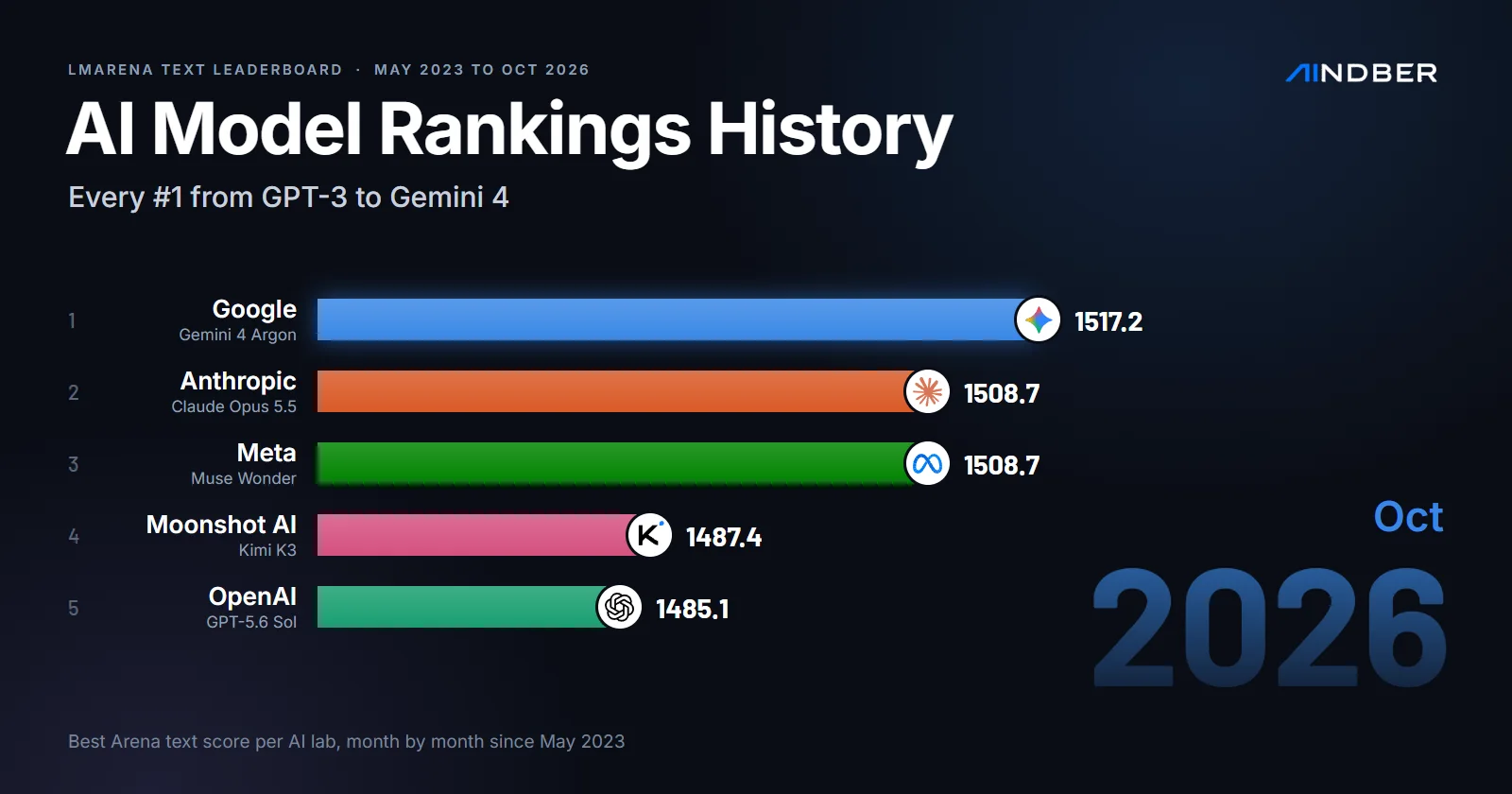
Data pulled: 24 October 2026 (UTC). The newest leaderboard in it was published on 22 October 2026, so the chart's October frame covers three weeks.
By Frankie C. · Senior Market Researcher, Mindber. Tracks 500+ AI/SaaS tools across SEA markets via the Mindber Innovation Index methodology.
How we assessed this: We read every main text leaderboard the Arena saved as a snapshot between May 2023 and August 2025. Boards published since then come from its open history dataset on Hugging Face. For each month we kept the last board and each lab's highest-rated model on it. Scores from before 2023 come from the papers that introduced each model. This is a reading of published data, not hands-on testing, and every monthly number is in the CSV linked under the chart.
Four AI labs have finished a month in first place on the Arena text leaderboard since it opened in May 2023. OpenAI did it in 17 months, Google in 16, Anthropic in 8 and xAI in one. OpenAI's GPT-4 models held the top spot for the board's first ten months. Since then first place has passed from one lab to another seven times.
The Arena ranks models by human votes, not by test scores. A visitor types a prompt and gets two answers from anonymous models side by side. They pick the better one, and only then see the names. Millions of these votes become a rating on a chess-style scale.
Press play to watch 42 months of the leaderboard, then read on for what moved each lead.
Each bar is a lab's best model on the last overall text leaderboard published that month. The axis starts just below the shortest bar on screen, not at zero.
Oct 2026Meta's Muse Wonder ties Claude Opus 5.5 for second


Months at #1Months at #1 since May 2023 OpenAI17 mo
 Google16 mo#1 now
 Anthropic8 mo
 xAI1 mo
OpenAI17 moGoogle16 mo#1 nowAnthropic8 moxAI1 moOct 2026: Google leads with 1517
| # | Lab | Best model that month | Score | Months at #1 |
|---|---|---|---|---|
| 1 | Gemini 4 Argon | 1517 | 16 | |
| 2 | Anthropic | Claude Opus 5.5 | 1509 | 8 |
| 3 | Meta | Muse Wonder | 1509 | 0 |
| 4 | Moonshot AI | Kimi K3 | 1487 | 0 |
| 5 | OpenAI | GPT-5.6 Sol | 1485 | 17 |
| 6 | Alibaba | Qwen3.8-Max | 1483 | 0 |
| 7 | Zhipu AI | GLM-5.3 | 1481 | 0 |
| 8 | Xiaomi | MiMo-V2.6-Pro | 1480 | 0 |
| 9 | DeepSeek | DeepSeek-V4.1 Flash | 1476 | 0 |
| 10 | xAI | Grok 4.20 Beta | 1475 | 1 |
| 11 | Baidu | ERNIE 5.1 | 1467 | 0 |
| 12 | ByteDance | Seed 2.0 | 1456 | 0 |
| 13 | Tencent | Hunyuan HY3 | 1454 | 0 |
| 14 | StepFun | Step 5 Preview | 1448 | 0 |
| 15 | MiniMax | MiniMax-M3 | 1440 | 0 |
| 16 | Meituan | LongCat-Flash | 1436 | 0 |
| 17 | Mistral AI | Mistral Large 4 | 1434 | 0 |
| 18 | NVIDIA | Nemotron 3 Ultra | 1426 | 0 |
| 19 | Cohere | Command A | 1354 | 0 |
| 20 | Ai2 | Olmo 3.1 32B | 1329 | 0 |
| 21 | 01.AI | Yi-Lightning | 1328 | 0 |
| 22 | Nexusflow | Athene-V2 | 1314 | 0 |
| 23 | Reka | Reka Core | 1288 | 0 |
| 24 | Microsoft | Phi-4 | 1256 | 0 |
| 25 | Hugging Face | Zephyr ORPO 141B | 1213 | 0 |
| 26 | OpenChat | OpenChat 3.5 | 1183 | 0 |
| 27 | LMSYS | Vicuna-33B | 1173 | 0 |
| 28 | UC Berkeley | Starling-7B | 1168 | 0 |
| 29 | MosaicML | MPT-30B-Chat | 1151 | 0 |
| 30 | TII | Falcon-180B | 1148 | 0 |
| 31 | U. Washington | Guanaco-33B | 1128 | 0 |
| 32 | Stanford | Alpaca-13B | 1070 | 0 |
| 33 | Nomic AI | GPT4All-13B | 1068 | 0 |
| 34 | RWKV | RWKV-4 Raven | 1042 | 0 |
| 35 | OpenAssistant | OpenAssistant Pythia | 1024 | 0 |
Source: LMArena leaderboard history · Monthly data (CSV) · Make your own chart race
Each bar is one lab, labeled with its best model that month. The scores have no meaningful zero, so the axis starts just below the shortest bar in view and shifts as the field moves. The panel under the bars counts months at #1, and the table button lists every lab's score for the month on screen. The 35 labs in the chart are the ones that made the top ten at least once.
The same race as a 75-second film, every change of #1 included:
Before the Arena: GPT-3 to GPT-4 on one exam
In 2020 nobody ranked chatbots by votes, because the public had no chatbots to vote on. Labs compared their large language models on benchmarks instead. The one that stuck was MMLU, a multiple-choice exam across 57 subjects published by Dan Hendrycks and colleagues in September 2020. Random guessing scores 25%.
The largest GPT-3, released that summer, scored 43.9% in the exam's own paper. DeepMind's Gopher reached 60.0% at the end of 2021. Google's PaLM got to 69.3% in April 2022. ChatGPT arrived on 30 November 2022, built on GPT-3.5, which OpenAI later put at 70.0%.
Share of questions answered correctly with five worked examples in the prompt, as each model's paper reports. Random guessing scores 25.
GPT-4 (Mar 2023)
86.4/100
GPT-3.5 (Nov 2022)
70/100
PaLM 540B (Apr 2022)
69.3/100
Chinchilla (Mar 2022)
67.6/100
LLaMA 65B (Feb 2023)
63.4/100
Gopher (Dec 2021)
60/100
GPT-3 175B (2020)
43.9/100
0255075100
Source: MMLU paper and each model's technical report, Oct 24, 2026
Then GPT-4 jumped 16 points past its predecessor in March 2023, according to the GPT-4 technical report. That left little room at the top of the exam. A public test has a second weakness too: its questions can turn up in the next model's training data. Rankings needed a judge that couldn't be memorized, and the Arena offered one.
2023: GPT-4 on top, open models fighting for fifth
LMSYS, a research group started at UC Berkeley, opened Chatbot Arena on 3 May 2023. Its first leaderboard ranked nine open models, with its own Vicuna-13B first at 1,169. Proprietary models joined within days. By the end of May GPT-4 led at 1,225 and Claude 1 followed at 1,195.
GPT-4 kept that lead all year, and its own successor did the replacing. GPT-4 Turbo, announced at OpenAI's DevDay in November, topped the board on 16 November.
Anthropic's year had a quirk. Claude 1 kept beating the models meant to replace it. On the 20 December board Claude 1 rated 1,149, Claude 2.0 rated 1,131 and Claude 2.1 rated 1,117. Voters don't reward a model for being newer.
Below the two proprietary labs, the board belonged to universities and small teams, most of them fine-tuning Meta's LLaMA. Vicuna came from LMSYS, Koala from UC Berkeley, Guanaco from the University of Washington and WizardLM from Microsoft researchers. That is why Stanford, MosaicML and RWKV appear on the 2023 bars. The best of these open models sat fifth or sixth, 80 to 170 points behind GPT-4. Meta released Llama 2 with open weights in July, and in December Mistral's Mixtral 8x7B became the strongest open model on the board.
March 2024: the month GPT-4 lost first place
The first crack came from Google. In January 2024 Bard, then running Gemini Pro, jumped to second place behind GPT-4 Turbo.
Anthropic released Claude 3 on 4 March. By the end of the month Claude 3 Opus rated 1,253.6, just 2.4 points above GPT-4 Turbo. For the first time since GPT-4 joined the Arena, an OpenAI model wasn't on top.
The Arena's own table treats a gap that small as a tie. Every score carries a confidence interval, and models whose intervals overlap share a rank. The post below, from 11 April, shows four models sharing rank 1, with GPT-4 Turbo's new April release listed first.
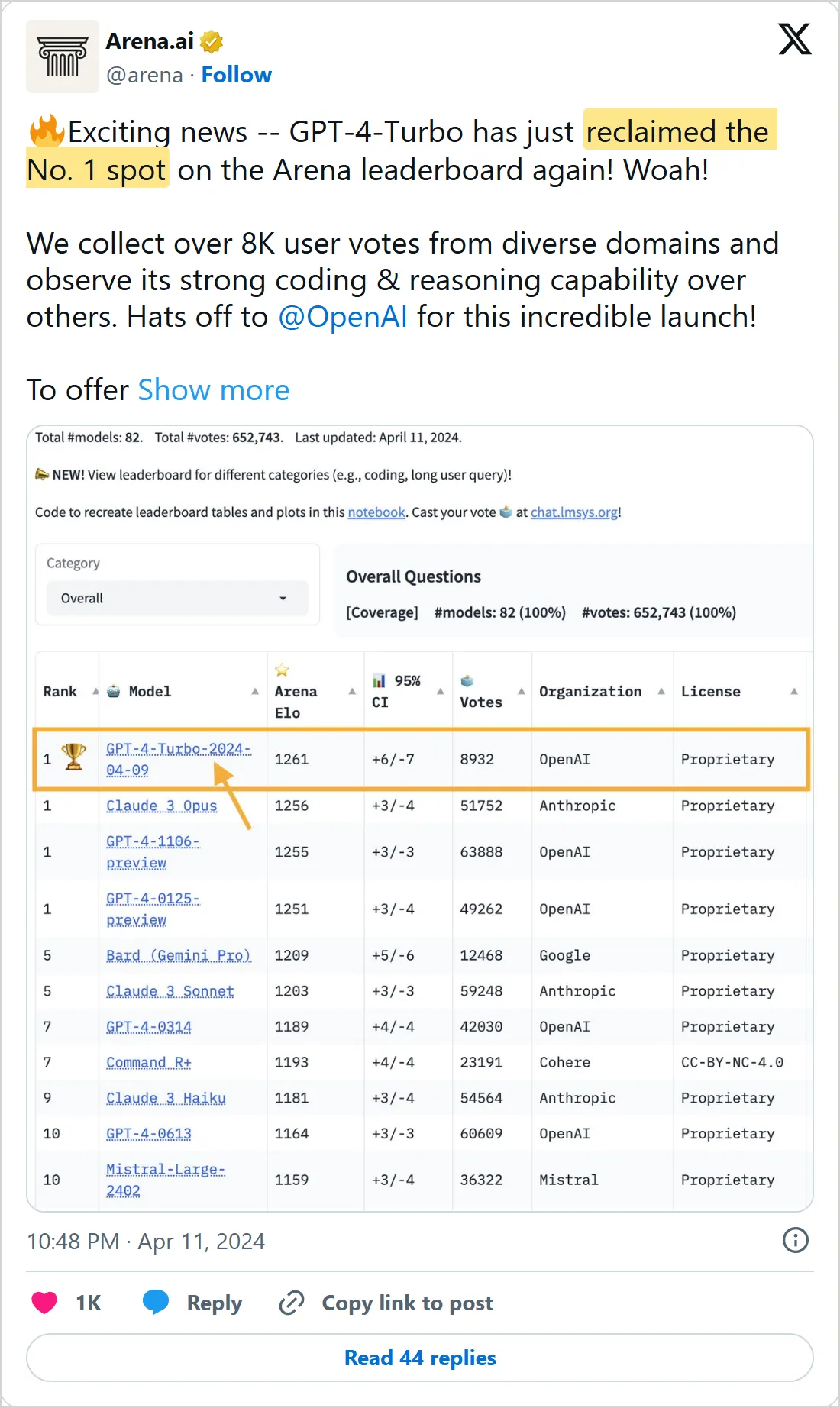
The Arena's post of 11 April 2024, then under the LMSYS account. Four models share rank 1 because their confidence intervals overlap. Time shown in UTC. Source: x.com/lmsysorg/status/1778555678174663100
Code names and the gpt2-chatbot week
Labs test unreleased models on the Arena under code names, and voters don't know whose answer they're reading. In early May 2024 an anonymous model called im-also-a-good-gpt2-chatbot kept winning its battles, and people online raced to guess who had built it.
OpenAI answered on 13 May. Its researcher Liam Fedus posted that the model was GPT-4o, along with the rating chart below. The preview showed it at 1,310, 57 points clear of GPT-4 Turbo's April release.
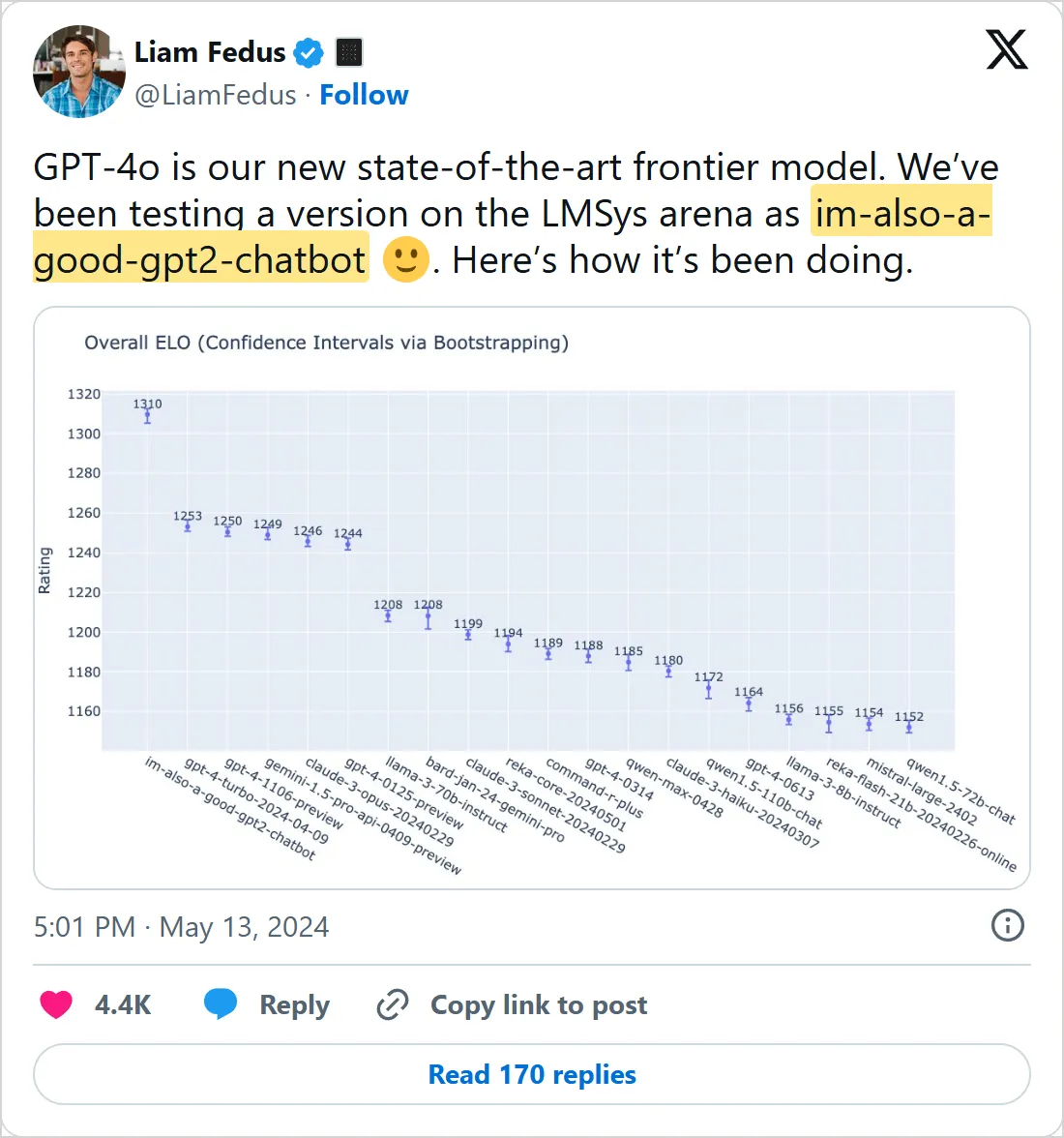
OpenAI's Liam Fedus revealing the code name on launch day. Time shown in UTC. Source: x.com/LiamFedus/status/1790064963966370209
Under its own name, GPT-4o settled at 1,287 by the end of May. That drop is normal. A rating built on a few thousand votes swings further than one built on tens of thousands, so a launch-day lead often shrinks. Read any new model's first week on the board with that in mind.
Reasoning models and Google's first leads
Google reached first place for the first time on the 1 August 2024 board. An experimental Gemini 1.5 Pro build, exp-0801, scored 1,300 against GPT-4o's 1,286. OpenAI had a new ChatGPT-4o version in front before the month was out.
September brought o1-preview, OpenAI's first reasoning model. It works through a problem in hidden steps before it answers, and it led the board at the end of the month. Many of the top entries on today's board are reasoning models, listed with an effort level such as High or Max.
November 2024 was the busiest month at the top. Gemini-Exp-1114 led the board of 13 November. ChatGPT-4o's 20 November update took over a week later, and Gemini-Exp-1121 was back in front the next day. Google then held first place through January with Gemini-Exp-1206 and Gemini 2.0 Flash Thinking.
DeepSeek released R1 on 20 January 2025 under the MIT license, so anyone could download and run it. By 28 January it ranked sixth on the board, above every model from Anthropic and Meta. In February xAI got its one month on top, with an early build of Grok 3 at 1,403.5.
Google's eleven-month run
Gemini 2.5 Pro went straight to first place on 25 March 2025. The Arena called it the largest score jump it had recorded. Google had tested the model on the board under the code name "nebula".
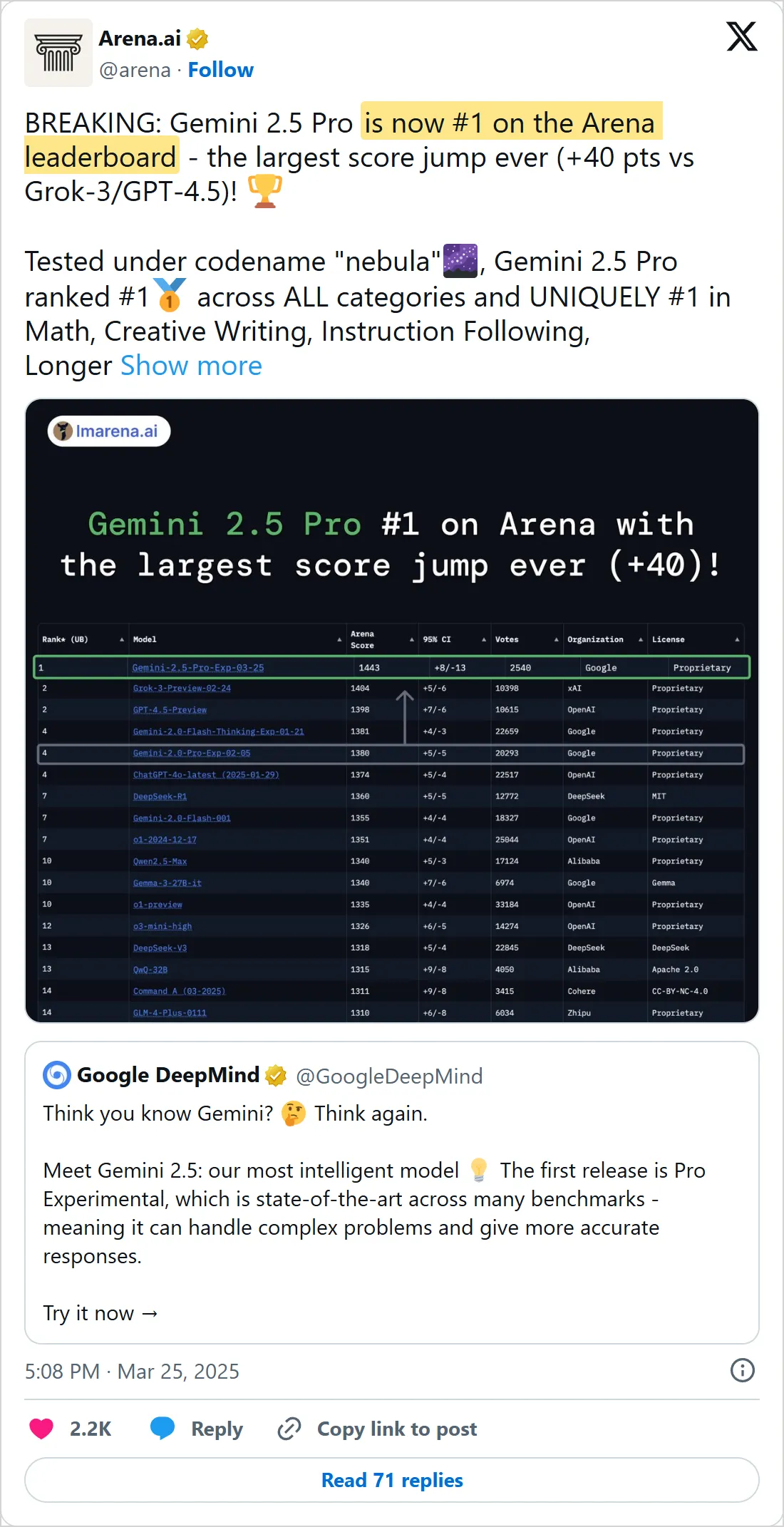
The Arena's post on launch day: 1,443 against 1,404 for Grok-3-Preview and 1,398 for GPT-4.5-Preview. Time shown in UTC. Source: x.com/lmarena_ai/status/1904581128746656099
Google kept the month-end lead for eleven straight months, first with three releases of that model and then with Gemini 3 Pro. Two rivals broke through for a few days inside that run. GPT-5 topped the board of 7 August 2025, its launch day, and Google was back in front by 21 August. On 3 October Claude Sonnet 4.5 Thinking led by less than one point, and lost the spot four days later. Month-end snapshots hide both, which is the price of a chart that moves one month at a time.
Gemini 3 Pro arrived on the board on 16 November 2025 as the first model rated above 1,500.
Anthropic's 2026, and the board on 22 October
Claude Opus 4.6 took first place on the board of 6 February 2026. Anthropic then stayed on top at every month's end through August, with Opus 4.6, Opus 4.7 and, from June, Claude Fable 5. Fable 5 entered at 1,510, the highest score the board had seen. A US government order took Fable 5 offline three days after its 9 June launch, yet the Arena kept publishing its rating through the three-week suspension.
Google came back on 30 September with Gemini 4 Argon, which opened 19 points clear of the next model.
Arena text leaderboard, last board of each month, May 2023 to October 2026 (42 months)
OpenAI
17/42
Google
16/42
Anthropic
8/42
xAI
1/42
011213242
Source: LMArena leaderboard history, Mindber analysis, Oct 24, 2026
On the 22 October board, Gemini 4 Argon (High) leads at 1,517.2. Claude Opus 5.5 (High) and Meta's new Muse Wonder (Max) tie for second at 1,508.7. Google's lead is real but thin, since the confidence ranges of all three overlap. Anthropic has the depth: nine of the top 14 entries are Claude models. Our Model Arena text board carries the live version of this ranking, with 418 models listed as of today.
OpenAI is the surprise. Its best entry is GPT-5.6 Sol (xHigh), 21st at 1,485.1, which makes OpenAI the fifth lab. Moonshot's open-weight Kimi K3 sits just above it. Its GPT-6 models rank lower still: GPT-6.1 Sol (Max) is 27th and GPT-6 Astra (Max) is 32nd. The text board measures which chat answer people prefer, and OpenAI's newest models haven't won that vote yet.
How far behind are open-weight models?
An open-weight model is one whose trained weights anyone can download and run on their own hardware. The gap between the best of them and the #1 model closed in steps, each tied to one release.
Arena text leaderboard, last board of the month. Shorter bars mean open models were closer to the top.
May 2023: Vicuna-13B
171/180
Dec 2023: Mixtral 8x7B
122/180
Jul 2025: Kimi K2
43/180
Oct 2026: Kimi K3
30/180
Jul 2024: Llama 3.1 405B
24/180
Jan 2025: DeepSeek-R1
24/180
Aug 2026: Kimi K3
19/180
04590135180
Source: LMArena leaderboard history and license labels, Mindber analysis, Oct 24, 2026
Meta set the first mark. Llama 3.1 405B, its largest open model, rated fifth on the July 2024 board. Since December 2024 the best open model at every month's end has come from a Chinese lab: DeepSeek, Moonshot, Zhipu or Alibaba. "Open" covers a range of licenses, from MIT to custom terms such as the Kimi K3 license, so read each one before you build on it.
The Arena's own posts track this. In April 2026 it put Kimi K2.6 second among open models on the text board and sixth in its Code Arena web development ranking.
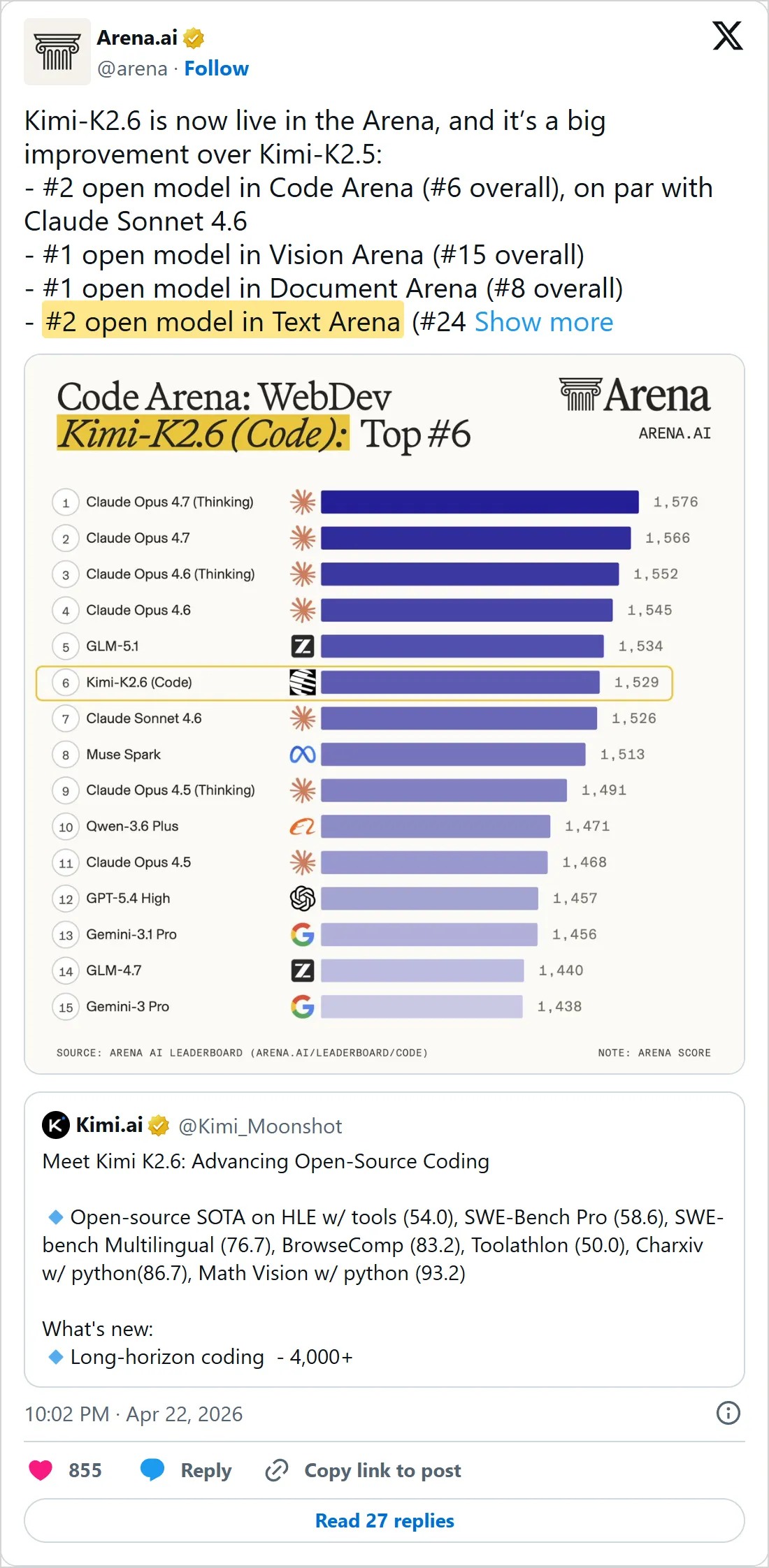
The Arena's post on Kimi K2.6. The chart is the Code Arena WebDev board, where Claude models hold four of the top five places. Time shown in UTC. Source: x.com/arena/status/2047073519851438345
Five of the ten best labs on the latest board are Chinese: Moonshot, Alibaba, Zhipu, Xiaomi and DeepSeek. In May 2024 the closest Chinese lab was 01.AI, 48 points behind the leader. Zhipu's GLM models, the ones behind its ChatGLM app, were the best open models on the board from February to June 2026.
The pack closed up
Points between the #1 lab and the #10 lab, Arena text leaderboard
304
May 2023, a board of 17 models
168
January 2024
108
January 2025
43
October 2026, a board of 418 models
A rating gap converts to odds. On the Arena's scale, 400 points means the stronger model is preferred ten times out of eleven. The 304-point gap of May 2023 meant GPT-4's answer beat the tenth lab's best about 85% of the time. In October 2026 Google's leader beats the tenth lab's best, xAI's Grok 4.20 Beta, about 56% of the time.
Part of that shrink is the field getting wider. The ninth and tenth labs in May 2023 were OpenAssistant and Zhipu, with models of 12 billion parameters or fewer that would have missed a top ten a year later. Most of it is real progress below the top, though. Every one of today's top ten labs sits inside that margin. In June 2024 only OpenAI, Anthropic and Google did.
Can a lab game the Arena?
Meta came close. When it released Llama 4 on 5 April 2025, the model on the leaderboard was "Llama-4-Maverick-03-26-Experimental", rated second at 1,417 on the board of 8 April. The Arena then posted that Meta's interpretation of its policy "did not match what we expect from model providers". Meta, it said, should have made clear that the model was "a customized model to optimize for human preference". Once the Arena scored the Maverick that Meta released to the public, it ranked below its rivals, and it stood 60th on the board of 23 April.
The same month, researchers from Cohere Labs and several universities published The Leaderboard Illusion. Studying 2 million battles from January 2024 to April 2025, they found that a few providers could test many private variants and publish only the best one. One provider tested 27. Picking the best of many draws lifts a score even when no single variant is better.
The Arena has also changed its own method three times in this history, according to its dataset notes:
- 9 January 2024: the rating moved from an online Elo system to a Bradley-Terry fit, which treats all votes at once.
- 16 May 2025: style control became the default board. It discounts the edge that longer, heavily formatted answers get from voters, and the Arena shifted it to sit on the same scale as before.
- 23 July 2025: the Arena added frequency-based reweighting of votes.
Our chart follows the board the Arena itself showed by default at the time. That means raw ratings through April 2025 and style-controlled ones from May 2025.
Text votes aren't the whole race
The text board answers one question: which reply would people rather read. The Arena now runs separate boards for other jobs, and their leaders differ. Its web development board joined the main site in November 2025. The Agent Arena, which judges whole agent sessions instead of single answers, opened on 4 June 2026 and uses its own scoring method.
Claude Fable 5.1 (Max) shows the difference. It ranks fifth on the current text board, yet it went straight to first place in the Agent Arena, which our agent leaderboard tracks.
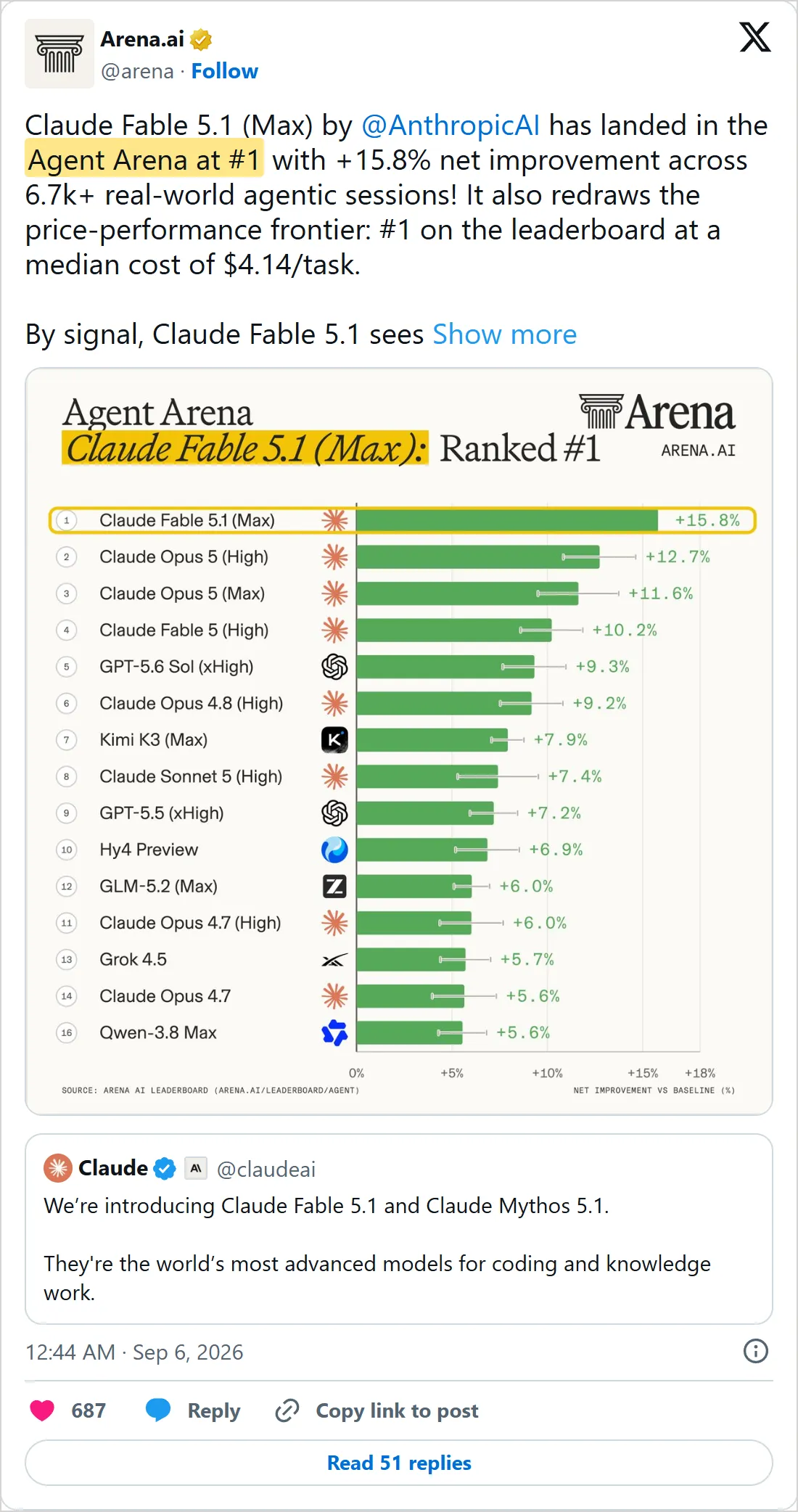
The Arena's Agent Arena post for Claude Fable 5.1. GPT-5.6 Sol (xHigh) is fifth on this board. Time shown in UTC. Source: x.com/arena/status/2096398986383184269
If your work is agents or code, those boards are the better guide, and the June 2026 leaderboard ranks models by job across several independent sources. Their scores sit on different scales from the text board, so don't compare the numbers directly.
Every #1 since 2023, and how we built the chart
This table lists each month-end where the #1 model changed, using the names the Arena printed. Scores are the rating on that month's last board.
| Month | #1 model, as listed | Lab | Score |
|---|---|---|---|
| May 2023 | gpt-4 | OpenAI | 1,225 |
| Nov 2023 | gpt-4-turbo | OpenAI | 1,210 |
| Mar 2024 | claude-3-opus-20240229 | Anthropic | 1,253.6 |
| Apr 2024 | gpt-4-turbo-2024-04-09 | OpenAI | 1,257.4 |
| May 2024 | gpt-4o-2024-05-13 | OpenAI | 1,287.1 |
| Aug 2024 | chatgpt-4o-latest | OpenAI | 1,316.2 |
| Sep 2024 | o1-preview | OpenAI | 1,339.1 |
| Oct 2024 | chatgpt-4o-latest-20240903 | OpenAI | 1,340.2 |
| Nov 2024 | gemini-exp-1121 | 1,365.3 | |
| Dec 2024 | gemini-exp-1206 | 1,373.5 | |
| Jan 2025 | gemini-2.0-flash-thinking-exp-01-21 | 1,382.0 | |
| Feb 2025 | early-grok-3 | xAI | 1,403.5 |
| Mar 2025 | gemini-2.5-pro-exp-03-25 | 1,440.1 | |
| May 2025 | gemini-2.5-pro-preview-05-06 | 1,446.0 | |
| Jun 2025 | gemini-2.5-pro | 1,466.6 | |
| Nov 2025 | gemini-3-pro | 1,492.4 | |
| Feb 2026 | claude-opus-4-6-thinking | Anthropic | 1,503.4 |
| Apr 2026 | claude-opus-4-7-thinking | Anthropic | 1,504.0 |
| May 2026 | claude-opus-4-6-thinking | Anthropic | 1,502.2 |
| Jun 2026 | claude-fable-5 | Anthropic | 1,508.2 |
| Sep 2026 | gemini-4-argon-high | 1,524.8 |
Two sources feed the chart, joined at September 2025. From May 2023 to August 2025 we read the leaderboard snapshots the Arena kept in its Hugging Face Space, one file per update. From September 2025 we read the Arena's history dataset. The dataset alone wasn't enough, because it drops retired models: Claude 1 and 2, Bard and every Gemini "exp" build are missing, though several of them were #1. Where the two sources overlap, their ratings matched to the decimal on every model we compared.
Each lab's bar uses the Arena's organization field, so Vicuna counts for LMSYS and WizardLM for Microsoft. The logos come from the open-source Lobe Icons set and belong to their companies. For 2023, when the board showed the online Elo some weeks and the bootstrap median in others, we used the number printed in the published table.
What the ranking can't tell you
Votes measure preference, not correctness. A confident wrong answer can win a battle if the voter doesn't know better, and the people voting are whoever chooses to visit a model comparison site. Their prompts aren't your prompts.
The bars also hide cost. The best entry for a lab is often its most expensive setting, such as a "Max" or "xHigh" reasoning effort, which can cost several times the default.
Frequently asked questions
Was there ever a ChatGPT 3?
No. GPT-3 launched in 2020 for developers only, through OpenAI's API. ChatGPT came out on 30 November 2022 running GPT-3.5, and GPT-4 reached paying ChatGPT users in March 2023. Our ChatGPT explainer covers how the app and the models behind it relate.
Is Claude better than ChatGPT right now?
On the current text board, Anthropic's best model outscores OpenAI's best by 24 points, which works out to voters preferring the Claude answer about 53% of the time. That is a lead, not a rout. The Claude vs ChatGPT guide compares the two apps feature by feature, and our Claude Pro vs ChatGPT Plus breakdown prices the paid plans.
Which single model held #1 the longest?
Gemini 2.5 Pro, counting its experimental, preview and final releases: eight month-ends in a row, from March to October 2025. The original GPT-4 managed six, from May to October 2023.
Why do the top scores keep climbing if the scale is relative?
The Arena pins its scale to reference models. From March 2024 to April 2025, Mixtral 8x7B sat at exactly 1,114 on every board. A new leader has to beat the old ones in head-to-head votes, so the top creeps upward. Method changes shift the scale too, so treat a comparison across several years as rough.
Can I use this data?
Yes. The Arena publishes its history dataset under the CC BY 4.0 license, and our monthly CSV under the chart holds every lab's best score and model name. Credit LMArena as the source and link back here for how we grouped the labs.
More from Mindber
For attention rather than quality, our AI brand race tracks the same labs on Wikipedia views and Google searches. The Claude Fable 5 guide explains what that model does differently. The consumer apps behind these bars have their own pages: ChatGPT, Claude and Gemini.
Sources and methodology
Monthly ratings come from the Arena's leaderboard snapshots (May 2023 to August 2025) and its CC BY 4.0 history dataset (September 2025 on), both read on 2026-10-24. Scores before 2023 come from each model's paper. Screenshots are public posts on X captured through X's embed page on 2026-10-24. No hands-on model testing.
- [1]Overall text leaderboard history since 2023, model organizations and licenses, and the Arena's method changes of January 2024, May 2025 and July 2025
- [2]Leaderboard snapshots from May 2023 to August 2025, including retired modelsArena leaderboard Space on Hugging Face · 2026-10-24
- [3]Chatbot Arena launch on 3 May 2023 and its first open-model leaderboardLMSYS: Chatbot Arena, Benchmarking LLMs in the Wild · 2023-05-03
- [4]GPT-4 first at 1,225 and Claude second on the late-May 2023 boardLMSYS: Chatbot Arena Leaderboard Updates (Week 4) · 2023-05-25
- [5]MMLU benchmark design and GPT-3's 43.9% score
- [6]Gopher's 60.0% MMLU score
- [7]Chinchilla's 67.6% MMLU score
- [8]PaLM 540B's 69.3% MMLU score
- [9]LLaMA 65B's 63.4% MMLU score
- [10]GPT-4's 86.4% and GPT-3.5's 70.0% MMLU scoresOpenAI, GPT-4 Technical Report · 2023-03-15
- [11]GPT-4 Turbo reclaims first place, April 2024Arena (then LMSYS) post on X · 2024-04-11
- [12]GPT-4o tested on the Arena as im-also-a-good-gpt2-chatbotLiam Fedus post on X · 2024-05-13
- [13]DeepSeek-R1 release under the MIT license on 20 January 2025DeepSeek API Docs: DeepSeek-R1 release · 2025-01-20
- [14]Gemini 2.5 Pro takes first place with the largest score jump, tested as nebulaArena post on X · 2025-03-25
- [15]The public Llama 4 Maverick ranks below rivals on the ArenaTechCrunch · 2025-04-11
- [16]The Arena's statement that Meta should have disclosed the experimental Llama 4 Maverick was customizedArena (then LMArena) post on X · 2025-04-08
- [17]Style control: adjusting ratings for answer length and markdown formattingLMSYS: Does Style Matter? · 2024-08-28
- [18]Private testing of model variants, 2 million battles studied, one provider testing 27 variantsSingh et al., The Leaderboard Illusion · 2025-04-29
- [19]Kimi K2.6 ranks second among open models on the text boardArena post on X · 2026-04-22
- [20]Claude Fable 5.1 (Max) first in the Agent ArenaArena post on X · 2026-09-06
- [21]Fable 5 suspension from 12 June and restoration on 1 July 2026Anthropic: Redeploying Fable 5 · 2026-07-01
- [22]Logos used in the chartLobe Icons, MIT license · 2026-10-24
Learn the basics on Mindber
Background for this article, from the free Mindber learning hub.
Topic guides
AI Basics lessons
Share this article
Legal notice
This publication constitutes editorial commentary on publicly available information and does not constitute financial, legal, investment, or professional advice. Product names, trademarks, and registered trademarks referenced herein are the property of their respective owners; their appearance does not imply endorsement or affiliation. Mindber's analysis reflects editorial judgment based on public signals and is subject to change without notice. Scores are not buy, sell, or hold recommendations. No commercial relationship exists between Mindber and the vendors evaluated unless separately disclosed in writing. This publication is governed by the laws of Malaysia. Any dispute arising from or in connection with this publication shall be submitted to the exclusive jurisdiction of the courts of Malaysia.