
Most Popular AI Companies, 2015 to 2026: The Race Month by Month
guideUpdated 15 min read
OpenAI has led every month since October 2022. Watch 15 AI companies and their models race from 2015 to 2026 on Wikipedia views and Google searches.
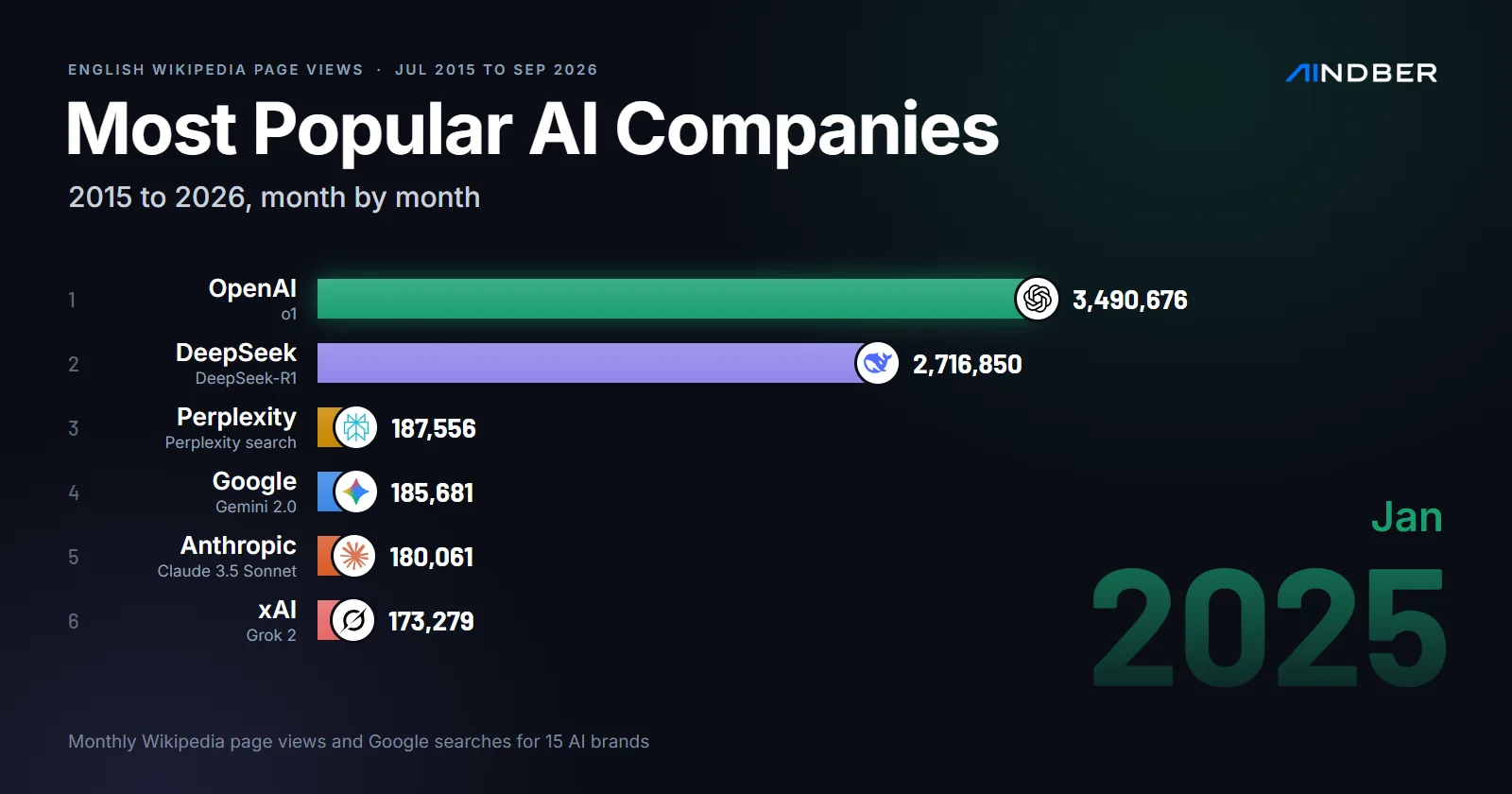
Data pulled: 24 October 2026 (UTC), covering July 2015 to September 2026. October is left out because the month is not over.
By Frankie C. · Senior Market Researcher, Mindber. Tracks 500+ AI/SaaS tools across SEA markets via the Mindber Innovation Index methodology.
How we assessed this: We pulled monthly English Wikipedia page views for 15 AI companies and their flagship model pages from the Wikimedia Pageviews API. Worldwide search interest for each brand's main product came from Google Trends. Both pulls ran on 24 October 2026. This is attention data, not hands-on product testing, and every monthly number is in the CSV files linked under the chart.
OpenAI is the most popular AI company of the past eleven years, and it isn't close. Its pages drew 74% of all English Wikipedia views across the 15 brands we tracked from July 2015 to September 2026. It has ranked first every month since October 2022.
Press play to watch eleven years go by, then read on for what drove each lead change.
Monthly views of each company's English Wikipedia pages and its flagship models, counted for human readers only.
Sep 2026OpenAI ships GPT-6 Astra


Total since Jul 2015Total since Jul 2015 OpenAI173M
 Google14M
 Anthropic8.9M
 DeepSeek5.9M
OpenAI173MGoogle14MAnthropic8.9MDeepSeek5.9MSep 2026: OpenAI leads with 2,452,839
| # | Brand | Model on the bar | Views | Total since Jul 2015 |
|---|---|---|---|---|
| 1 | OpenAI | GPT-6 | 2,452,839 | 172,943,796 |
| 2 | Anthropic | Claude Fable 5.1 | 546,919 | 8,927,449 |
| 3 | Gemini 3.5 | 204,280 | 14,050,262 | |
| 4 | xAI | Grok 4.7 | 118,897 | 4,862,261 |
| 5 | DeepSeek | DeepSeek-V4 | 99,515 | 5,913,701 |
| 6 | Perplexity | Perplexity Computer | 73,153 | 4,691,653 |
| 7 | Moonshot AI | Kimi K3 | 57,193 | 690,491 |
| 8 | Microsoft | Copilot | 50,416 | 3,390,192 |
| 9 | Alibaba | Qwen3.8 | 42,290 | 525,310 |
| 10 | Mistral AI | Vibe | 37,985 | 959,363 |
| 11 | Meta | Muse Spark | 34,285 | 2,172,741 |
| 12 | Stability AI | SD 3.5 | 25,968 | 3,272,241 |
| 13 | Character.AI | Character.AI app | 24,213 | 3,790,554 |
| 14 | Midjourney | V7 | 16,482 | 3,530,195 |
| 15 | IBM | watsonx | 9,198 | 3,789,851 |
Source: Wikimedia Pageviews API · Monthly data (CSV) · Make your own chart race
Each bar shows a company with the model or product it was best known for that month, so OpenAI's bar reads GPT-2 in 2019 and GPT-6 in September 2026. The panel under the bars keeps a running total since the first month. Switch the data source under the chart to see the Google view, which starts in November 2022, and open the table to read any month as plain numbers.
Before ChatGPT, IBM Watson and DeepMind took turns
The race opens with only three real contenders. IBM's Watson pages led for 17 months between 2015 and 2017, a long tail of interest from the computer that won Jeopardy in 2011. Google DeepMind led for 39 months, almost all of them between 2016 and early 2020.
March 2016 is the one month that broke the pattern. DeepMind's AlphaGo beat Lee Sedol four games to one in Seoul, and Google's pages drew 507,462 views. That is still Google's best month on this chart. Gemini, Bard and every model launch since 2023 have come nowhere near it.
OpenAI spent those years as the smaller lab. It took first place for single months in 2018 and 2019. Then came May 2020 and the GPT-3 paper, and from there OpenAI lost the lead only once. The numbers were tiny by later standards: OpenAI won that month with 75,227 views against Google's 64,795.
The month Midjourney came first
Since May 2020 only one brand other than OpenAI has led, for one month, by 941 views. In September 2022 Midjourney drew 129,886 views to OpenAI's 128,945. It was a photo finish. The image generator had opened to the public in July, and a picture made with it had just won an art prize at the Colorado State Fair. Stable Diffusion, released with open weights in August, was close behind them.
That summer belongs to image models, and it didn't last. Stability AI and Midjourney stayed in the top three into early 2023, and then their curves fell away. Both now sit in the bottom four of the Wikipedia ranking. Midjourney still sells one of the better-known image generators, and our Midjourney page tracks the product itself.
ChatGPT's lead, and why its Wikipedia line is falling
ChatGPT launched on 30 November 2022. December brought 3.16 million views to OpenAI's pages, more than every other brand on the chart had drawn in any month before it. April 2023 set the record that still stands: 9.30 million views in one month. Nobody, OpenAI included, has come close since.
The Altman episode shows up clearly. OpenAI's board fired its chief executive in November 2023 and took him back within a week. Views rose from 2.54 million in October to 3.40 million that month.
By September 2026, OpenAI's Wikipedia views had fallen to 26% of their April 2023 peak. Search tells a different story. ChatGPT's Google interest peaked in October 2025, and in September 2026 it still sat at 83% of that peak.
Our reading is that people haven't lost interest in ChatGPT. They no longer need an encyclopedia to explain it, and many search for it only to open it. A Wikipedia lead says a brand is new and talked about. A search lead comes closer to how many people use it. For the product itself, our ChatGPT page covers its plans and features.
Second place has changed hands ten times
English Wikipedia page views, July 2015 to September 2026 (135 months)
Google
63/135
IBM
33/135
Anthropic
10/135
OpenAI
8/135
Midjourney
5/135
Character.AI
4/135
Stability AI
3/135
Perplexity
3/135
DeepSeek
3/135
xAI
3/135
03468101135
Source: Wikimedia Pageviews API, Mindber analysis, Oct 24, 2026
Only four brands have ever ranked first. Second place is where the story moves, and since ChatGPT arrived each new runner-up has had a reason.
Character.AI took it in May 2023, the month its phone app came out, with 570,652 views. The chatbot for talking to made-up characters stayed second through August.
DeepSeek came closer to the top than anyone since ChatGPT launched. In January 2025 it released R1, a free reasoning model of the kind OpenAI had introduced with o1 four months earlier, along with its own app. DeepSeek's pages drew 2.72 million views that month, 78% of OpenAI's total. By March the surge had mostly faded, and our DeepSeek page follows where the lab went next.
xAI took second in March 2025 with 518,395 views, the month it merged with X. Perplexity took it in August 2025, when it offered $34.5 billion for Google's Chrome browser. Both were news spikes, and neither brand held the spot for more than two months in a row.
Anthropic is the exception. Since January 2026 it has been second every single month.
Anthropic's 2026: from news story to steady number two
Claude launched in March 2023 on the same day as GPT-4, and for a year Anthropic sat in the middle of the pack. Claude 3 put it in the top three for the first time in March 2024. It first ranked second in June 2025, and this year the spot became its own.
February 2026 was Anthropic's biggest month: 1,042,883 views. Three stories landed within four weeks. Anthropic ran two Super Bowl ads promising Claude would stay free of advertising, and it released Claude Opus 4.6. Then it refused a Pentagon demand to drop its limits on surveillance and autonomous weapons, and President Trump ordered federal agencies to stop using its models.
June added another spike. Claude Fable 5 launched on 9 June and went offline three days later under a US government order, a sequence our Fable 5 suspension report covered as it happened. Fable 5.1 followed on 1 September.
The gap to the leader is still wide. OpenAI drew 4.5 times Anthropic's views in September 2026. For a product-level comparison, our Claude vs ChatGPT guide sets the two assistants side by side.
Read about vs searched for: where the two measures split
English Wikipedia page viewsGoogle search interest
OpenAI
English Wikipedia page views
65 %
Google search interest
60.6 %
English Wikipedia page views
5.1 %
Google search interest
23.3 %
Anthropic
English Wikipedia page views
14.3 %
Google search interest
7.4 %
xAI
English Wikipedia page views
3.7 %
Google search interest
1.8 %
Microsoft
English Wikipedia page views
1.5 %
Google search interest
2.1 %
DeepSeek
English Wikipedia page views
1.9 %
Google search interest
1.6 %
Perplexity
English Wikipedia page views
2.3 %
Google search interest
0.9 %
Source: Wikimedia Pageviews API and Google Trends, Mindber analysis, Oct 24, 2026
Google is the clearest split. Its pages took 5.1% of Wikipedia attention this year, fourth behind xAI in some months, while Gemini took 23.3% of search interest, a solid second. Google's search line jumped fivefold from August to September 2025, the month its Nano Banana image editor went viral, and it hasn't dropped below 25 since. Our Gemini page covers the paid tiers behind those searches.
Anthropic runs the other way, with about twice the share on Wikipedia that it has on Google. We read that as a brand people hear about in the news before they use it. Microsoft is the only brand besides Google with a larger search share than reading share, which fits a product that arrives inside Windows and Office rather than through headlines.
These shares are each brand's slice of the 15-brand total in each source, so they compare the shape of attention, not its size. A 1% share of Google search interest and a 1% share of Wikipedia views are different amounts of people.
The Chinese labs: one spike and two slow climbs
DeepSeek's year after its spike shows how fast attention moves. Its 2026 views run 85% below the same months of 2025, and it sat fifth in September. That doesn't track the company's work, which kept going with V3.1, V3.2 and a V4 preview in April 2026. Its earlier R1 and V3 releases came out as open-weight models, which anyone can download and run.
Moonshot AI and Alibaba are climbing more quietly. Kimi K3, released on 16 July 2026, gave Moonshot 172,229 views that month and fourth place. Alibaba's Qwen pages had their best month on record in September 2026, the last month in the data.
All three are undercounted here, and it matters. Wikipedia and Google search are both blocked in mainland China, so both sources miss most of these companies' home audience. Read the Chinese labs' bars as their profile outside China.
The data behind the chart
This table is the race in plain numbers: yearly English Wikipedia views per brand, in thousands. The full monthly series is in the Wikipedia CSV, and the Google index is in the Google Trends CSV.
| Brand | 2015* | 2016 | 2017 | 2018 | 2019 | 2020 | 2021 | 2022 | 2023 | 2024 | 2025 | 2026* | Total |
|---|---|---|---|---|---|---|---|---|---|---|---|---|---|
| OpenAI | 34 | 327 | 382 | 276 | 337 | 1,010 | 1,398 | 4,710 | 64,566 | 25,974 | 49,165 | 24,764 | 172,944 |
| 81 | 1,194 | 812 | 622 | 549 | 653 | 640 | 709 | 2,165 | 2,259 | 2,420 | 1,947 | 14,050 | |
| Anthropic | 0 | 0 | 0 | 0 | 0 | 0 | 1 | 1 | 244 | 1,093 | 2,138 | 5,450 | 8,927 |
| DeepSeek | 0 | 0 | 0 | 0 | 0 | 0 | 0 | 0 | 0 | 6 | 5,181 | 726 | 5,914 |
| xAI | 0 | 0 | 0 | 0 | 0 | 0 | 0 | 0 | 219 | 773 | 2,465 | 1,406 | 4,862 |
| Perplexity | 0 | 0 | 0 | 0 | 0 | 0 | 0 | 0 | 0 | 1,351 | 2,478 | 862 | 4,692 |
| Character.AI | 0 | 0 | 0 | 0 | 0 | 0 | 0 | 21 | 2,235 | 764 | 491 | 280 | 3,791 |
| IBM | 296 | 653 | 802 | 485 | 355 | 246 | 176 | 152 | 185 | 206 | 150 | 83 | 3,790 |
| Midjourney | 0 | 0 | 0 | 0 | 0 | 0 | 0 | 567 | 1,676 | 667 | 415 | 205 | 3,530 |
| Microsoft | 0 | 0 | 0 | 0 | 0 | 0 | 42 | 130 | 516 | 1,160 | 960 | 582 | 3,390 |
| Stability AI | 0 | 0 | 0 | 0 | 0 | 0 | 0 | 526 | 1,269 | 730 | 480 | 266 | 3,272 |
| Meta | 0 | 0 | 0 | 0 | 0 | 0 | 0 | 23 | 286 | 674 | 827 | 363 | 2,173 |
| Mistral AI | 0 | 0 | 0 | 0 | 0 | 0 | 0 | 0 | 4 | 286 | 357 | 312 | 959 |
| Moonshot AI | 0 | 0 | 0 | 0 | 0 | 0 | 0 | 0 | 0 | 5 | 146 | 539 | 690 |
| Alibaba | 0 | 0 | 0 | 0 | 0 | 0 | 0 | 0 | 0 | 1 | 227 | 297 | 525 |
*2015 starts in July, when Wikimedia's pageview records begin. 2026 runs to September.
A brand here is a company plus its flagship assistant and model pages, counted with every redirect into them. Redirects matter more than they sound. "Bard (chatbot)" now redirects to Google Gemini, "Bing Chat" to Microsoft Copilot and "Claude (language model)" to Claude (AI), so old names keep their history. We count human readers only, which is the API's "user" agent filter.
| Brand | Wikipedia pages counted | Google Trends item |
|---|---|---|
| OpenAI | OpenAI, ChatGPT, the ten GPT-1 to GPT-6 model pages, OpenAI o1, OpenAI o3 | ChatGPT topic |
| Google DeepMind, AlphaGo, AlphaFold, LaMDA, Google Gemini, Gemini (language model) | Gemini topic, which includes Bard | |
| Anthropic | Anthropic, Claude (AI), Claude Mythos | Claude topic |
| Meta | Meta AI, Llama (language model) | Meta AI topic |
| xAI | SpaceXAI (formerly xAI), Grok (chatbot) | Grok topic |
| DeepSeek | DeepSeek, DeepSeek (AI) | DeepSeek topic |
| Microsoft | Microsoft Copilot, GitHub Copilot | Microsoft Copilot topic, plus "bing chat" searches before November 2023 |
| Mistral AI | Mistral AI | Mistral AI topic |
| Perplexity | Perplexity AI | Perplexity AI topic |
| Midjourney | Midjourney | Midjourney topic |
| Stability AI | Stability AI, Stable Diffusion | Stable Diffusion topic |
| Alibaba | Qwen | Qwen topic |
| Moonshot AI | Moonshot AI, Kimi (AI) | Kimi topic |
| Character.AI | Character.ai | Character.ai topic |
| IBM | IBM Watson, IBM Watsonx | IBM Watson topic |
Parent companies' own pages stay out. "Google", "Microsoft", "Meta Platforms" and "Alibaba Group" are about far more than AI, and counting them would bury the AI signal under searches for Gmail or Facebook.
Three fixes changed the numbers before publishing. Our first pull credited OpenAI with about 490 million views, nearly three times the real figure. The script cached each page title as a file, and Windows treats "Chatgpt" and "ChatGPT" as the same file name, so redirect spellings re-counted the main page. Hashing the titles brought OpenAI down to 173 million.
We also dropped a page called "Le Chat", which turned out to be a Belgian comic strip rather than Mistral's chatbot. Four person pages merged into brand pages went too, among them Perplexity's chief executive, since they measure interest in a person.
Google Trends needed its own repairs. Its ChatGPT topic only starts counting in June 2023, months after launch. Earlier months use searches for "chatgpt" and "chat gpt" instead, scaled up by the 15% more queries the topic catches once both run. Grok, Meta AI and DeepSeek got the same treatment for their first months.
Trends also compares at most five items at once and rounds to whole numbers. We fetched each brand alone for detail, then chained overlapping five-topic comparisons to set the levels. Google's notes on how Trends data is adjusted explain why the result is relative. Each point is a share of all searches at that time and place, scaled from 0 to 100.
What this race can't tell you
Attention isn't usage. Neither source counts users. A spike can come from a fight with a government as easily as from a launch, and Anthropic's February 2026 peak had both. Revenue, retention and model quality sit outside this data entirely. Our Model Arena ranks models on benchmark results instead.
English Wikipedia leans toward English readers, though they live everywhere. A brand covered mostly in Japanese, Korean or Chinese news will look smaller here than it is. Wikipedia pages also appear late: Perplexity's page only shows views from January 2024, more than a year after its search engine launched, and DeepSeek's from November 2024.
Search interest in the Google view is a share of all Google searches, scaled so the busiest brand-month equals 100. It can say Gemini drew about 40% of ChatGPT's search interest in September 2026. It can't say how many searches that was. You can check any brand's raw curve yourself with the free Pageviews tool or Google Trends.
Frequently asked questions
Which AI company grew fastest in 2026?
By Wikipedia views, Moonshot AI: its January to September 2026 total was 780% above the same months of 2025, mostly from Kimi K3. Anthropic grew 270%, the largest rise among the big three. By Google search interest, Anthropic grew 584% and Google 205% over the same months.
Why does Microsoft rank so low when Copilot ships with Windows?
We count only the Copilot and GitHub Copilot pages, not Microsoft's own page, so Copilot competes as a product. In September 2026 it ranked fourth on search and eighth on Wikipedia. Our guess is that people who already have Copilot in Windows or Office look up how to use it, not its history.
Why aren't Apple, Amazon or Nvidia in the race?
None of them sells a flagship AI model brand with its own page the way OpenAI sells ChatGPT. Siri and Alexa are voice assistants that launched before this race starts, and counting them would turn the chart into a contest of phone and speaker features. Nvidia sells the chips that many of these models train on.
Does more attention mean a better AI model?
No. Midjourney's month at the top coincided with an art-prize story, and xAI's best month came with a merger. For model quality, use benchmark leaderboards such as our June 2026 model rankings, which name the source of every score.
Can I use this data in my own chart?
Yes. Both monthly CSV files are linked under the chart and in the data section, with one column per brand. Please credit Wikimedia or Google Trends as the source and link back to this page for the brand definitions, since another page list would give different totals.
Why does the Google view start in November 2022?
Before ChatGPT, search interest in every brand here was close to zero on a scale that ChatGPT later tops, and Google Trends rounds those months to nothing. The Wikipedia view carries the race back to 2015, where page views still separate IBM, DeepMind and OpenAI.
More from Mindber
If this race leaves you choosing between the two leaders' paid plans, our Claude Pro vs ChatGPT Plus breakdown compares what each $20 buys. The AI chatbot directory covers the products behind most of these bars. For the money behind xAI, read our report on SpaceX's IPO and its AI lab.
Logos in the chart come from the open-source Lobe Icons set and belong to their companies.
Sources and methodology
Page views come from the Wikimedia Pageviews API and search interest from Google Trends, both pulled on 2026-10-24. Model names and release dates come from vendor announcements and English Wikipedia articles read the same day. No hands-on product testing.
- [1]Monthly English Wikipedia page views per page, human readers only, July 2015 to September 2026Wikimedia Analytics API: page views · 2026-10-24
- [2]Worldwide monthly search interest by topic and search term, November 2022 to September 2026Google Trends · 2026-10-24
- [3]How Trends normalizes search interest and scales it from 0 to 100Google Trends Help: How Trends data is adjusted · 2026-10-24
- [4]AlphaGo's 4 to 1 win over Lee Sedol in March 2016Google DeepMind: AlphaGo · 2026-10-24
- [5]ChatGPT launch on 30 November 2022OpenAI: Introducing ChatGPT · 2022-11-30
- [6]OpenAI board removes and reinstates Sam Altman, November 2023Wikipedia: Removal of Sam Altman from OpenAI · 2026-10-24
- [7]GPT-6 Astra public release on 4 September 2026Wikipedia: GPT-6 · 2026-10-24
- [8]Claude launch in March 2023Anthropic: Introducing Claude · 2023-03-14
- [9]Claude versions and dates, Fable 5 launch and suspension in June 2026, Fable 5.1 on 1 September 2026Wikipedia: Claude (AI) · 2026-10-24
- [10]Anthropic's Super Bowl ads and the Pentagon dispute, February 2026Wikipedia: Anthropic · 2026-10-24
- [11]DeepSeek-R1 release in January 2025DeepSeek API Docs: DeepSeek-R1 release · 2025-01-20
- [12]Midjourney open beta in July 2022 and its model versionsWikipedia: Midjourney · 2026-10-24
- [13]Midjourney image wins the Colorado State Fair digital art prize, 2022Wikipedia: Théâtre D'opéra Spatial · 2026-10-24
- [14]Perplexity's $34.5 billion offer for Chrome, August 2025Wikipedia: Perplexity AI · 2026-10-24
- [15]xAI merges with X in March 2025 and becomes part of SpaceX in February 2026Wikipedia: SpaceXAI · 2026-10-24
- [16]Kimi K3 release on 16 July 2026Wikipedia: Kimi (AI) · 2026-10-24
- [17]Qwen releases through Qwen3.8 in 2026Wikipedia: Qwen · 2026-10-24
- [18]Brand logos used in the chartLobe Icons, MIT license · 2026-10-24
Learn the basics on Mindber
Background for this article, from the free Mindber learning hub.
Topic guides
AI Basics lessons
Share this article
Legal notice
This publication constitutes editorial commentary on publicly available information and does not constitute financial, legal, investment, or professional advice. Product names, trademarks, and registered trademarks referenced herein are the property of their respective owners; their appearance does not imply endorsement or affiliation. Mindber's analysis reflects editorial judgment based on public signals and is subject to change without notice. Scores are not buy, sell, or hold recommendations. No commercial relationship exists between Mindber and the vendors evaluated unless separately disclosed in writing. This publication is governed by the laws of Malaysia. Any dispute arising from or in connection with this publication shall be submitted to the exclusive jurisdiction of the courts of Malaysia.