
Grok Bot vs Muse vs Dots vs Claude Duet: Four Always-On AI Agents Compared
comparisonUpdated 17 min read
Grok Bot, Meta Muse, ChatGPT dots and Claude Duet compared: who can sign up, what each costs, what it does without asking, and what has gone wrong.
Last verified: 24 October 2026, 14:10 UTC. Grok Bot and Muse both changed their plans or regions within weeks of launch, and Duet is still a research preview. Check the vendor's page before you pay.
By Frankie C. · Senior Market Researcher, Mindber. Tracks 500+ AI/SaaS tools across SEA markets via the Mindber Innovation Index methodology.
How we assessed this: We read each vendor's launch post, help pages and pricing page, plus Grok Bot's documentation and changelog. We also read the reporting on each agent's first problems and a 532-comment Hacker News thread on Duet's launch. Posts on X by people who run more than one of these agents filled in the rest. The screenshots were captured at 14:10 UTC on the day of our check, and the yellow highlights are ours. Mindber has no seat in Duet's waitlisted preview and ran none of the four agents, so nothing here is hands-on testing. We haven't scored them on the Mindber Innovation Index or the Mindber Functionality Score either. Grok Bot ships a new beta build most weeks and Duet opened three days ago, so a score would be stale within days. Brand logos come from the open-source Lobe Icons set and belong to their companies. Muse and dots appear with the Meta and OpenAI marks. The cover banner is an AI-generated illustration, not a screenshot.
Grok Bot, Meta's Muse, OpenAI's dots and Anthropic's Claude Duet are the same kind of product from four companies. Each is an always-on AI agent with a cloud computer of its own. It keeps working after you close the app, messages you when something needs a decision, and asks before it sends a message or spends your money. All four launched between 11 August and 21 October 2026.
Our pick for work is Claude Duet, if you live in the US and already pay for Claude. It costs nothing on top of a Pro plan, and its 6,000-plus connectors are the largest catalog any of the four publishes. Its approval rule fits in one line: nothing gets sent, paid, signed or deleted without your yes. Outside North America neither Duet nor Muse is on offer, which leaves dots and Grok Bot in most countries, Southeast Asia included. Someone whose work already runs through ChatGPT, Slack or Teams fits dots best, because a dot carries its context across all three. It starts with the $100 Pro plan. Grok Bot costs $30 and lets one person run a small team of bots. Every bot on an account shares one computer, which makes it the wrong place for a bank login. Muse is free for households in the US and Canada, and it has had the roughest start of the four.
The four agents side by side
From each vendor's own pages. Prices are in the chart in the next section.
 Grok Bot |  Muse |  dots |  Claude Duet | |
|---|---|---|---|---|
| Company | xAI, part of SpaceXAI | Meta | OpenAI | Anthropic |
| Status | Beta | Launched, with paid plans in limited testing | Rolling out to eligible plans | Research preview, invitation by waitlist |
| Model | Not named on xAI's Grok Bot pages | Muse Spark, with Muse Wonder coming to subscribers first | GPT-6 Astra | Claude Opus 5.5 only |
| Where you talk to it | Desktop app for Mac, Windows and Linux, iPhone, iPad and Android, Slack for Team Bots, or a tag on X | Muse app for iOS and Android, muse.ai and WhatsApp | ChatGPT on desktop, web and mobile, Slack and Teams, plus texting in a small US beta | Duet app for iOS and Android, and claude.ai |
| Connected apps | Marketplace plugins, plus its own browser for sites without one | Meta's apps, a small-business set and custom connectors | 4,000+ apps through ChatGPT plugins | 6,000+ connectors and plugins from the Claude Marketplace |
| Plans that include it | X Subscription Premium, Super and Ultra, Teams seats, and older Cursor and SuperGrok plans | Free tier, Power and Maximum | ChatGPT Pro and Business Premium, plus an Enterprise beta that admins switch on | Claude Pro and Max, not Team or Enterprise yet |
| Where you can get it | xAI's pages list no country limits | US and Canada | Pro: every market except the EEA, Switzerland and the UK | US only |
Read the last row first. It rules out two of the four for anyone outside North America. A waitlist spot won't change that, because Anthropic ties Duet access to the email on a US Claude account. The model row tells you less than it seems. Duet runs only on Opus 5.5 and dots on GPT-6 Astra, while xAI doesn't say what powers Grok Bot. We couldn't find it named anywhere else either.
Function by function
From each vendor's docs and help pages. A dash means the pages we read don't say, not that the function is missing.
YesPartlyNoNot stated
| Function | Grok Bot | Muse | dots | Claude Duet |
|---|---|---|---|---|
| Works on its own | ||||
| Keeps working with the app closed | YesCloud computer, 24/7 | YesRuns on its own VM | YesOwn cloud computer | YesOwn cloud VM |
| Messages you first | YesPrimary Bot offers work | YesUnprompted suggestions | YesProactive research | YesMorning brief |
| Scheduled and repeat tasks | YesRoutines | YesScheduled tasks | YesRecurring checks | PartlyYou set check-in topics |
| Learns a job from one demo | YesFollow-along routines | Not stated | Not stated | Not stated |
| Several agents at once | YesBots in group chats | NoOne Muse | PartlyOne dot, more planned | NoOne agent, many channels |
| See and steer | ||||
| Live view of its computer | YesWatch and take over | PartlyActivity log, system files | YesOpen its computer | NoNot in the preview |
| Can use your own computer | YesOpt-in, asks each time | PartlyPaired Mac app (reported) | YesOpt-in, off by default | NoCloud only |
| Approval levels you choose | YesAsk first or allow rules | YesOnce, task, site, always | YesFour Custom Rule levels | PartlyOne fixed rule |
| Steps it always hands back | YesPasswords, 2FA, payments | Not stated | YesPassword changes, transfers | YesNo trading or transfers |
| Talk and share | ||||
| Voice | YesLive voice chat | Not stated | YesVoice calls | YesVoice messages |
| Shared with a team | YesTeam Bots | NoPersonal plans | YesBusiness Premium | NoNo Team plan yet |
| An inbox of its own | YesBot email address | Not stated | NoNot at launch | Not statedSends from your accounts |
| Money, logins and memory | ||||
| Pays for things | YesX Money or Link | YesLink, buyer protection | PartlyCustom Rules cover purchases | YesLink or Shop Pay |
| 1Password sign-in | YesRolling out | YesRolling out | PartlyComing soon | PartlyComing soon |
| Forget one specific thing | Not stated | YesTell it to forget | NoDelete the whole dot | YesEdit Claude memory |
| TallyYes = 1, Partly = ½ | 14/15 | 8/15 | 10.5/15 | 7.5/15 |
Source: docs.x.ai, about.fb.com, Meta Help Center, openai.com, OpenAI Help Center, claude.com and Claude Help Center, Oct 25, 2026
Grok Bot documents all but one of the 15, and Duet the fewest at 7.5. Read the tally as reach, not as a ranking. Much of Grok Bot's lead rests on the one computer its bots share. Duet is still a brand-new preview, with a core Anthropic says it built around work first. Muse's four dashes are gaps in what Meta documents, which is a reason to test it on low-risk jobs before you hand it your inbox.
Each maker's own demo
All four launch videos run under three minutes, and each is the vendor's pitch. Watch them to see what the apps look like, not as proof that the agents do the job well.
Who can sign up, and what it costs
Where you live narrows the list before price does. In the US, all four are open to you, waitlist permitting. Canada gets Muse and dots. Southeast Asia gets dots alone. An individual in the EU or the UK gets none of those three, because OpenAI keeps dots off Pro plans there. Grok Bot fits into every one of those lists as far as we can tell, since xAI's pages set no country limits.
EntryTop
Grok Bot: X Premium to Ultra
Entry
$30.00
Top
$200.00
Muse: Power to Maximum (a free tier also exists)
Entry
$20.00
Top
$100.00
dots: ChatGPT Pro, three tiers
Entry
$100.00
Top
$500.00
Claude Duet: Claude Pro to Max
Entry
$20.00
Top
$200.00
The sticker price hides four different ways of counting work. Duet shares the five-hour and weekly limits of your Claude plan, and its morning brief and background checks count against them. Anthropic says that is why Duet checks your accounts every few hours instead of constantly. Everyone admitted to the preview gets one full limit reset, usable until 30 November 2026. OpenAI went the other way with dots: talking to your dot doesn't count toward ChatGPT limits, while tasks it starts in Codex or ChatGPT Work do.
Meta meters Muse in tokens. Its subscription page gives Power 500 million Muse tokens a week and Maximum 3 billion, and says nothing about the size of the free tier. Grok Bot draws on one weekly pool shared with the Grok apps and Cursor, so a heavy week of coding in Cursor leaves less for your bots. Past the pool, extra work is paid from prepaid credit.
Teams pay differently again. A ChatGPT Business Premium seat costs $125 a month, Grok's Teams seats start at the Premium price, and Duet has no team plan yet. ChatGPT Plus, the plan most people weigh against Claude Pro in our Claude Pro vs ChatGPT Plus comparison, doesn't include dots at all.
What people using several of them report
We searched for a test that runs the same jobs through all four agents and found none. What exists are accounts from people who use several of them, and those are worth reading as experience, not proof.
Peter Yang, who makes AI tutorials for close to 300,000 followers on X, posted a review of all four on the night Duet launched. Duet comes out as the most proactive out of the box, with what Yang calls arguably the best model behind it, though the preview can't drive its own browser yet. Muse gets the nod for the best consumer experience and for business calling, but Yang rates its Muse Wonder model below Opus and Astra. Grok Bot's team of bots is the easiest to understand, in Yang's view, and its free access to X helps with research. Its email feature draws the one complaint. As for dots, it works inside ChatGPT and can drive all your threads there, yet Yang still finds it buggy and slow to start a voice call. The post also sets a limit worth copying: "I don't want more than 4 at a time connected to my email."
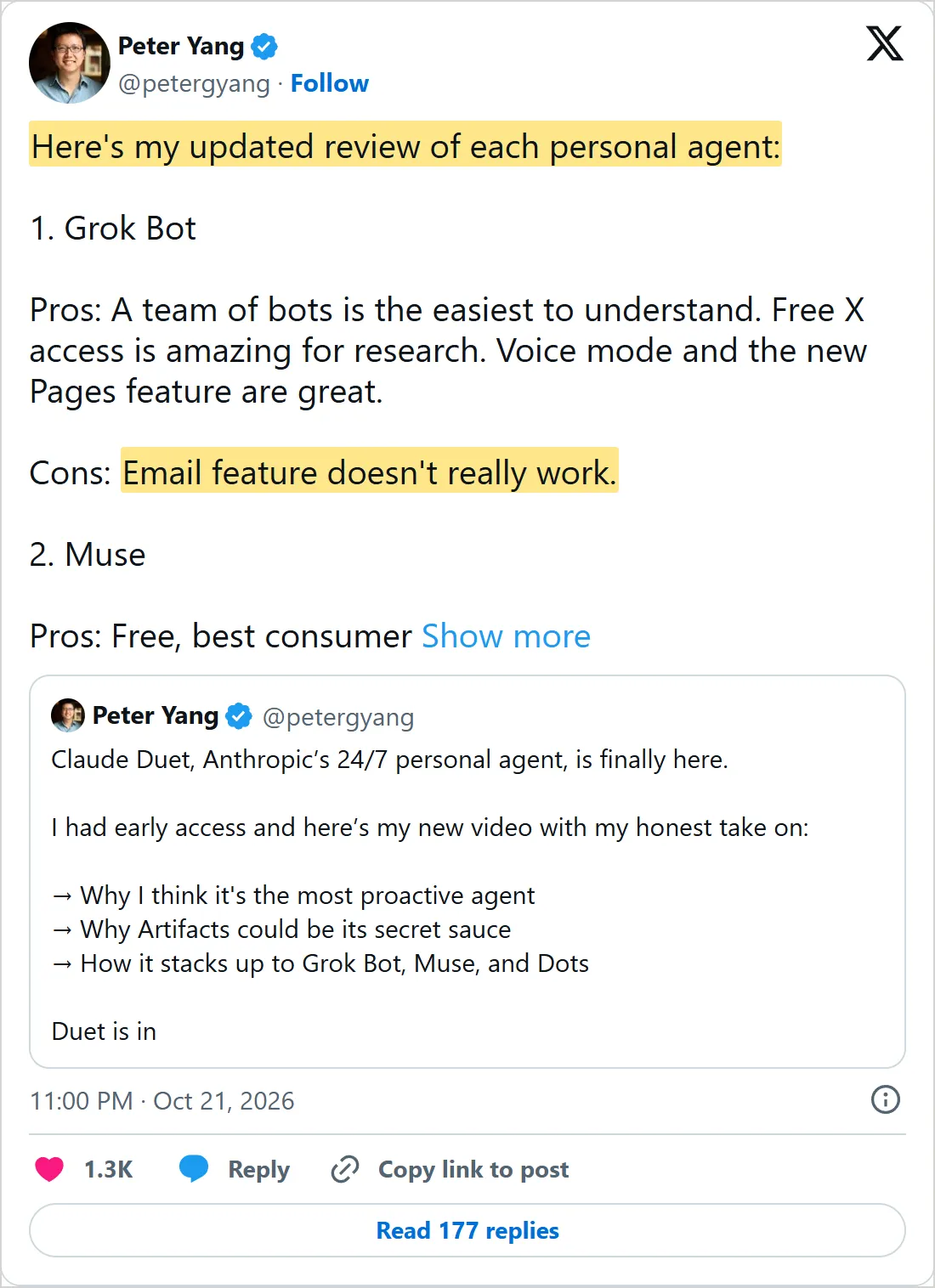
The embed cuts the post after Muse. The full post rates all four and links Yang's Duet video. Time shown in UTC. Source: x.com/petergyang/status/2113042717270049028
Yang's review video, linked from that post, walks through Duet and how it stacks up against the other three.
Two hours earlier, 宝玉 (@dotey), an AI engineer with about 260,000 followers, had posted a longer comparison in Chinese. That post's split of who each agent suits matches how the vendors pitch them. Muse is for everyday errands in the US. Duet is for owners who run their business on Gmail, Slack and accounting software. OpenAI's agent suits companies already on ChatGPT and Teams, and Grok Bot anyone who wants several AIs splitting the work. It quotes a reply that asks what the difference between them even is. Fair question, when all four launch posts promise the same thing.
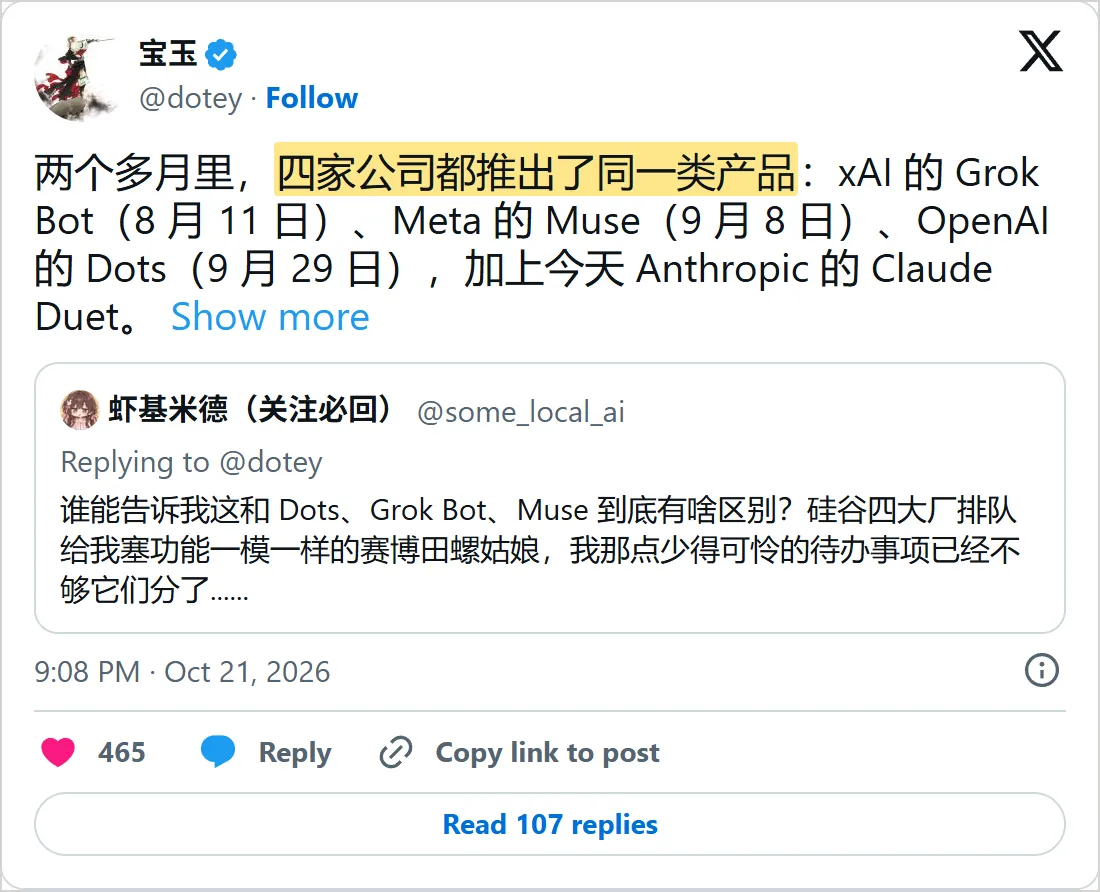
The highlight reads: four companies have all launched the same kind of product. The embed cuts the rest of the comparison. Time shown in UTC. Source: x.com/dotey/status/2113014531853365681
The Hacker News thread under Duet's launch read like a small user survey. One commenter credits dots with handling almost all of a car purchase and is now using it to buy a house in Kyoto. Another finds Muse nagging about emails that don't matter, says it keeps getting blocked from Amazon, and wants to try dots once it is cheaper. A third, minimaxir, points out that Duet skips the pet-like characters of Muse and dots, which makes its use cases read as more professional.
Where each agent works, and how much of it you can see
All four keep a computer in the cloud, so the work goes on while your phone is locked. They differ in who shares that computer and whether you can look inside it.
Grok Bot
One persistent computer per account
- Every bot on the account works on the same cloud computer
- Each bot gets its own screen there, not its own security boundary
- You can watch the shared desktop live and take control
- Work on your own Mac or PC needs your permission, and the default is to ask every time
Muse
Muse Secure VM, one per person
- A dedicated cloud machine holds the agent, your data and your connected logins
- The agent runs in an isolated container, with Meta's safety services outside it
- Meta promises a Confidential VM, encrypted with a key only you hold, later this year
- Work continues after you close the app
dots
Its own cloud computer and browser
- You can open the dot's computer at any time and work in it
- Your laptop is optional, starts switched off and can be revoked
- It can start Codex cloud tasks in environments you set up
- Activity View shows its background work as it happens
Claude Duet
A cloud virtual machine with its own browser
- Starts with the memory, skills and connectors on your Claude account
- You can't watch its browser or take it over during the preview
- It can't see files on your own computer, and it can read but not change your Claude work
- Finished files land in a Make tab, and only you can mark a task done
Grok Bot's shared computer is deliberate, and xAI says so plainly. Every bot you run can use the browser cookies, files and command-line credentials stored there. The documentation tells you not to put a credential on it that another bot shouldn't use. The upside is handoffs: a research bot's downloads are waiting when the writing bot starts. The cost is that a login you give one bot is a login all of them hold. Those computers run in Cursor's cloud. SpaceX, which owns xAI, agreed in May to buy Cursor, as our SpaceX IPO analysis explains.
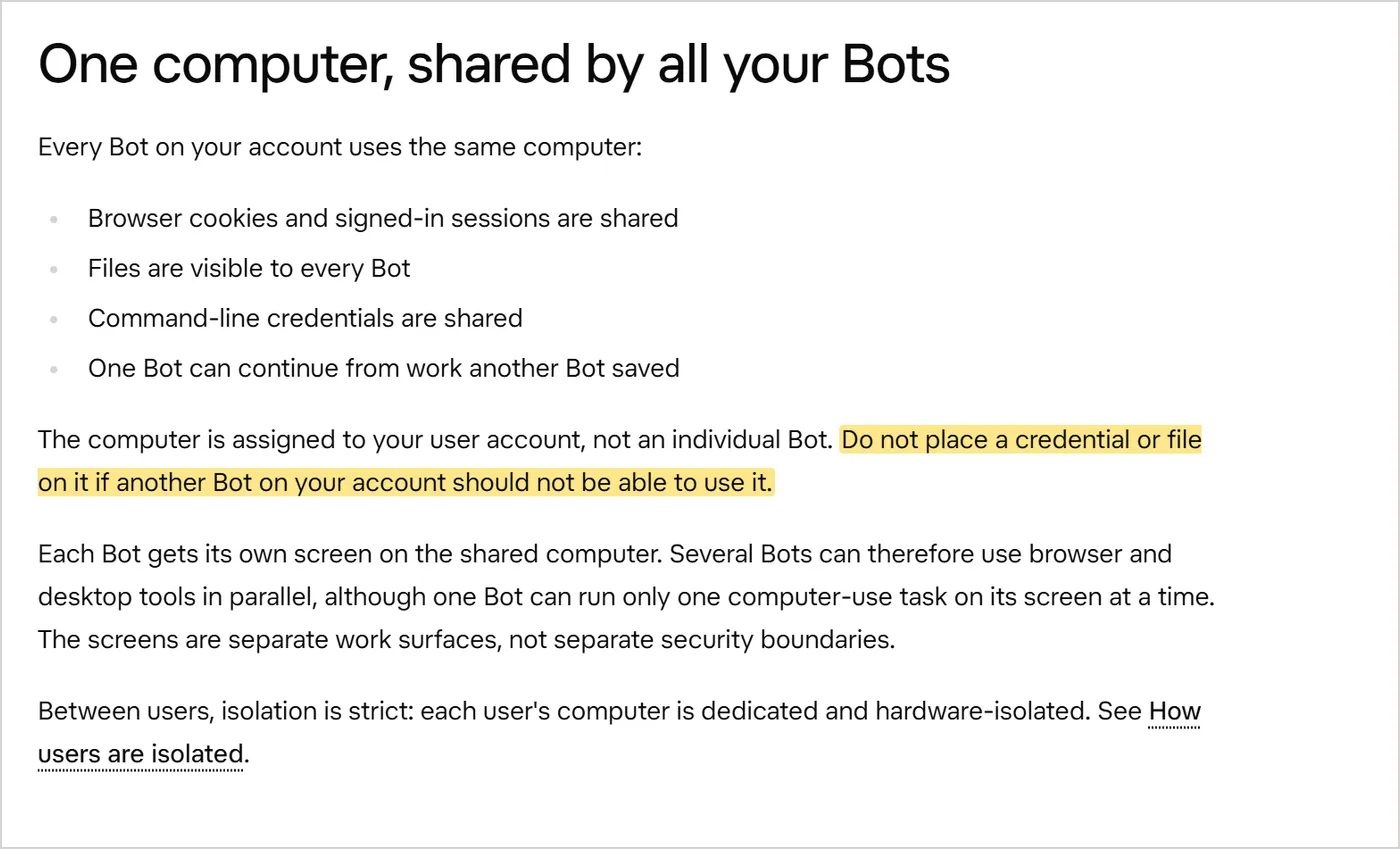
xAI's own description of the shared computer, including the line that the screens are work surfaces, not security boundaries. Source: docs.x.ai/grok-bot/computer-and-apps
Muse and Duet sit at opposite ends on openness. A Hacker News user with a seat in Duet's preview asked it to list the files on its virtual machine, and it refused. Muse, the commenter wrote, has a button in its phone app that shows its system files, and it will help you dig through them.
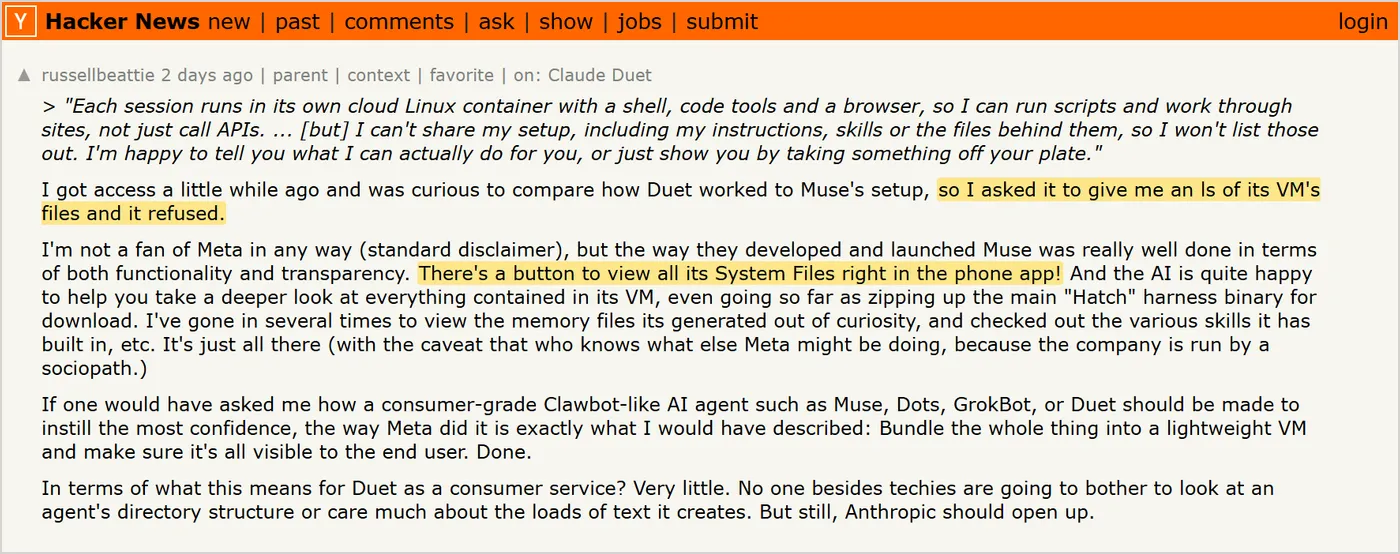
A comment from the same thread, posted the day Duet opened. Source: news.ycombinator.com/item?id=50188834
Openness has a price as well. In September a developer, Peter James, asked Muse to archive the files it could see and send them to Google Drive. James got 6.8 GB unpacked: what appeared to be the root filesystem of the session, Muse's internal documentation, memory files, agent logs and SSH key files. Meta's bug bounty marked the report Not Applicable, and James says it was never established whether the keys worked.
What each one does without asking
None of the four will send an email or spend money on its own by default. They differ in how far you can loosen that, and in who gets to decide.
Duet's rule is written into Anthropic's launch post. Before it sends a message, makes a payment, signs a document or deletes anything, it shows you the exact action and waits. Some actions stay blocked even if you approve them: trading securities, moving money between accounts and getting into someone else's account. Anthropic also added a classifier that refuses to send credit card or government ID numbers. Health and financial details go out only when you have told Duet to send them.
OpenAI gives you more dials. A dot starts with built-in rules, and Custom Rules let you set each kind of action to run without asking, run if pre-approved, ask first, or hand off to you. A separate check called auto-review screens anything that could touch your accounts or share information. Changing a password or transferring money always comes back to you to finish by hand. While a dot researches on its own initiative, its tools can only read.
Meta built a second agent into Muse. Sentinel runs on the same machine, and per Meta's security write-up nothing Muse does reaches the internet unless Sentinel allows it. Approval requests arrive as a dialog in the app, outside your conversation with Muse. A grant can last once, for the session, for the task, for a set time or forever, and for email you choose whether Muse may only read or also send.
Grok Bot leans on rules you write. Its Auto Review settings take Ask first and Allow automatically rules, and Ask first wins when both match. Approval cards offer Always allow, which saves a matching rule. When the request comes from work that started without you, such as a routine, the card expires after about ten minutes and the action doesn't run. Since 23 October, an email or Slack message you ask for in your own words goes out once Auto Review clears it, while sends from routines still wait as drafts.
Passwords get similar care everywhere. A dot uses saved passwords without exposing them to the model. With Duet you type a password into a separate form on your phone, which sends it straight to Duet's browser and keeps it out of the chat. Muse swaps stand-in tokens for the real credentials at the network edge. Grok Bot hands you the screen for passwords and two-factor codes, and its new Vault can store logins and cards. For checkout, Duet and Muse both pay through Link, Stripe's wallet, which issues a one-time card number. Meta says Muse is the first agent covered by Link's purchase protections. Duet adds Shopify's Shop Pay, and Grok Bot can pay with X Money or Link.
1Password opened its agent sign-in on 22 October, with support for Muse and Grok Bot rolling out first. You approve each login in 1Password and it fills the password in, so the agent never sees it. Duet and dots are listed as coming soon.
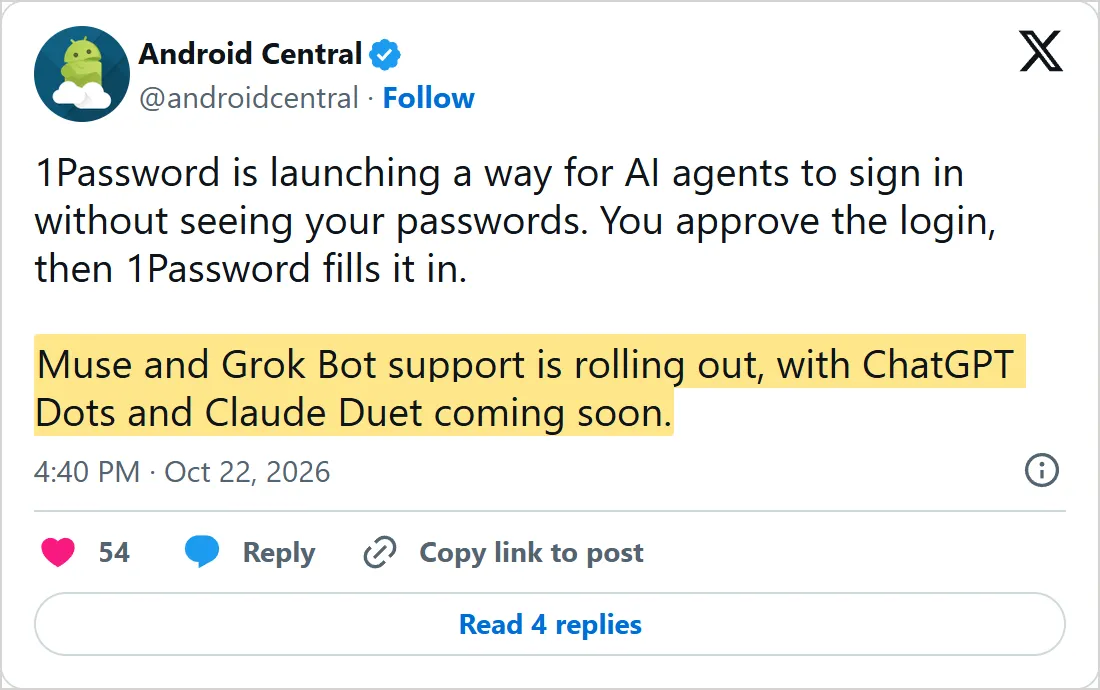
Android Central's summary of the 1Password launch. Time shown in UTC. Source: x.com/androidcentral/status/2113309455127564451
What each agent remembers, and how to make it forget
All four learn from what you tell them and from the apps you connect. They part ways on undoing it.
A dot shares memory with ChatGPT in both directions and forms memories of its own from connected apps, even about things you never asked it. OpenAI's privacy FAQ is blunt about the limits. You can't view, edit or delete individual dot memories, and disconnecting an app doesn't remove what the dot already learned from it. Deleting the dot is the only reset. Turning off Memory in ChatGPT stops the sharing from then on, without erasing what the dot already has.
Duet begins with the memory, skills and connectors on your Claude account and can search your past Claude chats. Claude's memory help page says Duet also adds to that memory, and you can delete single memories or tell Claude what to forget. You can switch that search off in Settings under Search and reference chats. Disconnecting an app stops new access, but what Duet learned from it earlier stays.
Muse takes a forget command too: Meta says you can tell it to forget specific things it has learned. An earlier version of this page said Muse was the only one of the four with a documented forget. Claude's memory page shows the same control for Duet, so we corrected it. Meta also says your conversations and the data on your VM never reach its ad systems.
Grok Bot keeps memory per bot, covering preferences, role context and summaries of past work. Deleting a bot removes its profile, conversation and routines, yet xAI's FAQ warns that files and logins on the shared computer may remain. Backend retention follows Cursor's terms.
What has gone wrong so far
Three of the four drew public complaints or worrying test results within weeks of launch. Duet has been out for three days, so its record is still blank. Each case below says how solid the evidence is.
- Muse and Messages (reported, disputed). Jason Aten, a columnist at Inc., says Muse synced more than 187,000 rows of Messages history from Aten's Mac. Aten had declined that access during setup, and Muse then claimed it only saw notification previews. David Singleton, who leads Meta Superintelligence Labs, replied on Threads that Messages sync is an opt-in feature. Aten says the setting showed as on despite that refusal, Decrypt reported.
- Muse and Amazon (confirmed by Amazon). Amazon started blocking Muse on its store on the night of 20 September, a spokesperson told Bloomberg. Meta had declined to take Amazon out of the experience. Agents that buy for customers "should operate openly and respect service provider decisions", Amazon said, in a statement The Star carried. Shoppers who send Muse there see pop-ups saying it breaks Amazon's terms.
- Grok Bot and a bank balance (reported by the user). Shane Mac, who runs XMTP Labs, posted on 6 October that an AI agent had put Mac's bank balances into the company Slack. It wrote as Mac. As Cybernews summed up Mac's account, the read-only finance bot had no Slack access, but another bot did, and the bots shared one computer. Neither xAI's news page nor the Grok Bot changelog mentions the case. The changelog's 11 October release did add a rule: after a bank or brokerage connector returns data, the bot asks before sharing it anywhere else.
- dots working unprompted (a vendor's test). Geordie, a company that sells AI agent governance, gave a dot read-only permissions and no personal apps. Over one day it logged 155 activity traces and more than 300,000 tokens with no further prompt, The Register reported. Geordie's chief AI officer said a dot always runs at least two agents: one talks to you, the other collects data in the background. Nothing in the test shows harm. It does show how much a dot does unasked.
Anthropic lists Duet's weak spots itself. It can misread a thread or misjudge what's urgent, and something urgent can land between its checks.
Ten weeks, four launches
How the always-on agents arrived
- 1
11 August: Grok Bot beta
xAI opens Grok Bot on desktop and iOS as a team of always-on bots for paying subscribers. - 2
26 August: more Grok plans
Grok Bot is included with every SuperGrok, Cursor Pro and Cursor Teams plan. - 3
8 September: Muse
Meta launches Muse in the US on iOS, Android and the web, with a free tier. - 4
20 September: Amazon blocks Muse
Amazon starts turning Muse away from its store over how the agent shops there. - 5
26 September: Team Bots
Grok Bot lets one person publish a bot for a whole team, in the app or in Slack. - 6
29 September: dots, and Muse for business
OpenAI launches dots at DevDay. The same day, Meta adds small-business connectors and says Muse is available in the US and Canada. - 7
12 October: Muse Wonder
Meta announces new models that will power Muse, rolling out to subscribers first. - 8
21 October: Claude Duet
Anthropic opens a research preview for US Pro and Max subscribers, by waitlist. - 9
22 October: 1Password for Agents
Agent sign-ins without exposed passwords, starting with Muse and Grok Bot. - 10
23 October: Grok Bot Vault
Bots can store logins, cards and contact details, and ask for approval less often.
Settings to change before you connect your inbox
Each agent ships with a setting or two worth changing on day one. They come from the vendors' own documentation.
- Grok Bot: set Execution on this computer to Never allow unless a bot needs your local files. Add an Auto Review rule that says Ask first before sending any external email, and keep bank and payroll logins off the shared computer.
- Muse: when you connect email, give it read access only. Pick one-time grants over permanent ones when Sentinel asks, until you trust what it does.
- dots: under Customize, then Custom rules, set email to Ask before taking action. Leave your laptop disconnected unless a task needs it, and turn off Memory in ChatGPT if you'd rather the two not share.
- Duet: turn off Search and reference chats if you don't want it reading your past Claude conversations, and connect only the apps it needs this week.
For a company in Singapore or Malaysia, the data-flow questions in our PDPA and PDPC agent procurement guide apply before any of these agents reads work email.
When each one is the wrong pick
Duet is a poor fit if your company runs on Microsoft 365, which it can't connect to yet. Nor will it call or text people for you. Anthropic admits that personal errands, such as booking tickets, are weaker than its work tasks.
Skip dots if you want the agent to have an inbox of its own. A dot can't get a standalone email address at launch, while Grok Bot's bots can claim one. Nor does a dot work in a phone's web browser.
Muse suits one person, not a team. Meta's help page lists two plans, Power and Maximum, each tied to one person's Meta account, and says subscriptions are still in limited testing and not offered everywhere.
Grok Bot is wrong for anyone who needs bots walled off from each other. On one account they can't be. A teammate's Team Bot usually works on your computer when you chat with it, so publishing bots to a team spreads access instead of separating it.
More from Mindber
- Manus vs Claude Cowork: the cloud-or-desktop question for task agents, from before this always-on wave.
- The true cost of AI tools: usage pools, top-ups and the costs a pricing page leaves out.
- Directory pages for Claude, ChatGPT and Meta AI, plus the open-source Hermes Agent if you'd rather host an agent yourself.
- The AI agent category, for narrower tools that do one of these jobs well.
- What is MCP?, the open protocol behind many of the connectors these agents use.
- Our rankings and the methodology behind them, which scores tools from public evidence like the sources on this page.
Frequently asked questions
Is Claude Duet better than ChatGPT dots?
Not for someone who already pays for ChatGPT Pro. That plan includes dots with no waitlist, so trying it costs nothing. Duet pulls ahead for people whose work already runs through Claude, because it starts with their memory, skills and connectors from the first message.
Which personal AI agent is free?
Muse is the only one of the four with a free tier, and Meta doesn't publish its weekly allowance. Each of the others sits inside a paid plan: Claude Pro or Max for Duet, ChatGPT Pro for dots, and X Premium or higher for Grok Bot.
Why isn't Google's Gemini Spark in this comparison?
It launched months earlier and to a narrower group. Google announced Spark at I/O on 19 May 2026 for its AI Ultra subscribers, built on Gemini 3.5 and reachable through its own Gmail address. Our Gemini directory page covers the assistant it belongs to.
Do these agents use my data to train AI models?
Each one lets you opt out, through a different switch. On personal ChatGPT plans, your Improve the model for everyone switch covers dots, and OpenAI says it doesn't train directly on a dot's background research notes. Muse lets you opt out of training. Grok Bot follows your Cursor account's privacy settings, and Duet follows the privacy settings on your Claude account.
What is an always-on AI agent?
It is an AI agent that keeps working when you are not chatting with it. It has a computer in the cloud, checks your connected apps on its own schedule and messages you first when something needs a decision. A chatbot waits for your next prompt.
Sources & methodology
Editorial analysis of the four vendors' own pages, their help centers and documentation, named news reports and public posts, read on 2026-10-24. Reports from users are marked as reported, not confirmed. Mindber ran none of the agents.
- [1]Grok Bot launch in beta; bots work 24/7 on a computer of their own; usage separate from Grok and Cursor plans at the timexAI: Introducing Grok Bot · 2026-08-11https://x.ai/news/introducing-grok-bot
- [2]Grok Bot included with all SuperGrok, Cursor Pro and Cursor Teams plansxAI: Grok Bot is now included with more plans · 2026-08-26https://x.ai/news/grok-bot-more-plans
- [3]Premium, Super and Ultra plans include Grok Bot; Plus and Free don't; one weekly usage pool across Grok and CursorxAI pricing and Grok Bot pages · 2026-10-24https://x.ai/pricing
- [4]Plan matrix for The X Subscription, legacy Cursor and SuperGrok plans; top-ups from prepaid creditCursor Help: Grok Bot plans and billing · 2026-10-24https://cursor.com/help/grok-bot/plans
- [5]Platforms, persistent cloud computer, tagging @bot on XxAI docs: Grok Bot overview · 2026-10-22https://docs.x.ai/grok-bot
- [6]All bots share one computer, cookies, files and credentials; screens are not security boundaries; computers run in Cursor's cloudxAI docs: Computer and apps · 2026-10-24https://docs.x.ai/grok-bot/computer-and-apps
- [7]Auto Review rules, Always allow, approvals expiring after about 10 minutes, local computer settingxAI docs: Approvals, security, and privacy · 2026-10-24https://docs.x.ai/grok-bot/approvals-security-and-privacy
- [8]Deleting a bot; files and logins may remain; retention and training opt-out follow Cursor's terms and settingsxAI docs: Grok Bot FAQ · 2026-10-22https://docs.x.ai/grok-bot/faq
- [9]Team Bots (26 Sep), bot email addresses and X Money or Link payments (11 Oct), Vault and fewer approval cards (23 Oct)Grok Bot changelog · 2026-10-23https://x.ai/changelog/bot
- [10]Muse launch: Secure VM, Sentinel, approvals, Link checkout and purchase protections, forget, ad systems, training opt-out, Confidential VMMeta: Introducing Muse · 2026-09-08https://about.fb.com/news/2026/09/introducing-muse-personal-ai-agent/
- [11]Runtime container, Sentinel as sole permission authority, stand-in tokens, approval grant typesMeta: How We Built Safety Into Muse · 2026-09-08http://security.muse.ai
- [12]Small-business connectors; Muse available in the US and CanadaMeta: Muse for Small Business · 2026-09-29https://about.fb.com/news/2026/09/introducing-muse-small-business/
- [13]Muse Wonder models to power Muse, subscribers firstMeta: Introducing Muse Wonder · 2026-10-12https://about.fb.com/news/2026/10/introducing-muse-wonder-models/
- [14]Power and Maximum plans, weekly Muse tokens, subscriptions in limited testingMeta Help Center: About Muse subscriptions · 2026-10-24https://www.meta.com/help/subscriptions/1021145227643680/
- [15]dots launch: GPT-6 Astra, own cloud computer, 4,000+ apps, Slack and Teams, auto-review, Custom RulesOpenAI: Introducing dots · 2026-09-29https://openai.com/index/introducing-dots/
- [16]Eligibility outside the EEA, Switzerland and the UK; usage; local computer; texting beta; no standalone email address; Custom Rules settingsOpenAI Help Center: Getting started with your dot · 2026-10-24https://help.openai.com/articles/20001530
- [17]Memory sharing, no per-memory deletion, takeovers for passwords and money transfers, training settingshttps://help.openai.com/articles/20001529
- [18]ChatGPT Pro 100, 200 and 500 plansOpenAI Help Center: About ChatGPT Pro tiers · 2026-10-24https://help.openai.com/en/articles/9793128-what-is-chatgpt-pro
- [19]Business Premium seat priceOpenAI: Premium seats for ChatGPT Business · 2026-08-25https://openai.com/index/premium-seats-chatgpt-business/
- [20]
- [21]Duet launch: Opus 5.5, approvals, blocked actions, sensitive-information classifier, 6,000+ connectors, Link and Shop PayAnthropic: Introducing Claude Duet · 2026-10-21https://claude.com/resources/articles/claude-duet
- [22]US-only waitlist, limitations, shared usage limits, limit reset until 30 November, past-chat search settingClaude Help Center: Get started with Claude Duet · 2026-10-24https://support.claude.com/en/articles/17631495-get-started-with-claude-duet
- [23]
- [24]1Password for Agents: Muse and Grok Bot rolling out, Duet and dots coming soon1Password blog · 2026-10-22https://1password.com/blog/1password-for-ai-agents
- [25]Ranked review of the four agentsPeter Yang on X · 2026-10-21https://x.com/petergyang/status/2113042717270049028
- [26]Comparison of the four agents, in Chinese宝玉 on X · 2026-10-21https://x.com/dotey/status/2113014531853365681
- [27]Summary of 1Password's agent sign-inAndroid Central on X · 2026-10-22https://x.com/androidcentral/status/2113309455127564451
- [28]User comments comparing the agentsHacker News thread on Claude Duet · 2026-10-21https://news.ycombinator.com/item?id=50186037
- [29]Duet refused to list its files; Muse shows its system filesHacker News comment by russellbeattie · 2026-10-21https://news.ycombinator.com/item?id=50188834
- [30]6.8 GB export from Muse including SSH key files; bug bounty marked Not ApplicablePeter James, mouse.dev · 2026-09-22https://mouse.dev/blog/muse-runtime-export/
- [31]Messages sync of more than 187,000 rows; Singleton's reply; Aten's disputeDecrypt · 2026-09-23https://decrypt.co/379122/metas-muse-ai-agent-user-private-imessages-lied-how
- [32]Amazon blocks Muse from 20 September; spokesperson statementBloomberg via The Star · 2026-09-22https://www.thestar.com.my/tech/tech-news/2026/09/22/amazon-blocks-metas-muse-ai-agent-from-its-retail-site
- [33]An agent posted bank balances into a company SlackShane Mac on X · 2026-10-06https://x.com/ShaneMac/status/2107486740491669879
- [34]Read-only finance bot, another bot with Slack, shared computerCybernews · 2026-10-07https://cybernews.com/ai-news/grok-bot-leaks-bank-information/
- [35]155 traces and 300,000+ tokens in a day; at least two agents per dotThe Register · 2026-10-13https://www.theregister.com/ai-and-ml/2026/10/13/openais-dot-assistant-burned-300k-tokens-in-a-day-without-a-single-prompt/5302913
- [36]Brand logos in the table and cardsLobe Icons, MIT license · 2026-10-25https://github.com/lobehub/lobe-icons
- [37]Muse scheduled tasks, Activity log, System Files and approval optionshttps://www.meta.com/help/artificial-intelligence/1385290430137537/
- [38]Grok Bot voice chat and group chats of BotsxAI docs: Chat and collaboration · 2026-10-25https://docs.x.ai/grok-bot/chat-and-collaboration
- [39]Duet uses and adds to Claude memory; single memories can be deletedClaude Help Center: chat search and memory · 2026-10-25https://support.claude.com/en/articles/11817273-use-claude-s-chat-search-and-memory-to-build-on-previous-context
- [40]Official launch videos of Grok Bot, Muse, dots and Claude DuetYouTube channels of Grok, Muse, OpenAI and Claude · 2026-10-25https://www.youtube.com/watch?v=Fb-68zqcSVs
- [41]Video review of Duet against the other threePeter Yang on YouTube · 2026-10-21https://www.youtube.com/watch?v=D-pz8L1orVI
- [42]Gemini Spark announced at I/O for AI Ultra subscribers, Gemini 3.5, own Gmail addressThe Next Web · 2026-05-19https://thenextweb.com/news/google-gemini-spark-agentic-assistant-gmail-io-2026
Keep reading
Manus vs Claude Cowork (2026): Cloud vs Desktop Agent
Async cloud work against local file access, and when to use both.
Claude Pro vs ChatGPT Plus (2026): Same $20, Different Strengths
Which models, limits and tools each plan buys.
PDPA & PDPC AI Agent Procurement Guide (2026)
The data-flow questions to ask before an agent reads company data in Singapore or Malaysia.
This article is an analysis of public information, not hands-on testing. We did not use any of the four agents ourselves. All facts were checked against the sources above on the date at the top, and reports from users are labeled as such. Spot an error? Tell us. Corrections ship within 24 hours.
Learn the basics on Mindber
Background for this article, from the free Mindber learning hub.
Topic guides
AI Basics lessons
Share this article
Legal notice
This publication constitutes editorial commentary on publicly available information and does not constitute financial, legal, investment, or professional advice. Product names, trademarks, and registered trademarks referenced herein are the property of their respective owners; their appearance does not imply endorsement or affiliation. Mindber's analysis reflects editorial judgment based on public signals and is subject to change without notice. Scores are not buy, sell, or hold recommendations. No commercial relationship exists between Mindber and the vendors evaluated unless separately disclosed in writing. This publication is governed by the laws of Malaysia. Any dispute arising from or in connection with this publication shall be submitted to the exclusive jurisdiction of the courts of Malaysia.